Risk-Based Quality Management: Turning ICH E6(R3) Into a Working Plan
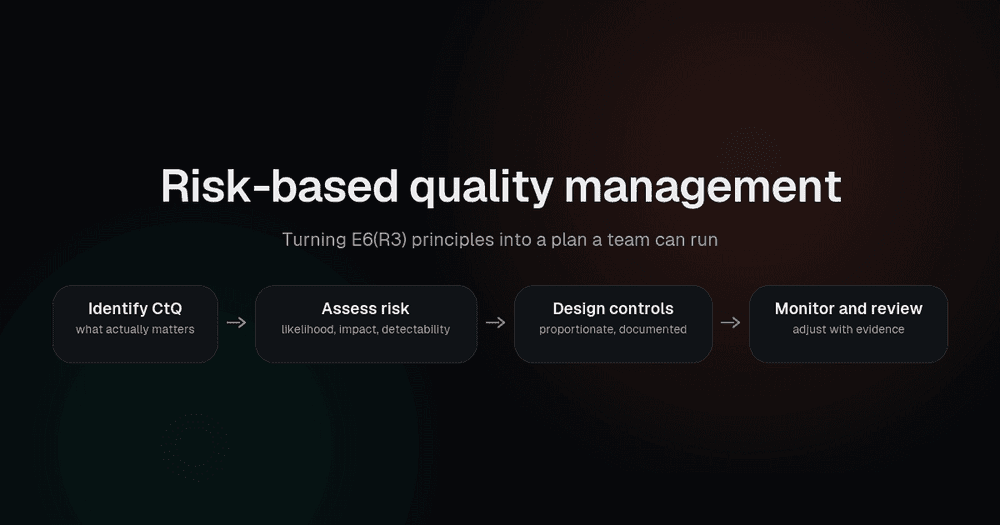
Risk-based quality management under ICH E6(R3) means identifying the factors critical to participant safety and to the reliability of results, assessing what could go wrong with them in this specific study, and designing controls in proportion. The documented reasoning matters as much as the controls, because the reasoning is what an inspector reviews.
Most RBQM implementations fail in a recognizable way. A risk assessment is produced at study start, filed, and never opened again. A dashboard of indicators is built with no predefined action attached to any of them. Monitoring is reduced, described as risk-based, and the reduction turns out to be the only thing the risk assessment influenced.
This guide sets out how to build the plan so that it survives a live study: selecting critical-to-quality factors, designing monitoring in layers, separating indicators from tolerance limits, and keeping the assessment current. It sits under which system owns which part of the study.
After reading this you will be able to:
- Produce a critical-to-quality list short enough to prioritize against
- Design monitoring as three layers rather than an on-site versus remote choice
- Set indicators and tolerance limits that each have a defined action
- Keep the risk assessment live rather than filing it at study start
Where the Guideline Stands
E6(R3) reached Step 4 on 6 January 2025 and came into effect in the European Union on 23 July 2025. Annex 2, which addresses decentralized elements and additional trial designs, reached Step 4 on 3 June 2026, was adopted by the CHMP on 25 June 2026, and takes effect on 15 January 2027.
That second date is worth planning against now rather than reacting to later, particularly if you are designing studies with remote visits, direct-to-participant supply or decentralized data collection. Confirm the current position for your own region before relying on any specific date, since implementation timing varies.
The substance is a continuation rather than a reversal. Risk-proportionate monitoring has been the stated direction since earlier risk-based monitoring guidance. What R3 sharpens is the expectation that the reasoning is written down and revisited.
Critical-to-Quality Factors, Kept Short
The first failure mode is a list that includes everything, because a list that includes everything provides no basis for allocating anything.
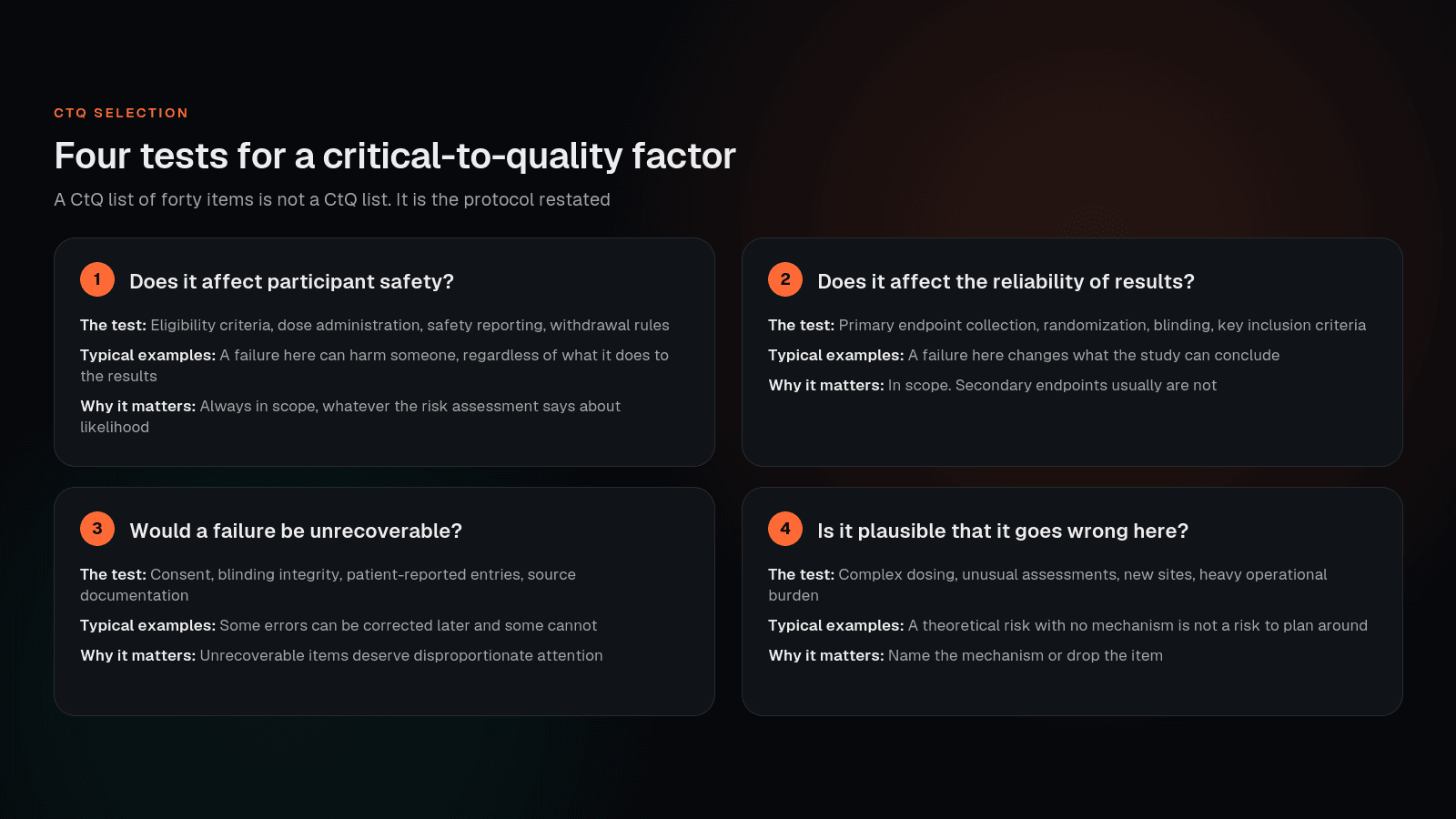
The fourth test is the one usually skipped. A risk with no plausible mechanism in this study is a theoretical risk, and planning around it consumes attention that belongs elsewhere. Requiring someone to state how a factor could actually fail here, given this protocol and these sites, removes a surprising amount from most draft lists.
The third test earns its place too. Some failures can be corrected: a missing laboratory value can often be repeated. Some cannot: a consent problem, a broken blind, a patient diary entry about yesterday. Unrecoverable items deserve disproportionate attention, and that asymmetry is worth naming explicitly in the plan. The patient-reported case is worked through in why ePRO adoption drops in month four.
Monitoring as Three Layers
The conversation usually reduces to on-site versus remote, which is the wrong axis.
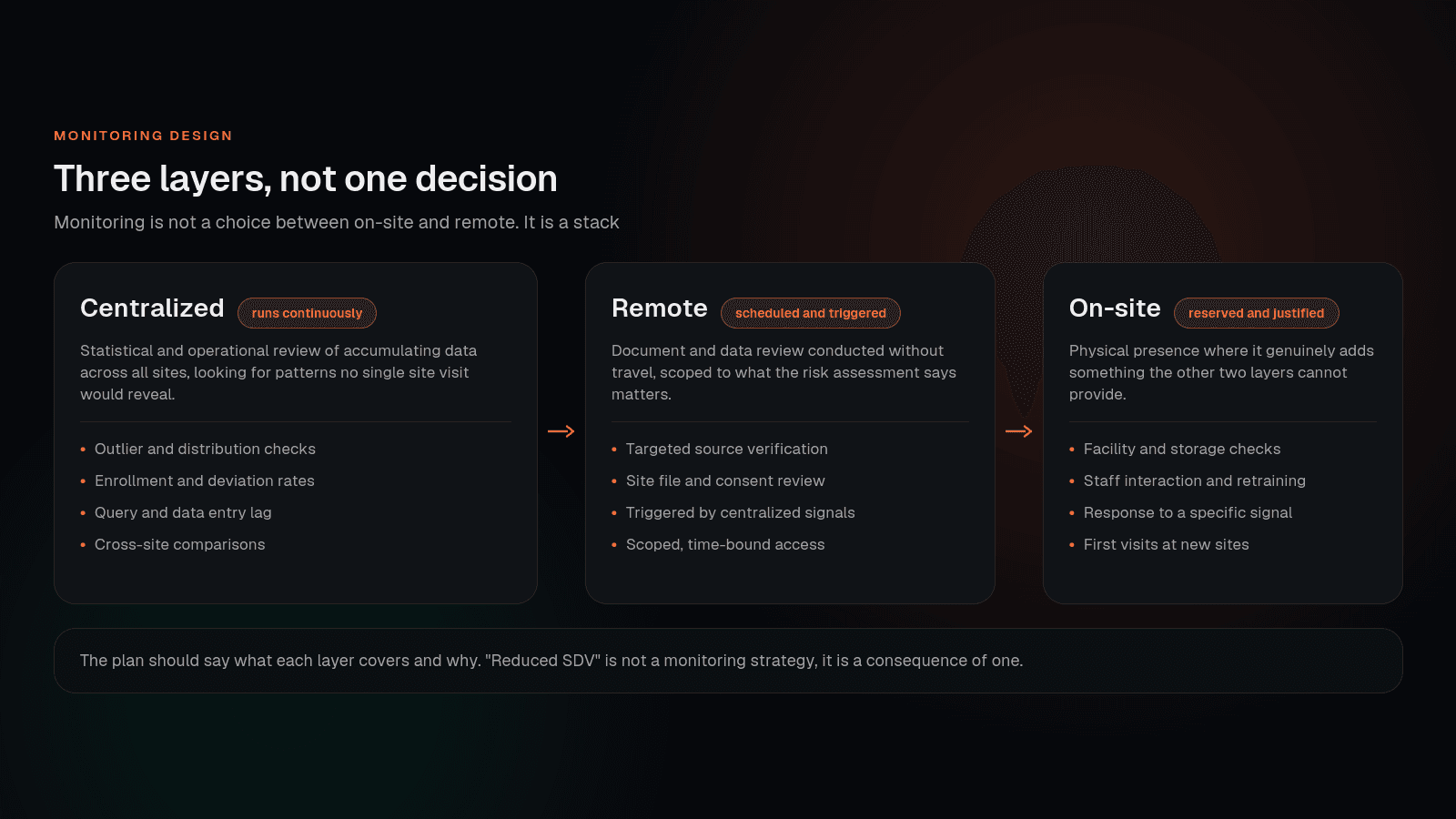
Centralized review is the layer that finds what no site visit can, because it works on the accumulating data across all sites at once. Distribution anomalies, an outlier enrollment pattern, a site whose data is unusually clean, query aging that clusters in one region: none of these is visible from inside a single site.
Remote review is where a centralized signal becomes a specific check, and where scoped document access matters operationally. That access model is covered in giving monitors access without losing document control.
On-site is then reserved for what genuinely requires presence. Written this way, the plan says what each layer covers and why, which is a monitoring strategy. "Reduced source data verification" is not a strategy, it is a consequence of one.
Indicators and Tolerance Limits Are Not the Same Thing
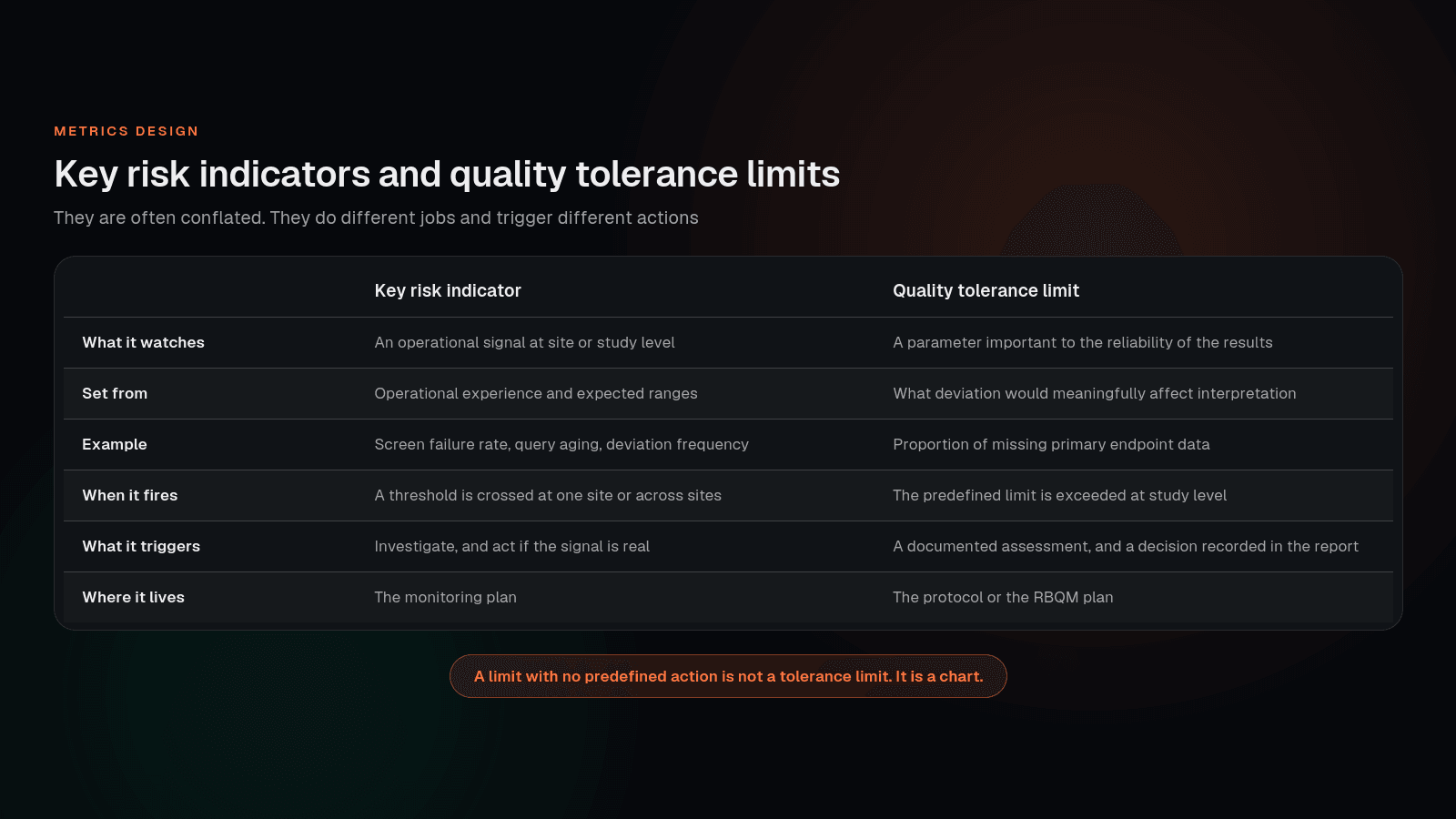
Conflating these produces dashboards full of thresholds that nobody acts on. The distinction that keeps them useful is the action attached. An indicator crossing its threshold means someone investigates and records what they found, even if the answer is that the signal was not real. A tolerance limit being exceeded means a documented assessment and a decision that appears in the clinical study report.
Set fewer of both than feels comfortable. Every threshold you define is a commitment to respond, and an unactioned threshold is worse than no threshold, because it demonstrates that the system was watched and ignored.
Keeping the Assessment Live
A risk assessment written at study start describes a study that does not exist yet. Sites activate unevenly, amendments change the protocol, enrollment patterns surprise people, and a risk that looked theoretical becomes a mechanism.
Two habits keep it current without much overhead. Review the assessment at a fixed cadence, tied to an existing meeting rather than a new one, and review it after every substantial amendment. In both cases the useful question is not whether the risks changed but whether the controls are producing evidence that they work.
Amendments deserve special attention because they change what the controls are pointed at, and because they carry their own validation consequences. That scoping is covered in handling a mid-study amendment without revalidating the whole build.
What the Plan Should Actually Contain
Seven sections, and it should be short enough that people read it.
- The critical-to-quality factors, with the mechanism by which each could fail here.
- The risk assessment: likelihood, impact and detectability for each.
- The controls, mapped to the factors they address.
- The monitoring design across the three layers, with what each covers.
- Key risk indicators, thresholds, and the action each one triggers.
- Quality tolerance limits, with the assessment required if exceeded.
- The review cadence, and who owns it.
A plan that runs to eighty pages will be filed rather than used, which returns you to the first failure mode. Clinera CTMS holds the operational data the indicators run on, and clinical and R&D AI covers where automated signal detection genuinely adds to centralized review rather than adding to the dashboard.
References
- ICH E6(R3) Good Clinical Practice. International Council for Harmonisation, Step 4 adopted 6 January 2025, EU effective 23 July 2025. www.ich.org
- ICH E6(R3) Annex 2. Step 4 on 3 June 2026, CHMP adopted 25 June 2026, effective 15 January 2027. www.ema.europa.eu
- Oversight of Clinical Investigations, A Risk-Based Approach to Monitoring. US Food and Drug Administration guidance for industry. www.fda.gov
- Clinical Trials Regulation EU No 536/2014. European Medicines Agency, clinical trials regulation. health.ec.europa.eu
This guide describes process and regulatory expectations in general terms and is not legal or regulatory advice. Confirm the current version and applicability of any standard or guidance for your study and region.
Frequently Asked Questions
What does ICH E6(R3) actually require for risk-based quality?
That quality management is proportionate to the risks that matter to participant safety and to the reliability of results, and that the reasoning is documented. In practice that means identifying critical-to-quality factors, assessing the risks to them, designing controls in proportion, monitoring whether the controls work, and revisiting the assessment as the study changes. The guideline reached Step 4 on 6 January 2025 and came into effect in the EU on 23 July 2025.
What is happening with Annex 2?
Annex 2, which covers decentralized elements and additional trial designs, reached Step 4 on 3 June 2026 and was adopted by the CHMP on 25 June 2026, with an effective date of 15 January 2027. That is worth planning against now rather than reacting to, particularly for studies designing in remote visits, direct-to-participant supply or decentralized data collection. Confirm the current status for your region before relying on any specific date.
How many critical-to-quality factors should a study have?
Few enough that the list means something. A CtQ list with forty entries is the protocol restated, and it gives no basis for prioritizing anything. The test is whether a failure would affect participant safety or the reliability of the results, whether it would be unrecoverable, and whether there is a plausible mechanism for it going wrong in this study. Most protocols produce a short list once those filters are applied honestly.
What is the difference between a KRI and a quality tolerance limit?
A key risk indicator is an operational signal, usually at site level, that prompts you to investigate: screen failure rate, query aging, deviation frequency. A quality tolerance limit is set on a parameter important to interpreting the results, at study level, and exceeding it requires a documented assessment and a recorded decision. A limit with no predefined action attached is not a tolerance limit, it is a chart on a dashboard.
Does risk-based monitoring mean less monitoring?
It means differently distributed monitoring, and for some studies the total effort is similar. What changes is that effort follows the risk assessment rather than a fixed percentage applied uniformly. Some sites and some data points get more attention than they would have under a blanket approach, and others get less. If your implementation produced only reductions, the risk assessment probably was not driving it.
Can Nirmitee Healthtech help build an RBQM plan?
Yes, and the useful starting point is the critical-to-quality workshop rather than the tooling. That session produces the short list, the mechanisms by which each factor could fail in this specific study, and the controls that follow. From there the monitoring design, the indicators and the tolerance limits fall out with their rationale attached. Clinera CTMS holds the operational data those indicators run on.