Site Payments and Study Budget Tracking in a CTMS
Site payment disputes are almost always caused by a mismatch between what the contract says triggers payment and what the CTMS is configured to recognize, or by a gap between work performed and work recorded. Finance sees the end of the chain. The problem started two steps earlier.
The pattern is familiar. A site says it is owed for visits performed last quarter. Finance says the schedule shows something different. Both are reading their own system correctly, and a meeting is arranged to reconcile numbers that were never going to match, because the disagreement is structural rather than arithmetic.
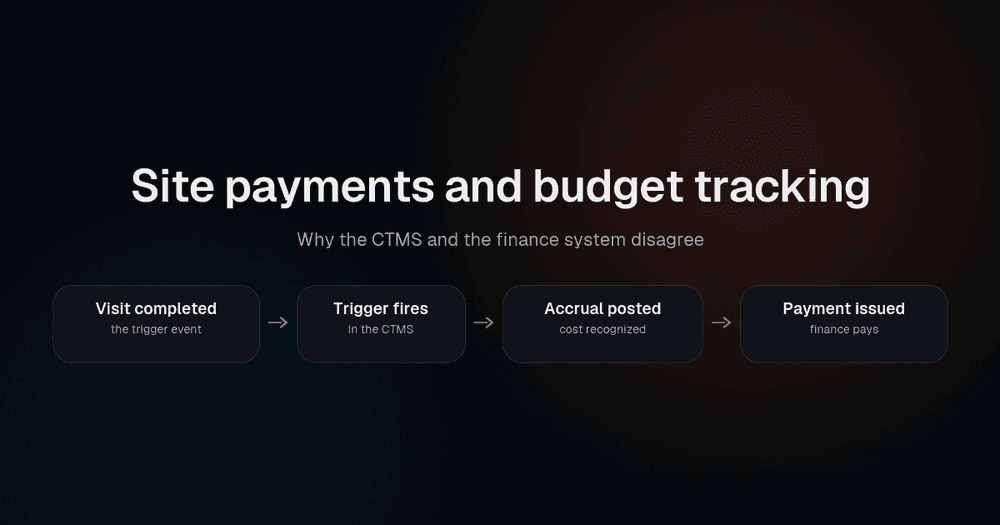
This guide follows the chain from completed visit to paid invoice, names the four places it breaks, and separates accruals from payments, which are different questions that get reported as one. It sits under which system owns which part of the study.
After reading this you will be able to:
- Trace a payment dispute back to the step that actually caused it
- Configure triggers so the contract and the system say the same thing
- Report accruals and payments as the separate questions they are
- Remove the two recurring cases that have no rule on most studies
The Chain From Visit to Invoice
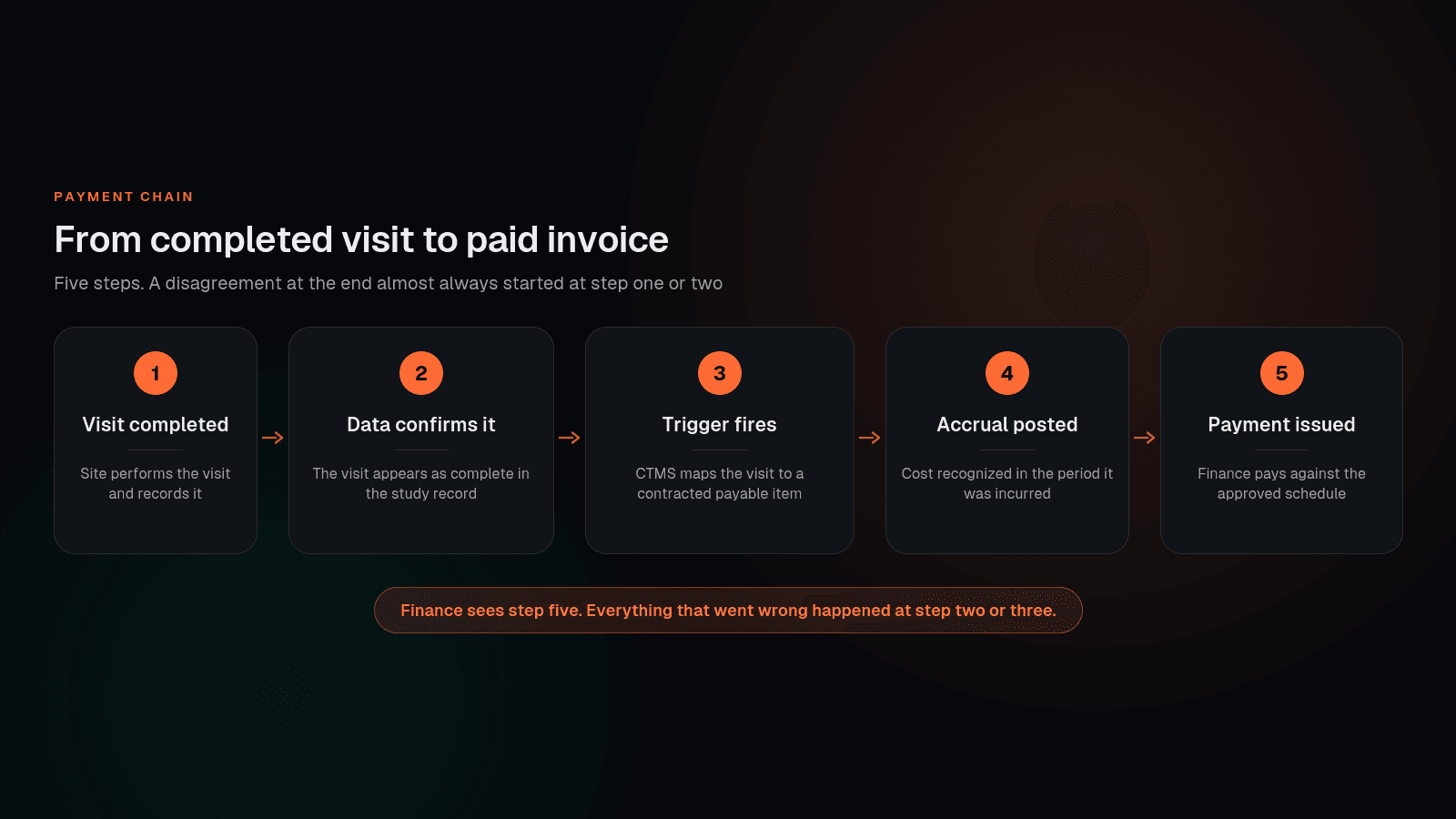
Finance is accountable for step five and is usually the first to be asked about a discrepancy. But steps one through three happen in clinical operations, and that is where almost every dispute originates. A finance team can only pay against what the trigger produced, and the trigger can only fire on what the study record shows.
Framing the problem this way changes who is in the room. A payment dispute is a clinical operations issue with a finance symptom, and the people who can fix it are the ones who configured the triggers.
Four Reasons the Two Systems Disagree
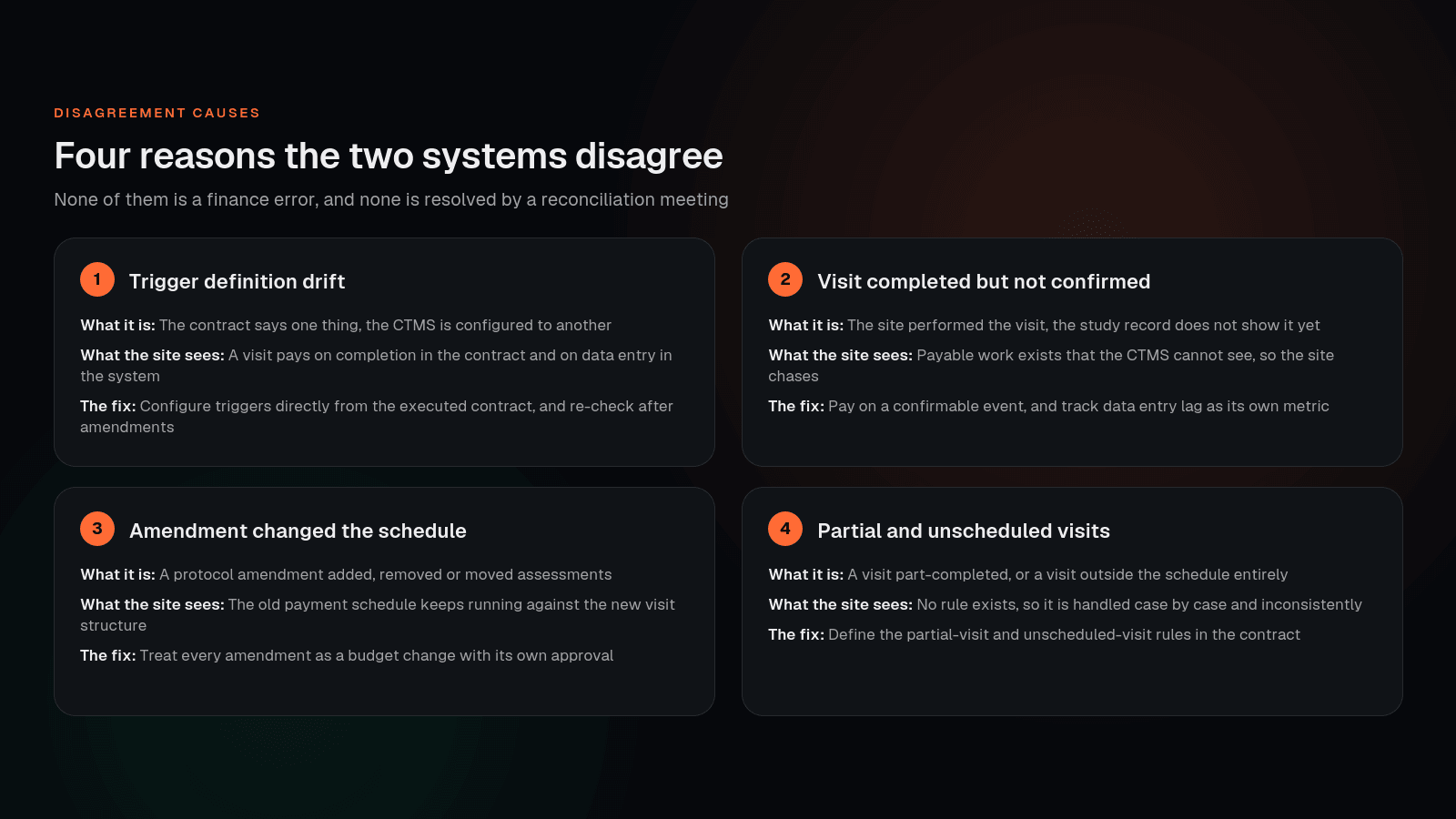
The first is the most common and the most avoidable. A contract says a visit is payable on completion. The CTMS is configured to fire the trigger when the visit data is entered and marked clean. Those are different events, sometimes separated by weeks, and both parties can quote their own document in good faith.
The fix is not to argue about which is right but to make them identical. Configure triggers directly from the executed contract, with someone reading both documents side by side, and re-check after every amendment.
The Gap Between Performed and Recorded
The second cause deserves separate attention because it is not a configuration error. The site did the work. The record does not show it yet.
That lag is real on every study and it has operational causes: coordinator workload, query resolution, a monitoring visit that has not happened. It becomes a payment problem when the trigger sits on the far side of it, so a site waits for money because of a data entry backlog rather than because of anything it did.
Two things help. Track data entry lag as its own metric, by site, so the gap is visible rather than absorbed. And when choosing a trigger event, understand that a later trigger buys data certainty at the cost of site cash flow, which is a trade-off worth making deliberately. The forces that lengthen that lag are covered in why query volume rises late in a study.
Accruals and Payments Answer Different Questions
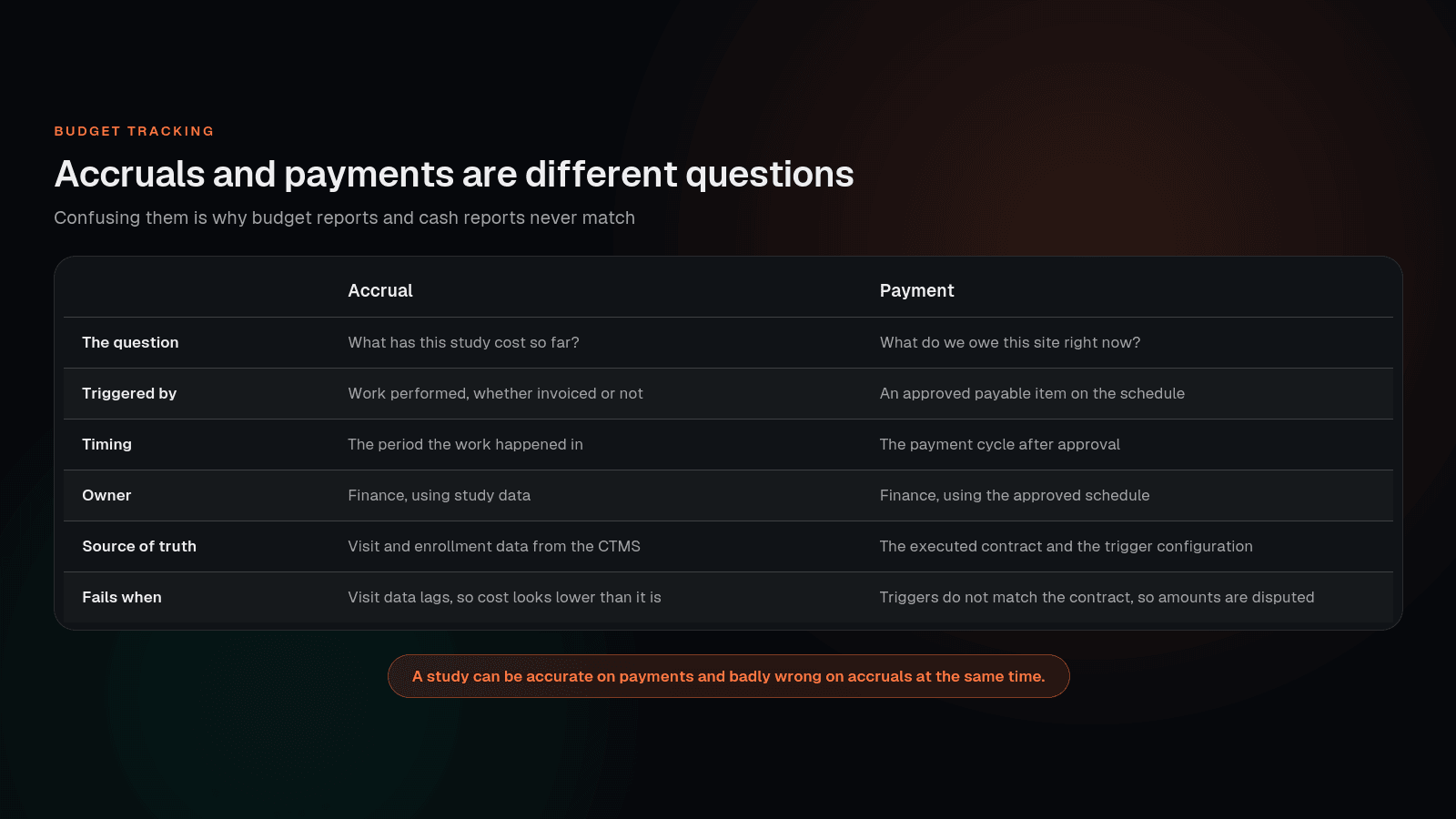
The practical consequence is that a study can be entirely accurate on payments and badly wrong on accruals at the same time, which is why a clean payment record is not reassurance about the financial picture.
Accruals depend on visit and enrollment data being current, so they degrade whenever data entry lags, and they degrade silently. Every site that is behind on entry makes the study look cheaper than it is, and the correction arrives later as an unwelcome adjustment. Tracking accrual accuracy against subsequent actuals, by period, is the check that catches it early.
The Two Cases Nobody Wrote a Rule For
Partial visits and unscheduled visits happen on every study, and on most studies neither has a defined rule.
A patient attends and completes three of five assessments. A patient comes in for an unscheduled safety review. Both are legitimate, both cost the site time, and in the absence of a rule each becomes an individual negotiation. The negotiation frequently costs more, in everyone’s time, than the amount being discussed.
Writing both rules into the contract is a small drafting exercise with a disproportionate return. It also removes a source of friction that sites remember, which matters for the next protocol. Getting these settled before the budget is drafted also shortens contracting itself, as covered in where study start-up weeks actually go.
Wiring the CTMS to Finance
Integration is often treated as the solution when it is closer to an amplifier. Connecting two systems that disagree produces faster disagreement.
Get the trigger definitions aligned with the contract first. Then integrate, and be specific about direction: the CTMS should be the source of truth for what happened and when, and finance should be the source of truth for what was approved and paid. Anything that tries to hold both in both places will drift.
Clinera CTMS holds the visit and trigger data those accruals run on, and for organizations managing this across many sponsors at once, CRO and research organization teams face the same reconciliation at multiple times the volume.
References
- ICH E6(R3) Good Clinical Practice, sponsor and investigator responsibilities. International Council for Harmonisation, adopted 6 January 2025. www.ich.org
- Clinical Trials Regulation EU No 536/2014. European Medicines Agency, clinical trials regulation. health.ec.europa.eu
- Sunshine Act, Open Payments program. US Centers for Medicare and Medicaid Services. www.cms.gov
This guide describes process and regulatory expectations in general terms and is not legal or regulatory advice. Confirm the current version and applicability of any standard or guidance for your study and region.
Frequently Asked Questions
Why do site payment disputes keep happening?
Because they are usually data problems presented as finance problems. The site performed work it believes is payable, and the study record does not yet show the event that triggers payment, or the trigger was configured differently from what the contract says. Finance sees the end of a five-step chain and gets asked to explain a discrepancy created at step two or three. Reconciliation meetings rarely fix it because the cause is upstream.
What should a payment trigger be based on?
Something confirmable in the study record, defined identically in the contract and in the system configuration. Visit completion is the usual basis, but the definition matters: completion as performed by the site, or completion as recorded in the data, can be weeks apart. Whichever you choose, both documents should say the same thing, and the gap between the two events should be tracked as its own metric rather than absorbed as friction.
How do amendments affect the payment schedule?
More than most teams plan for. An amendment that adds an assessment, removes a visit or changes the schedule has changed what is payable, and the old configuration will keep running against the new structure until someone updates it. Treating every amendment as a budget change with its own review and approval prevents the slow divergence that surfaces months later as a batch of disputed invoices.
What is the difference between an accrual and a payment?
An accrual answers what the study has cost so far, recognized in the period the work happened, whether or not anyone has invoiced. A payment answers what is owed to a specific site now, against an approved schedule. They use different triggers and fail in different ways: accruals go wrong when visit data lags, so cost looks lower than it is, while payments go wrong when triggers do not match the contract.
How should partial and unscheduled visits be handled?
By a rule written into the contract rather than case by case. Partial visits and unscheduled visits both happen on every study, and in the absence of a defined rule each one becomes a negotiation that consumes more time than the amount in dispute. Deciding in advance what proportion a partial visit attracts, and what an unscheduled visit is worth, removes an entire recurring category of friction.
Can Nirmitee Healthtech audit our payment configuration?
Yes, and it is a contained exercise. The audit reads your executed site contracts against the trigger configuration in the CTMS, identifies where the two have diverged, checks whether amendments were reflected in the schedule, and flags the partial and unscheduled visit cases that have no defined rule. Clinera CTMS holds the visit and trigger data that makes accruals accurate, but the audit is useful on whatever system you currently run.