Clinical Trial Management Systems: What CTMS, eTMF and eISF Each Own
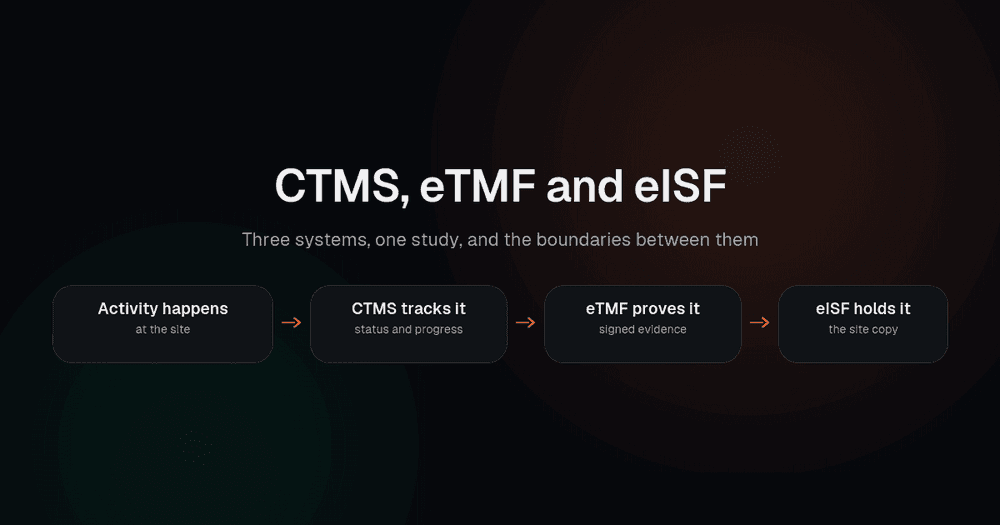
A CTMS tracks where the study is. An eTMF proves what happened, as signed and dated evidence. An eISF is the site’s own copy of its own record. They are not competing systems and none substitutes for another, because operational status, regulatory evidence and site custody are three different obligations.
Most organizations end up with all three, arrived at separately, with boundaries that were never written down. That works until someone asks a question that crosses them: which copy of this contract is authoritative, why was this monitoring report filed nine months late, what did the monitor actually review at that visit.
This guide sets out what each system owns, where they legitimately overlap, and the categories of record that fall between them and produce most of the findings. It covers the shape of the problem rather than the procedure for any one part. Each section links to a guide that goes deeper.
After reading this you will be able to:
- State clearly which system owns which record, and which copy is authoritative
- Find the document types currently living in none of the three
- Recognize the four boundary questions before an audit asks them
- Decide which of the six deeper guides your team needs this quarter
Three Systems, Three Different Jobs
Start with what each is for, because most confusion comes from treating them as three places to put documents.
| The question it answers | Who it is for | Guide |
|---|---|---|
| If the CTMS stores documents, do we need an eTMF? | Study managers and QA together | CTMS vs eTMF, a document-by-document answer |
| Why can a 98% complete TMF still fail? | Document specialists and QA | eTMF inspection readiness beyond completeness |
| How do monitors get site access without taking control? | Clinical operations and sites | eISF access without losing document control |
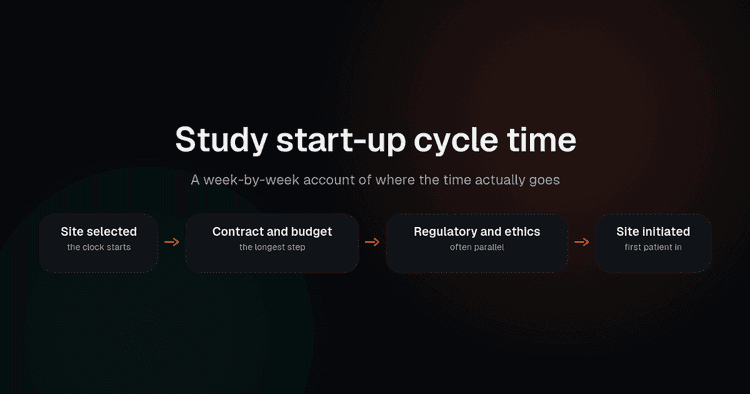
| Where do the start-up weeks actually go? | Study start-up and CRO teams | Study start-up cycle time, week by week |
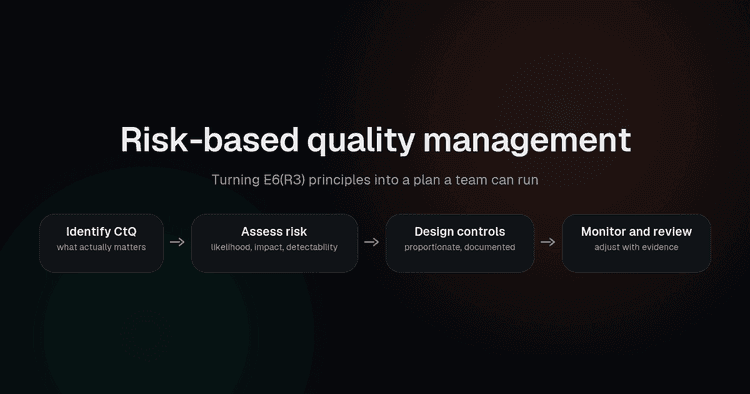
| What does ICH E6(R3) mean in practice? | Quality and clinical operations leads | Risk-based quality management under E6(R3) |
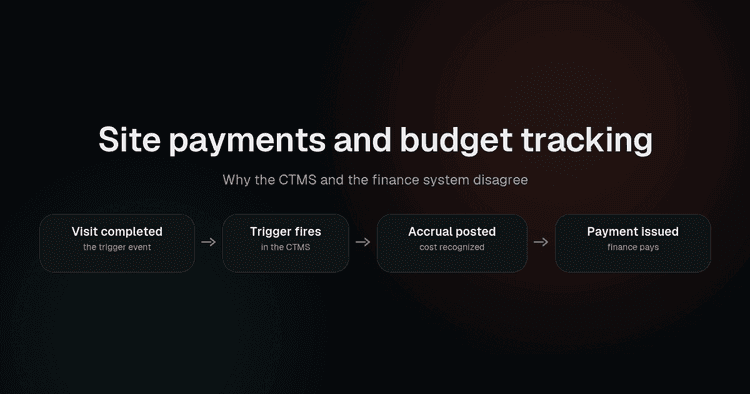
| Why do the CTMS and finance disagree on payments? | Study managers and finance | Site payments and budget tracking in a CTMS |
The CTMS is an operations tool. Its records are designed to change: a visit moves from scheduled to complete, a contract from draft to executed, a site from selected to activated. That mutability is the point, and it is exactly what makes it unsuitable as an evidence store.
The eTMF is an evidence store. Its records are designed not to change once filed, because their value is showing what was true at a point in time. The eISF is the same idea seen from the site’s side, with a different owner and a retention clock that outlives the sponsor’s involvement.
The Same Study, Seen Through Five Stages
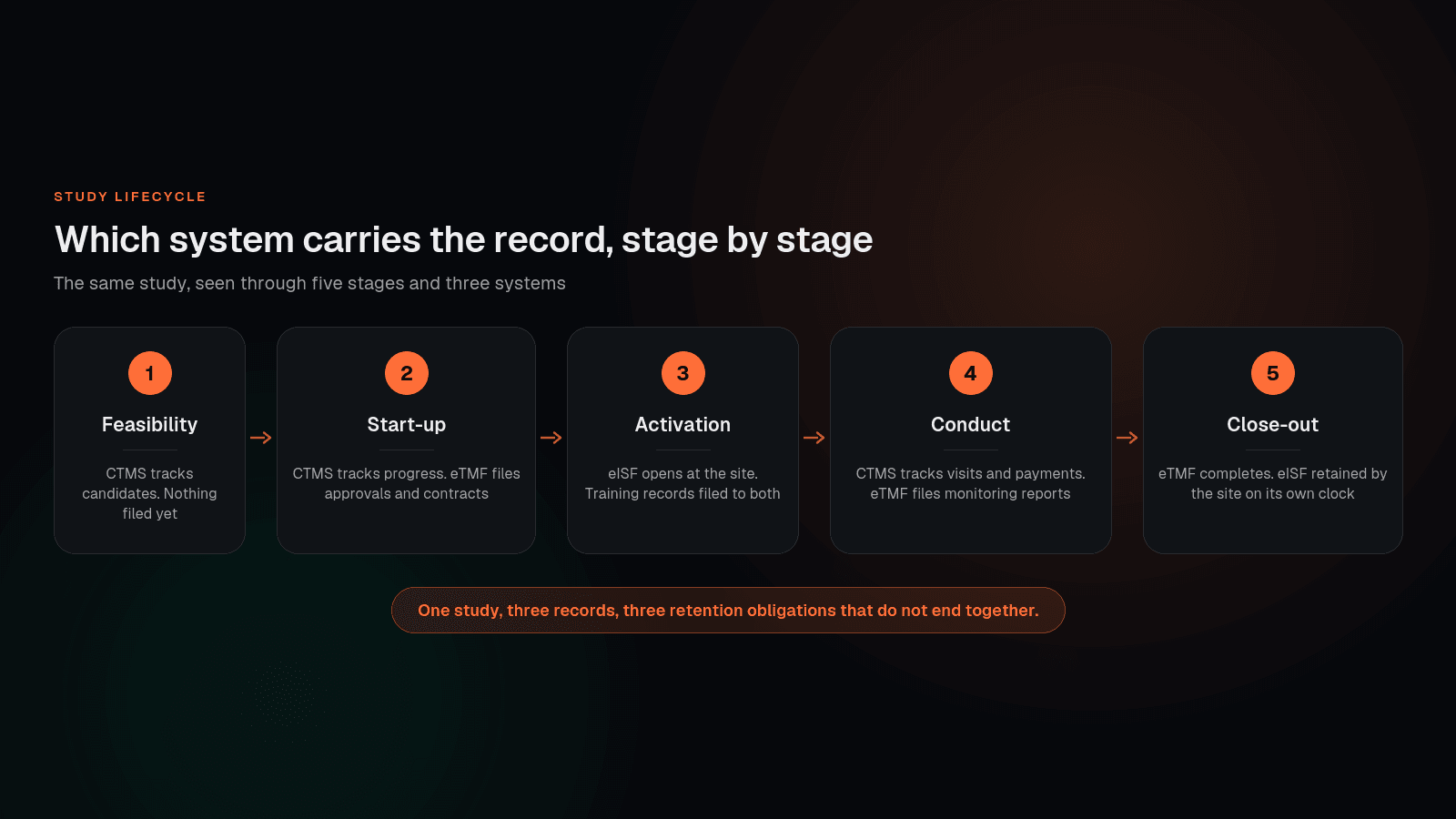
Two features of that map matter more than the rest. During start-up, all three systems are active at once and the handoffs between them are densest, which is why start-up is where boundary problems are created even though they surface much later.
And at close-out the three do not finish together. The sponsor file completes and is archived. The site retains its own file, on its own obligation, often for years after the sponsor relationship ends. Teams that treat close-out as a single event tend to leave the site side undefined.
Where the CTMS Ends and the eTMF Begins
The recurring question is whether a CTMS with a document library removes the need for a trial master file. It does not, and there is a one-line test.
Would an inspector ask to see this document as evidence that regulated activity happened correctly? If yes, the eTMF owns the authoritative copy even when the CTMS also references it. Signed protocols, ethics approvals, executed contracts, monitoring reports and delegation logs all pass. Enrollment counts, visit schedules and payment triggers do not, and those belong to the CTMS outright.
Documents that legitimately live in both are fine, provided one copy is named authoritative in writing and new versions travel one path. The full split is in CTMS vs eTMF, a document-by-document answer.
Why Completeness Is Not Readiness
Once an eTMF exists, the usual measure of health is a completeness percentage. It is easy to produce, easy to report upward, and close to useless as a predictor of whether the file survives scrutiny.
Completeness counts filled slots. It cannot see whether the filed document is signed, dated, legible and the right version. It cannot see whether it was filed near the activity it evidences or eleven months later. It cannot see artifacts the study should have generated but never did. And it never reads documents against each other, which is precisely what an inspection does. That gap, and a sampling review that closes it, is covered in why a 98% complete TMF can still fail inspection.
The Site’s File, and Who Can See It
The eISF is where the framing most often goes wrong, because it gets treated as a sponsor-provided window rather than as the site’s own record.
Remote monitoring creates a real tension: a monitor needs to see site documents, and the site needs to keep custody of them. The resolution is not ownership transfer, it is access design in four layers: define the role, scope the documents, bound the time, and log at document level. Configured that way, nothing moves and the site can answer for itself what was reviewed. The three settings that go wrong on most studies are in giving monitors access without losing document control.
The Four Boundary Questions
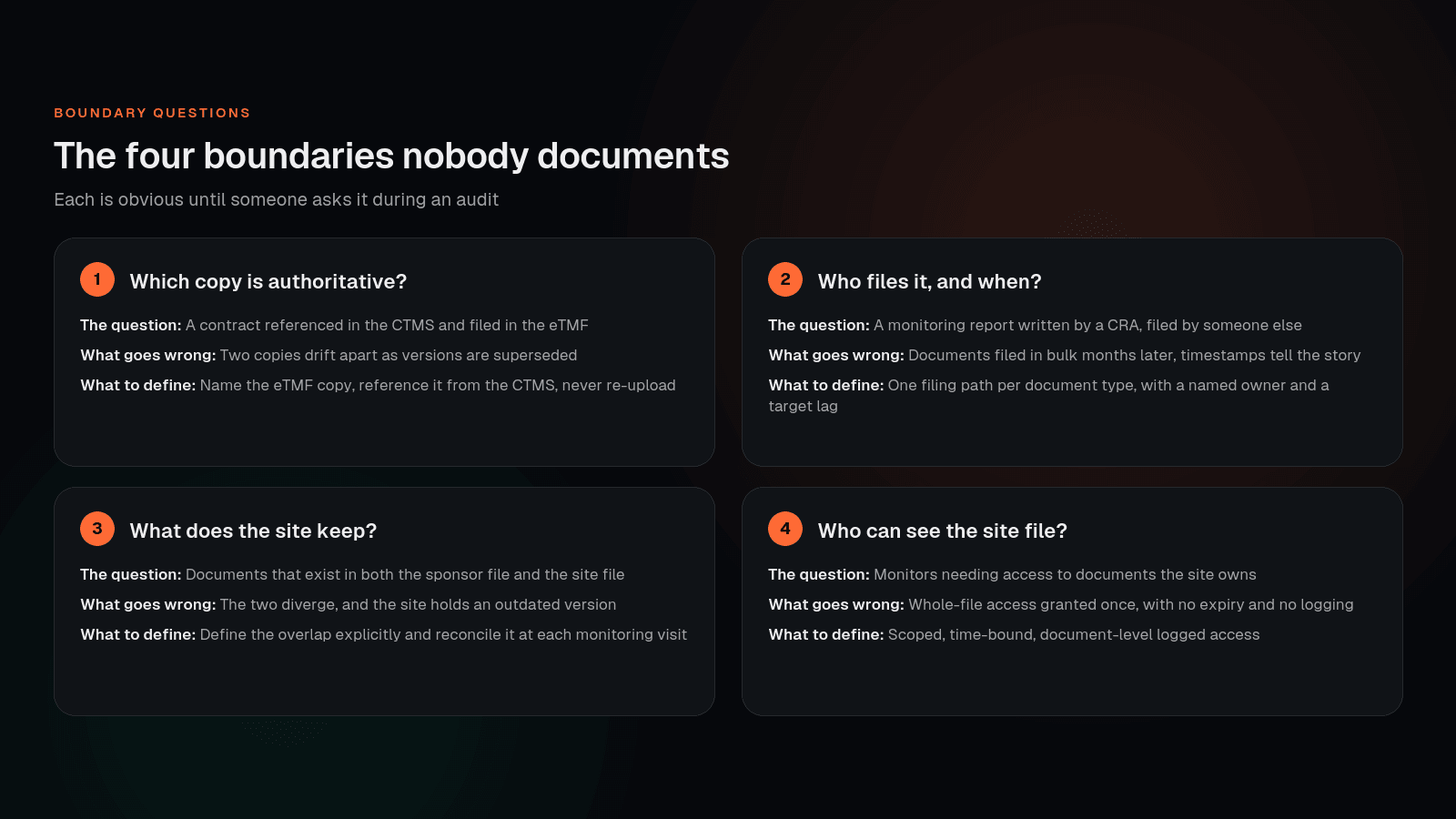
Each of these is answerable in a short meeting and expensive to answer retrospectively. The second one, who files a document and within what target lag, is the one that most reliably degrades: a document type with no named filer gets filed by whoever remembers, which in practice means later.
What Falls Between
The records that produce findings are rarely in the wrong system. They are in no system.
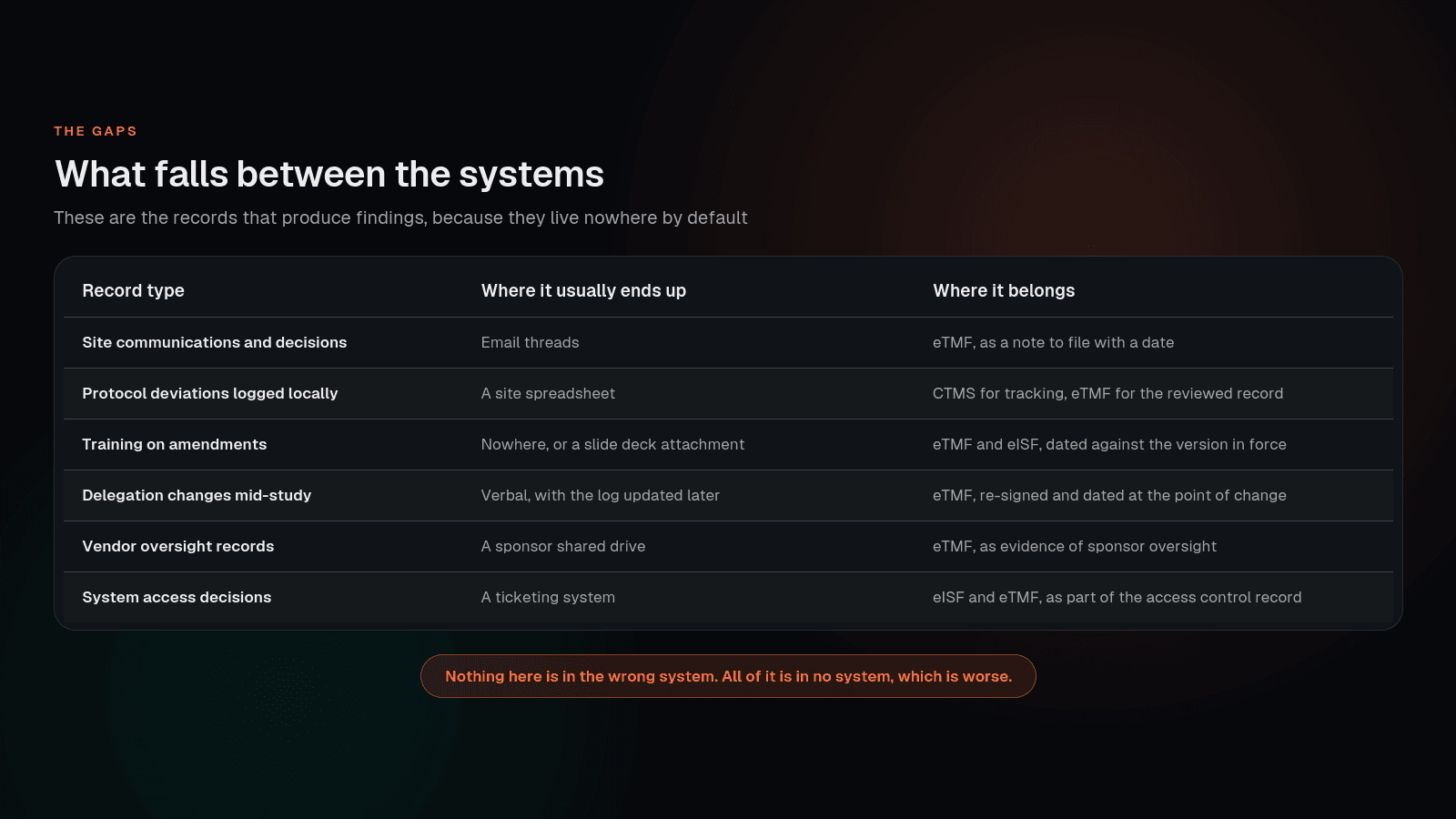
These share a characteristic: each is generated by a human decision rather than by a system event. A protocol deviation noticed and handled locally, a delegation changed because someone left, an email that settled a question about eligibility. No workflow creates them, so no workflow files them.
The remedy is an inventory rather than a tool. Walk your document types against a reference model, assign each an owning system and a named filer, and mark the ones that do not apply so their absence is a decision. That list is the single most useful artifact in this whole area.
The Operational Side: Time and Money
Two operational questions run through all three systems and are worth naming, because both are usually treated as unavoidable.
Start-up cycle time is mostly waiting rather than work, and at least two commonly serial step pairs have no real dependency at all. Where those weeks go is in a week-by-week account of start-up time. Site payment disputes are almost always caused upstream, by a trigger configured differently from the contract or by a gap between work performed and work recorded, which is covered in why the CTMS and the finance system disagree.
Quality Management Across All Three
ICH E6(R3) asks for quality management proportionate to the risks that matter to participant safety and to the reliability of results, with the reasoning documented. That cuts across all three systems: the CTMS holds the operational data indicators run on, the eTMF holds the evidence that controls were applied, and the eISF is where scoped access makes remote review workable.
Annex 2, covering decentralized elements, takes effect on 15 January 2027, which is close enough to plan against. Turning the principles into a plan a team can actually run is covered in risk-based quality management under ICH E6(R3).
Where to Start
Six steps, in this order, and the first two find most of the problems.
- List every document type your study generates, from a reference model rather than from what is already filed.
- Mark the types currently living in none of the three systems.
- Assign every type an owning system, an authoritative copy and a named filer.
- Find documents present in two systems and check the versions match.
- Review site access against role, scope, time bound and logging.
- Re-run the list after every amendment, because amendments create new types.
Clinera CTMS, Clinera eTMF and Clinera eISF are built to this separation rather than as one merged document store, and the Clinera accelerator covers how a study gets stood up across them. For the feasibility and selection end, the site selection and feasibility use case works through the same pattern applied earlier. The data side of the study, from site entry through to submission, is covered in the clinical data management guide.
References
- ICH E6(R3) Good Clinical Practice. International Council for Harmonisation, Step 4 adopted 6 January 2025, EU effective 23 July 2025. www.ich.org
- TMF Reference Model. CDISC TMF Reference Model community. www.cdisc.org
- 21 CFR Part 11, Electronic Records; Electronic Signatures. US Code of Federal Regulations, Title 21, Part 11. www.ecfr.gov
- Clinical Trials Regulation EU No 536/2014. European Medicines Agency, clinical trials regulation. health.ec.europa.eu
This guide describes process and regulatory expectations in general terms and is not legal or regulatory advice. Confirm the current version and applicability of any standard or guidance for your study and region.
Frequently Asked Questions
What is the difference between a CTMS, an eTMF and an eISF?
A CTMS tracks where the study is: enrollment, visit status, milestones, site payments, cycle times. An eTMF holds the sponsor's evidence that the study was conducted and overseen properly, as signed and dated artifacts. An eISF is the site's own electronic file, holding what that site needs to show it ran the study correctly at that location. One answers where are we, one answers prove it, and one belongs to somebody else.
Can one system do all three jobs?
Some platforms market that way, and the risk is not technical. It is that the boundaries stop being explicit. The reason the split matters is that operational data is designed to change as work progresses while evidence is designed not to change once filed, and the site file has a different owner with its own retention obligation. A single system can hold all three provided those distinctions are enforced inside it. If it holds them as one undifferentiated document store, the merge has removed the thing that made the split useful.
Which system do inspectors actually look at?
Primarily the trial master file, because that is where the evidence lives. They will also ask sites for the investigator site file, and the two being inconsistent is itself a finding. A CTMS is rarely inspected directly, though the data in it may be referenced when reconstructing a timeline. Building operational tooling to impress an inspector is effort spent in the wrong place.
What usually falls between the three systems?
Records that are nobody's obvious responsibility: site communications that settled something, protocol deviations logged locally, training delivered on an amendment, delegation changes made mid-study, vendor oversight evidence. None of these is in the wrong system. All of them are in no system, sitting in email or on a shared drive. That category produces more findings than misfiled documents do.
Where should we start if all three are already in place but not working together?
With a document type inventory rather than a tooling decision. Take a reference model, list every document type your study generates, and assign each one an owning system, an authoritative copy and a named filer. The exercise usually takes a few sessions and reliably surfaces both the duplicates that have drifted and the types currently living nowhere. Everything else follows from that list.
Can Nirmitee Healthtech help us map this across our current systems?
Yes, and the mapping is worth doing whatever systems you run. The work assigns every document type an owning system and an authoritative copy, identifies where operational and evidence records have been conflated, and defines the site file overlap. Clinera CTMS, eTMF and eISF are built to that separation, but the map is the deliverable and it is portable.