Mid-Study Amendments in EDC Without Revalidating the Whole Build
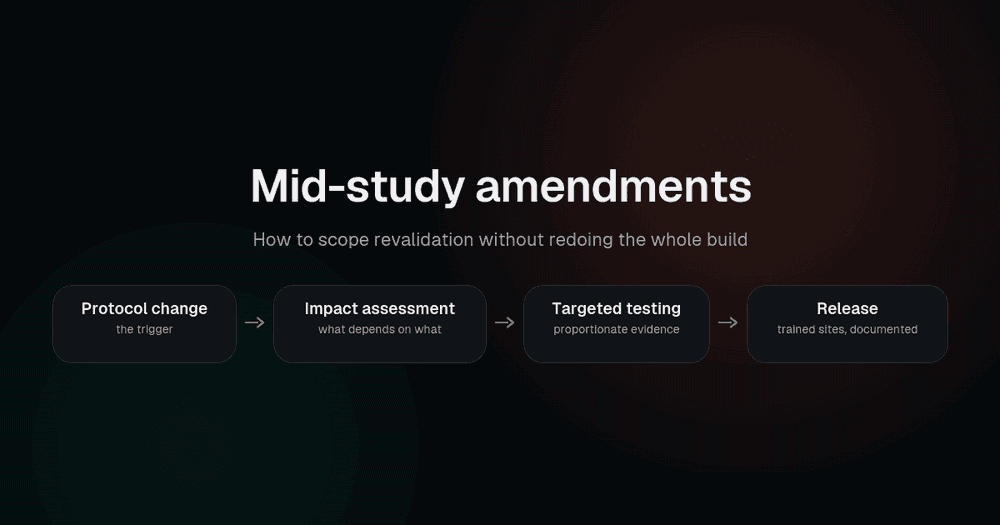
A mid-study amendment should be revalidated in proportion to what it can reach, not in proportion to how nervous it makes everyone. That means a documented impact assessment, a scoped set of tests with a written rationale, and evidence that connects the protocol change to the retested build. Revalidating everything is expensive and is not more compliant.
An amendment that adds two fields sounds like a morning of configuration. In practice it touches the eCRF, the edit checks around it, the export specification, the external transfer specifications, the validation package and the site training material. Six artifacts, six owners, six approval routes.
This guide sets out what an amendment actually reaches, the change control route through it, and how to scope revalidation by risk rather than by habit. It sits under how clinical trial data moves from site entry to submission, and it assumes the study is already live.
After reading this you will be able to:
- List everything a proposed amendment can reach, before scoping any testing
- Write an impact assessment that a reviewer can follow from change to evidence
- Scope revalidation proportionately, with a rationale that stands up at inspection
- See why metadata ownership sets the cost of every amendment you will ever make
What an Amendment Actually Touches
The configuration is rarely the expensive part. The coordination is.
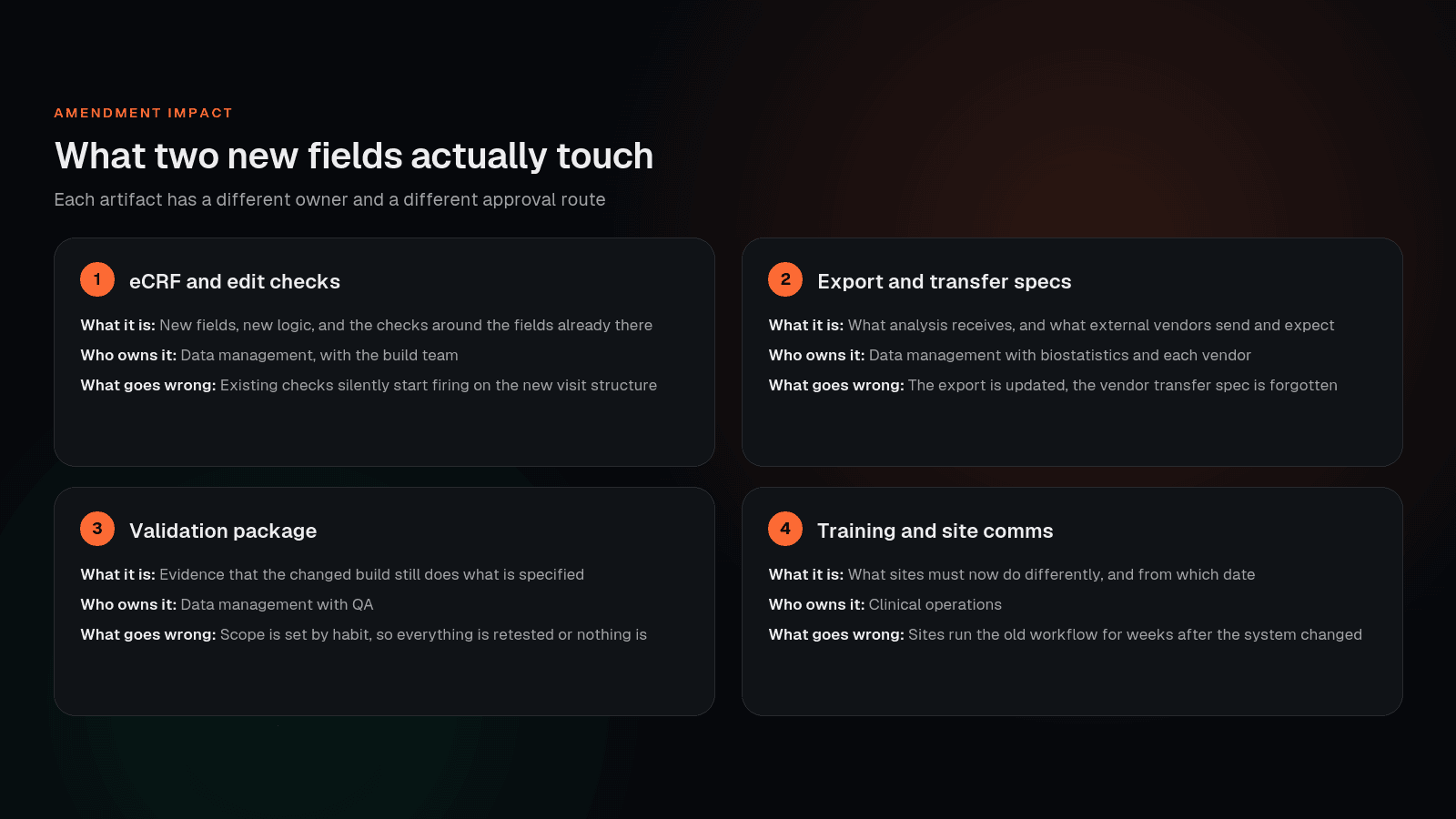
Two of these are missed more often than the rest. The external transfer specification is forgotten because the vendor relationship sits with a different team, so the export is updated and the laboratory feed is not. And the existing edit checks are forgotten because attention is on the new ones, while a changed visit structure quietly alters what every window check evaluates.
The Change Control Route
Six steps, and the second one decides the cost of the other five.
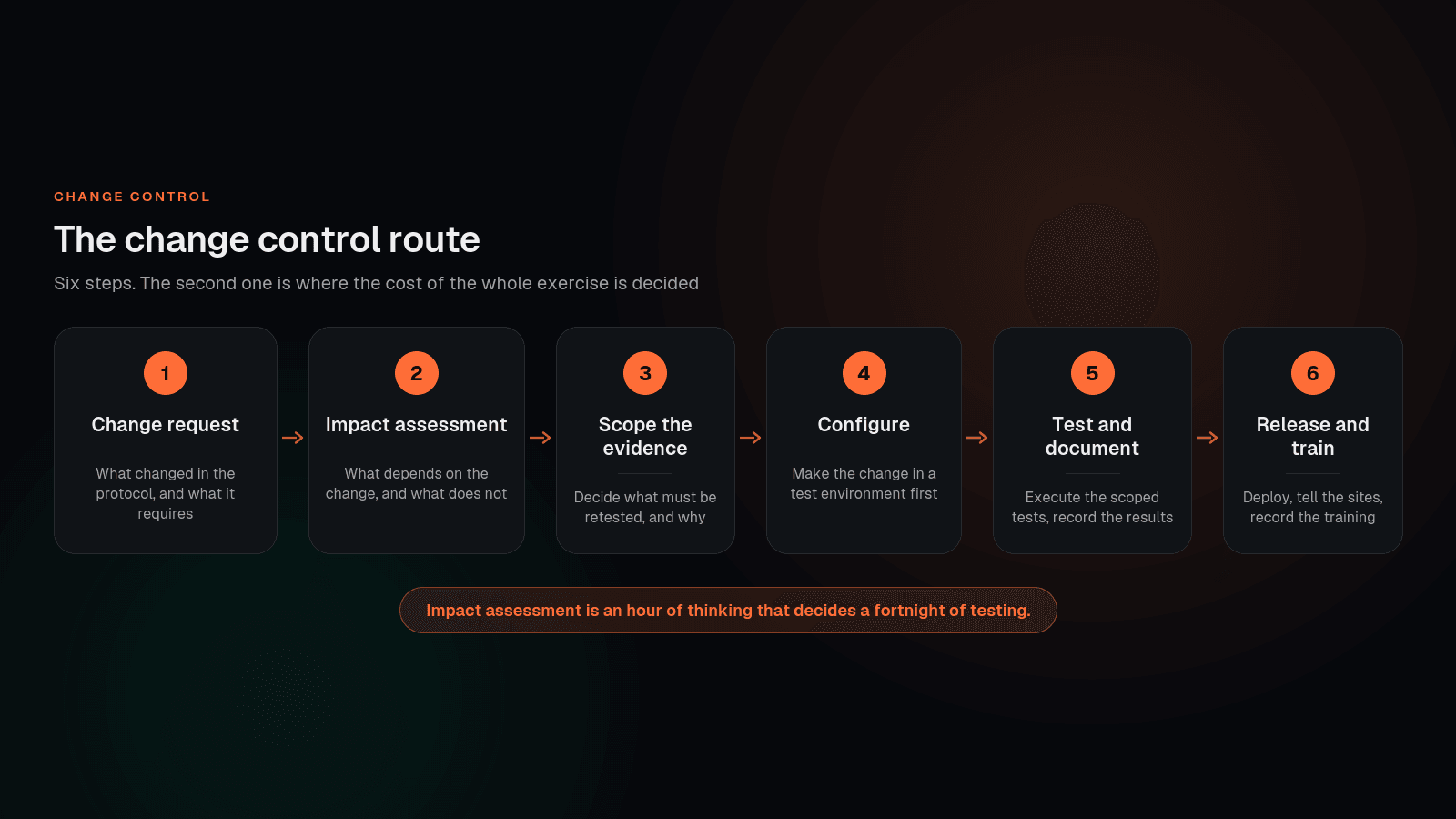
The impact assessment is an hour of structured thinking that determines a fortnight of testing. Done properly it produces a list: what changed, what depends on what changed, what the change cannot reach, and what evidence would satisfy a reviewer that nothing else broke. Skipped, the default is either to test everything, which is slow, or to test only the new thing, which is where regressions come from.
Scoping Revalidation by Risk
The useful question is never how much to test. It is what the change can reach.
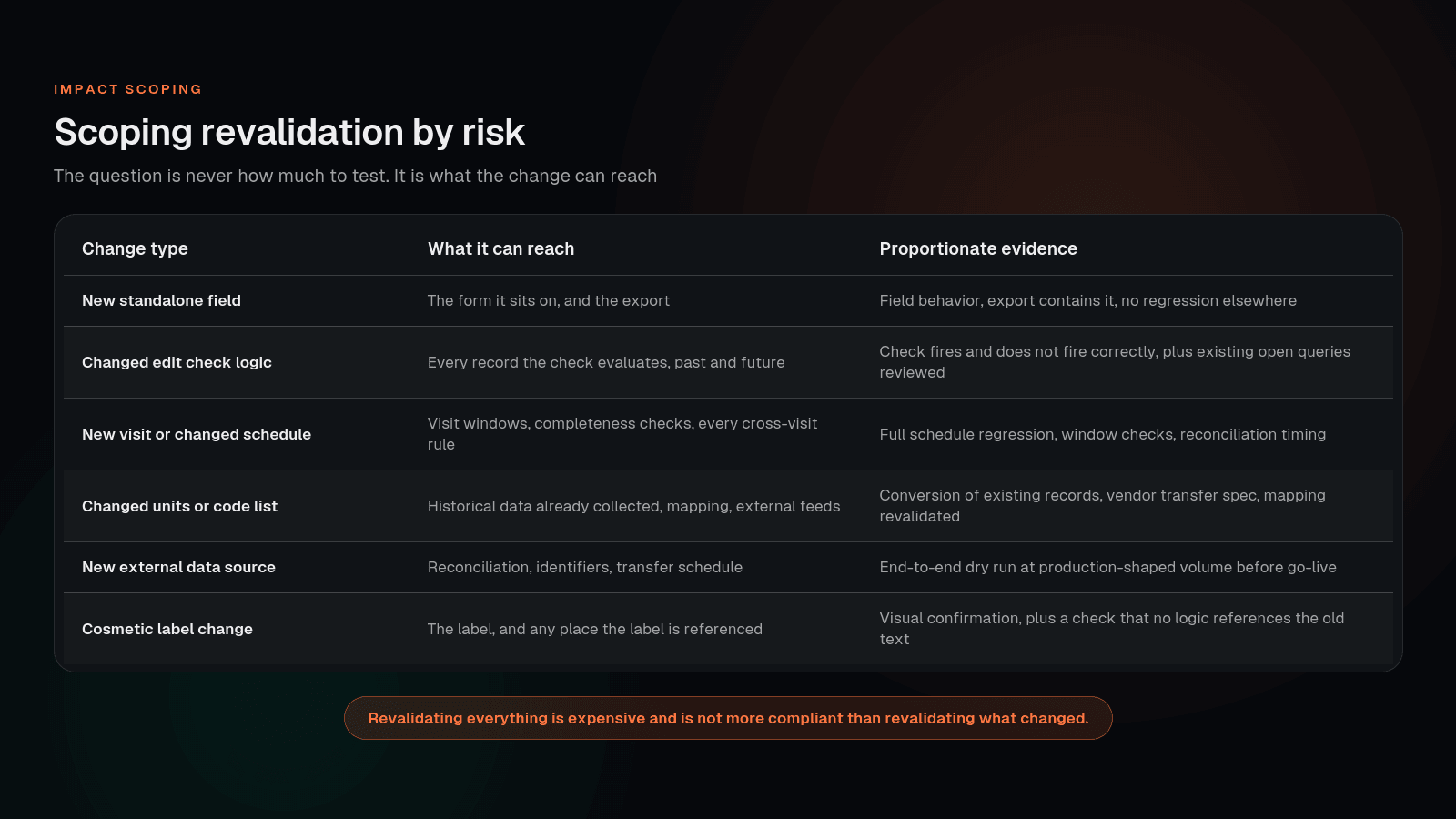
Two patterns are worth internalizing from that table. Changes to logic reach every record the logic evaluates, including records collected before the change, which is why an altered edit check is a bigger exercise than a new field even though it looks smaller. And changes to units or code lists reach outside the system entirely, into vendor feeds and into the mapping, which is why they are the most expensive small change in clinical data management.
The rationale for the scope matters as much as the testing itself. An inspector reviewing a change is looking for a thread from the protocol amendment to the evidence, and a documented reason for what was and was not retested is what makes that thread legible.
The Data You Already Collected
Every definitional change raises a question about records gathered under the old definition. If a unit changes, are historical values converted, left alone, or flagged? If a code list gains a value, do previously entered free-text responses get recoded?
All three answers can be correct. What is never correct is leaving the question unasked, because the audit trail will record whatever happened and someone will eventually ask why. Decide it during the impact assessment, write down the reasoning, and make the treatment consistent across sites.
Why Metadata Ownership Decides the Cost
Study metadata is the field definitions, the edit check logic and the coding configuration. The question is not where it is stored. It is who can change it.
If your team can edit it, an amendment is work you schedule against your own calendar and your own testers. If only the vendor can, the amendment is a request in someone else’s queue, priced and sequenced by them, and your timeline is a function of their backlog. Neither arrangement is wrong. What is wrong is discovering which one you have during your first urgent amendment.
This is a procurement decision with a multi-year consequence, which is why it belongs on the list of twelve questions to ask an EDC vendor before you sign. The broader scope question, what the platform owns versus what stays with you, is covered in what an EDC system does, and the four jobs it cannot do for you.
Telling the Sites, and Proving You Did
A system that changed on Tuesday and sites that heard the following month produces a window of data collected under the old understanding, and a set of queries nobody can interpret afterwards.
Communication needs a clear effective date, a short statement of what is different in practical terms rather than protocol terms, and a record that the training happened. That record belongs in the trial master file alongside the original training, because the amendment is part of the same story.
An Impact Assessment Worksheet
Nine questions. Answer them in writing and the scope decision writes itself.
- What exactly changed in the protocol, in one sentence?
- Which forms and fields does that require, and which does it retire?
- Which existing edit checks evaluate the fields or visits involved?
- Does the visit schedule, or any window, change?
- Does the export specification change, and has biostatistics confirmed it?
- Does any external transfer specification change, and has each vendor confirmed it?
- What happens to data already collected under the old definition?
- What is the shortest set of tests that would show nothing else broke?
- Who approves the change, and what will the sites be told, from what date?
Clinera EDC is the platform layer where these changes are made, and clinical and R&D AI covers where automation is useful in the regression and reconciliation work that follows an amendment. If the build itself is still ahead of you, every step between final protocol and first patient in is the place to start.
References
- ICH E6(R3) Good Clinical Practice. International Council for Harmonisation, adopted 6 January 2025. www.ich.org
- 21 CFR Part 11, Electronic Records; Electronic Signatures. US Code of Federal Regulations, Title 21, Part 11. www.ecfr.gov
- Good Clinical Data Management Practices. Society for Clinical Data Management. scdm.org
- Annex 11, Computerised Systems. EudraLex Volume 4, Good Manufacturing Practice guidelines. health.ec.europa.eu
This guide describes process and regulatory expectations in general terms and is not legal or regulatory advice. Confirm the current version and applicability of any standard or guidance for your study and region.
Frequently Asked Questions
How much revalidation does a mid-study amendment need?
Only as much as the change can reach. The scoping question is what depends on what changed: which forms, which checks, which exports, which external transfers, and which data already collected. A new standalone field reaches very little. A changed unit or code list reaches historical records, the mapping and every vendor feed. Revalidating everything regardless is expensive and it is not more compliant than revalidating what the change actually touches.
What is a risk-based approach to revalidation?
Targeting testing effort at what could go wrong and how much it would matter, rather than applying the same effort everywhere. In practice that means a documented impact assessment, a scope decision with a written rationale, and tests that map to that scope. GAMP 5 Second Edition sets out this approach, and it is consistent with how regulators expect validation effort to be targeted. The rationale matters as much as the testing, because the rationale is what an inspector reviews.
Why does adding two fields cost so much?
Because the fields are the small part. The change also touches the edit checks around them, the export specification, any external transfer specification, the validation package and the site training material. Each of those has a different owner and a different approval route, and the coordination between them is where the time goes. The configuration itself is often an afternoon.
Who owns our study metadata, and why does it matter here?
Study metadata means the field definitions, the edit check logic and the coding configuration. If your team can edit it, an amendment is work you can schedule against your own calendar. If only the vendor can, it is a change request in a queue with a price attached, and the queue sets your timeline. This is decided at procurement and felt at every amendment, which is why it belongs in the contract discussion rather than the change discussion.
Do we need to change data that was already collected?
Sometimes, and it is the case that most often gets missed. Changing units, altering a code list or redefining what a field means all raise the question of what happens to records gathered under the old definition. Leaving them as they are may be correct, converting them may be correct, and flagging them may be correct, but the decision needs to be made deliberately and recorded, because the audit trail will show the change either way.
Can Nirmitee Healthtech scope an amendment on a study we did not build?
Yes, and the impact assessment is the natural entry point because it is where the cost is set. The first questions are where the study metadata sits, what the existing validation package actually documents, how many external transfers are running and what the change can reach. That assessment is useful even if the implementation stays with your current team or vendor.