The Buyer Is Rarely The User.
A clinician uses the product, a health system pays for it, a patient experiences it, and a payer decides whether any of it is reimbursed. Four parties, four sets of criteria, and a sales cycle that reflects all of them.


The part of healthcare where software is the product. Companies here move at technology speed and are judged by healthcare rules — clinical safety, privacy law, interoperability mandates and reimbursement pathways that were written for a different kind of organisation. This page covers how the sector is structured and where the pressure points sit.
Discuss Your Use CaseDigital health companies build software under healthcare rules. Clinical safety, privacy, interoperability and reimbursement determine whether a product can be adopted.
Three structural features shape everything:
A clinician uses the product, a health system pays for it, a patient experiences it, and a payer decides whether any of it is reimbursed. Four parties, four sets of criteria, and a sales cycle that reflects all of them.
Whether a product is a regulated medical device or a wellness tool is determined by intended purpose and claims — the words on the marketing site as much as the code. That line is drawn during product definition, and moving it later is expensive.
A product that cannot read from and write to the systems a health system already runs is a parallel workflow, and parallel workflows are abandoned. Interoperability determines adoption more reliably than feature depth.
A single clinical or operational problem solved well — remote monitoring for one condition, scheduling, prior authorisation, documentation. Fast to sell, hard to defend, and under constant pressure to widen scope before the core is stable.
Care delivered remotely, which makes the company a provider organisation as well as a technology one — clinician licensing, credentialing, malpractice cover, prescribing rules and state or national scope-of-practice limits all become operating concerns.
Software that interprets data and suggests or produces a clinical finding. This is where the regulated-device line is most often crossed, and where evidence expectations are highest.
Products where the intervention itself is software — behaviour change programmes, symptom management, adherence. Digital therapeutics carry clinical evidence obligations closer to pharmaceutical products than to consumer apps.
Interoperability layers, data pipelines, identity, consent management and analytics sold to other healthcare organisations rather than to clinicians directly.
Revenue cycle, claims, care management, utilisation review, network operations. Less visible, larger budgets, longer contracts.
Companies frequently move between these. A point solution that adds clinical interpretation crosses into device regulation. A patient engagement product that adds licensed clinicians becomes a provider. The regulatory and operational consequences of those moves are usually discovered after the fact.
US, protected health information
Safeguards, access control, audit logging, breach notification, and Business Associate Agreements with every partner touching PHI
US, software with a medical purpose
Whether the product requires clearance, what evidence supports the claims, and how future versions may change
US, lower-risk health software
Categories of wellness and low-risk software the agency has indicated it does not actively regulate — a position, not an exemption
EU, medical device software
Classification, conformity assessment, clinical evaluation and post-market obligations for software with a medical purpose
US
Prohibitions on practices that interfere with access, exchange or use of electronic health information
US
Standardised FHIR-based API access to health data, shaping how third-party products connect to certified EHRs
US
A framework for nationwide health information exchange between networks
EU/UK
Lawful basis, consent, minimisation, cross-border transfer and data subject rights over health data
Global, commercial
Not law, but the de facto security requirement to close an enterprise health system or payer contract
US
Where clinicians may practise, what they may prescribe, and under what remote-care conditions
US reimbursement
Whether a service can be billed, by whom, and under what documentation and time thresholds
The practical consequence: regulatory status, security posture and interoperability approach are architectural decisions taken at the start. All three are significantly more expensive to retrofit than to design in.
The clinical system of record. Access is via standards-based APIs where available, and via interface engines and flat-file exchange where it is not. Each health system's configuration differs.
Appointments, eligibility, encounter administration. Frequently a separate vendor to the EHR.
Eligibility checks, prior authorisation, claim submission and remittance, running on transaction standards that predate modern APIs.
E-prescribing networks, formulary and benefit checks, medication history.
Consumer and clinical device data arriving through vendor SDKs, aggregators or platform health frameworks.
Patient matching, provider directories, authentication, and records of what a patient has agreed to.
The warehouse layer where population, quality and outcome reporting is produced.
01
Health systems have run pilots for a decade. The scarce outcome is a signed enterprise contract with a budget line and an owner.
02
Regulation requiring standardised API access changed the negotiating position for third-party products, though real-world variation between deployments remains substantial.
03
Adding interpretation, prediction or triage to a product that previously only displayed data can move it into regulated territory.
04
Buyers increasingly ask for outcome data rather than usage data. Evidence generation has to be planned into the product rather than assembled for a sales cycle.
05
Billing codes exist for remote monitoring and some digital services, which makes certain business models viable.
06
Enterprise health customers run vendor risk assessments that assume a mature security programme. Companies without documented controls lose deals at a stage where the product was never the issue.
Claims written for marketing that move the product across the device line, discovered during a customer's legal review.
Treated as one sprint, when each health system deployment carries its own configuration, credentialing timeline and data quirks.
Audit logging, access control and data segregation added under deal pressure rather than designed in, at several times the cost.
A product that requires clinicians to leave their existing system to use it, competing against a workflow that already works well enough.
Outcome data pulled together when a buyer asks, from instrumentation never designed to answer that question.
The build that won the pilot carrying production load, PHI and enterprise security expectations it was never designed for.
BUILD WITH CONFIDENCE
Nirmitee Health builds clinical, data and integration software for digital health and healthtech companies. Healthcare is the only industry we serve.
From our insights
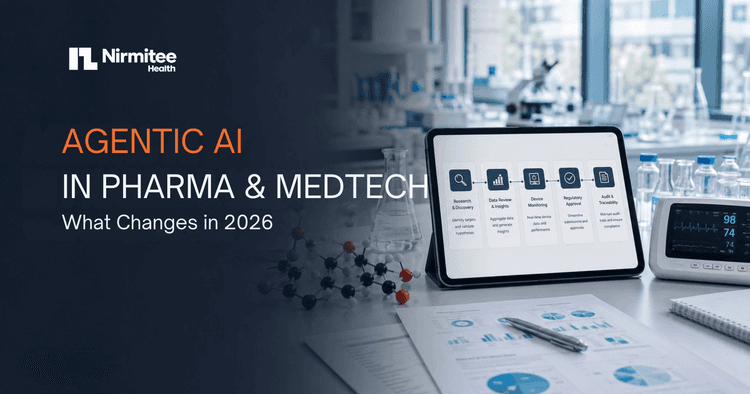
How agentic AI moves pharma and MedTech from assistants that answer to agents that execute, across…

How real-world data and clinical trial data differ in setting, population and purpose, and why evidence…

Where publication timelines are lost after last patient out, and how electronic data capture, query cycles…