Study Start-Up Cycle Time: Where the Weeks Actually Go
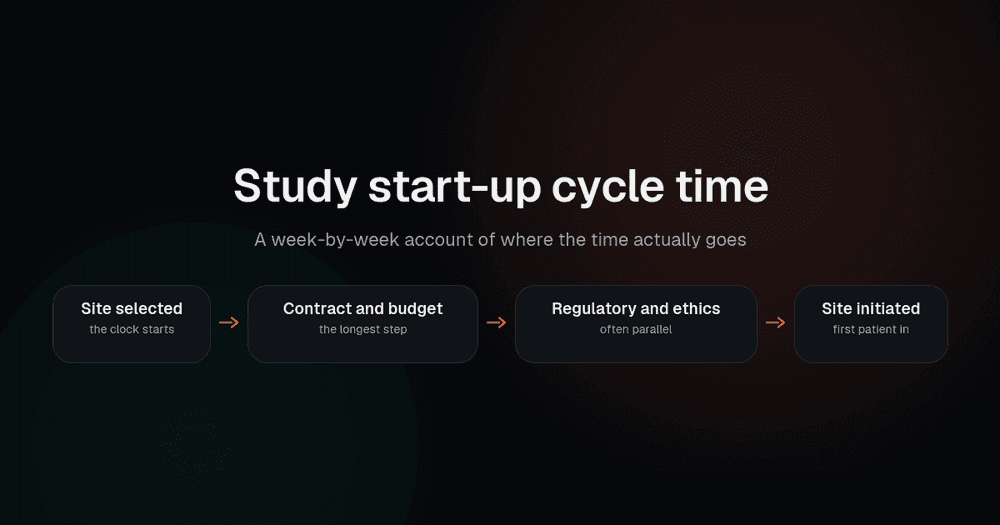
Study start-up rarely slips on one large delay. It slips on six serial steps, each individually reasonable, with waiting time between them that nobody owns. Two of the common step pairs have no real dependency at all, which is where the recoverable weeks are.
Activation timelines get discussed as a single number, which hides the structure underneath. A study that takes fourteen weeks from site selection to first patient in did not spend fourteen weeks working. It spent a few weeks working and the rest waiting, in places that a timeline report does not distinguish.
This guide walks the six steps, separates work from waiting, and identifies which sequencing is a genuine dependency and which is habit. It sits under which system owns which part of the study.
After reading this you will be able to:
- Break an activation timeline into milestones rather than one number
- Separate the weeks spent working from the weeks spent waiting
- Identify which step pairs can run in parallel without adding risk
- Plan submissions backward from committee dates instead of forward from readiness
The Six Steps
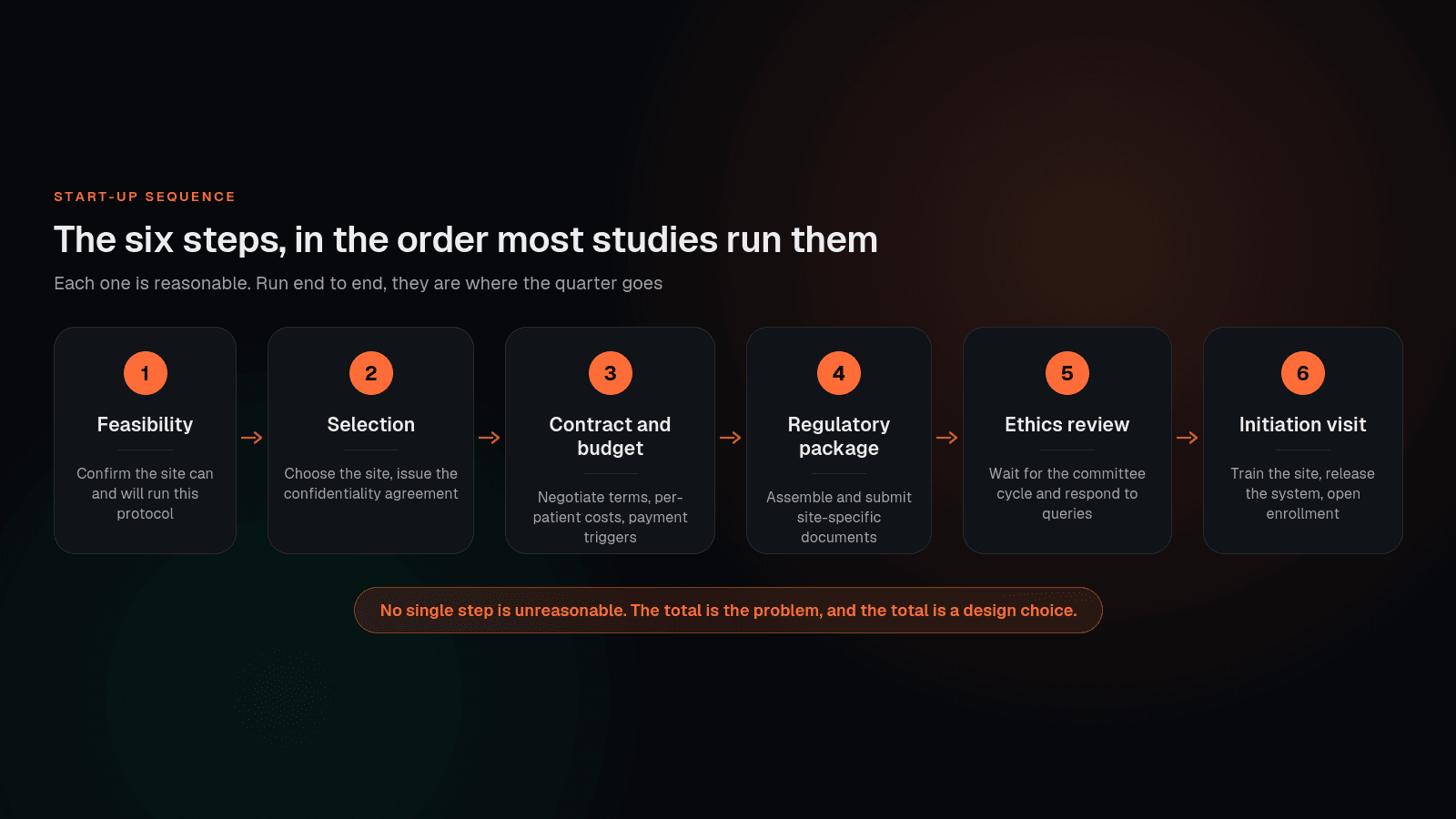
Read that sequence and nothing looks wrong. Each step has a clear purpose, a clear owner and a defensible duration. The problem is not any single step, it is that they are arranged end to end when several of them do not need to be.
It is also worth noticing which step the clock is usually measured from. Teams that start counting at site selection get a very different number from teams that start at feasibility, and comparing across organizations without checking that definition produces benchmarks that mean nothing.
Where the Calendar Goes Quiet
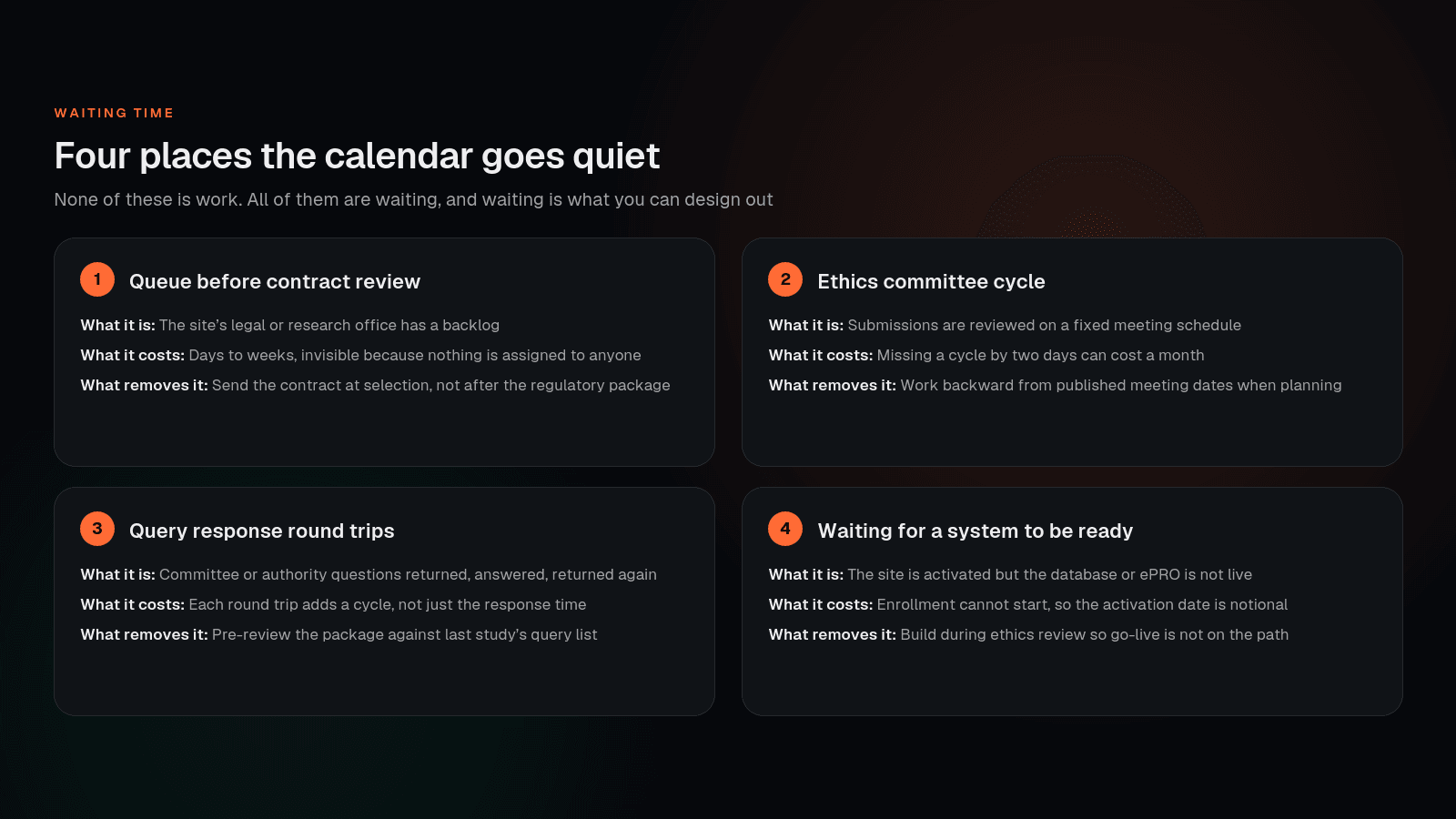
The first is the one worth attacking first, because it is pure sequencing. A contract sent at site selection enters the research office queue while the regulatory package is still being assembled. A contract sent after the package is ready enters the same queue, several weeks later, having gained nothing.
The fourth is the one most often missed in reporting, because the site shows as activated and the milestone is met. If the database or the ePRO is not live, the activation date is notional and enrollment cannot start. That gap is invisible in a CTMS milestone report unless someone deliberately tracks system readiness as its own date.
What Can Actually Run in Parallel
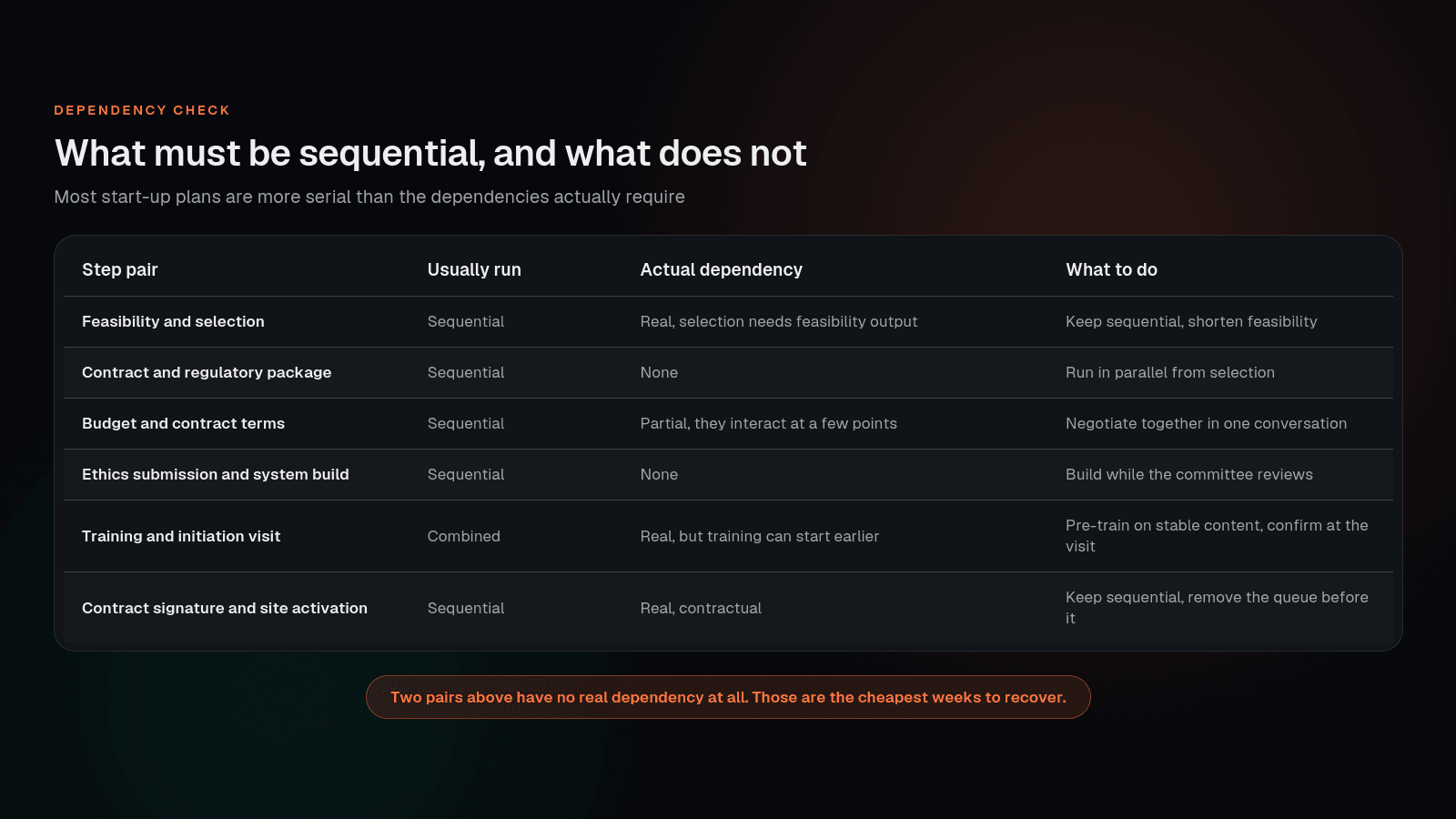
Two rows have no dependency whatsoever. Contract negotiation does not require the regulatory package, and the database build does not require ethics approval. Both are routinely run sequentially because the plan was drawn that way, not because anything breaks if they overlap.
Building the database during ethics review is the larger of the two, and it connects directly to the data management timeline. The build sequence itself, and the steps within it that get compressed under pressure, are covered in every step between final protocol and first patient in.
The Contract Step, Honestly
Contract and budget is reliably the longest single step, and the usual explanation is that negotiation is slow. That is mostly not what is happening.
The negotiation itself is often two or three working sessions. The elapsed time comes from three things: the gap before the site’s office picks the document up, budget and terms being handled as separate threads that alternate, and per-patient cost discussions that reopen once the visit schedule is properly understood.
All three are addressable. Send at selection. Put budget and terms in one conversation with both decision-makers present. And make sure the visit schedule and its payment triggers are settled before the budget is drafted, because reopening cost after the fact is what produces the second round. How those triggers should be wired is covered in why the CTMS and the finance system disagree.
Measuring It So the Answer Is Actionable
One activation number tells you whether you have a problem. It does not tell you where.
Track elapsed days between named milestones instead: selected to contract sent, sent to executed, package ready to submitted, submitted to approved, approved to initiated, initiated to first patient in. Use the median rather than the mean, because a single outlier site will otherwise hide a consistent pattern across the rest.
Then segment by site type. Academic centers, hospital networks and private sites have genuinely different queue behavior, and a plan built on a blended average will be wrong for all three. Feasibility and selection decisions that account for that are covered by site identification and feasibility tooling, and the same pattern applied with AI is worked through in the site selection and feasibility use case.
Three Changes Worth Making First
- Send the contract at site selection, before the regulatory package is assembled.
- Start the database build during ethics review rather than after approval.
- Plan the submission date backward from published committee meeting dates.
None of these requires new tooling or additional headcount, and together they typically account for most of the recoverable time. Clinera CTMS tracks the milestone dates that make the effect measurable rather than anecdotal.
References
- ICH E6(R3) Good Clinical Practice, trial conduct and site management. International Council for Harmonisation, adopted 6 January 2025. www.ich.org
- 21 CFR Part 312, Investigational New Drug Application. US Code of Federal Regulations, Title 21, Part 312. www.ecfr.gov
- Clinical Trials Regulation EU No 536/2014. European Medicines Agency, clinical trials regulation. health.ec.europa.eu
This guide describes process and regulatory expectations in general terms and is not legal or regulatory advice. Confirm the current version and applicability of any standard or guidance for your study and region.
Frequently Asked Questions
What actually drives study start-up cycle time?
Waiting, more than work. The six steps between site selection and first patient in each take a reasonable amount of effort, and most of the elapsed calendar is spent between them: a contract sitting in a research office queue, a submission waiting for the next ethics committee meeting, a query round trip. That matters because effort is hard to compress and waiting is often a sequencing choice you can change.
Which start-up steps can genuinely run in parallel?
Contract negotiation and the regulatory package have no real dependency on each other, and neither does the database build against ethics review. Those two pairs are the cheapest weeks to recover because nothing about running them together increases risk. Feasibility before selection, and contract signature before activation, are genuine dependencies and should stay sequential.
Why does the contract take so long?
Usually because it was sent late and then entered a queue. The negotiation itself is often a few working sessions. The elapsed time comes from the gap before the site's legal or research office picks it up, and from budget and terms being handled as separate conversations that ping back and forth. Sending at selection rather than after the regulatory package, and negotiating budget and terms together, removes most of it.
How should we handle ethics committee timing?
Plan backward from published meeting dates rather than forward from when your package will be ready. Missing a cycle by two days can cost a month, which makes the submission date far more consequential than the day or two usually spent polishing the package. It is also worth pre-reviewing against the query list from your last submission to the same committee, since repeat queries are common and each round trip costs a cycle rather than a response time.
What metrics are worth tracking for start-up?
Track elapsed days between named milestones rather than a single activation figure, because the aggregate hides where the time went. Site selected to contract sent, contract sent to executed, package ready to submitted, submitted to approved, approved to initiated. Median by site type is more useful than the mean, since one outlier site distorts the average and hides a systemic pattern in the rest.
Can Nirmitee Healthtech help compress our start-up timeline?
The useful starting point is a timeline audit rather than a tool. That means taking your last several activations, plotting the milestone dates, and separating elapsed time into work and waiting. In most cases two or three sequencing changes account for the majority of recoverable weeks. Clinera CTMS tracks those milestones, and Clinera Find supports the feasibility and selection end, but the sequencing decisions come first.