ePRO Adoption Drops in Month Four: The Site Workflow Reason
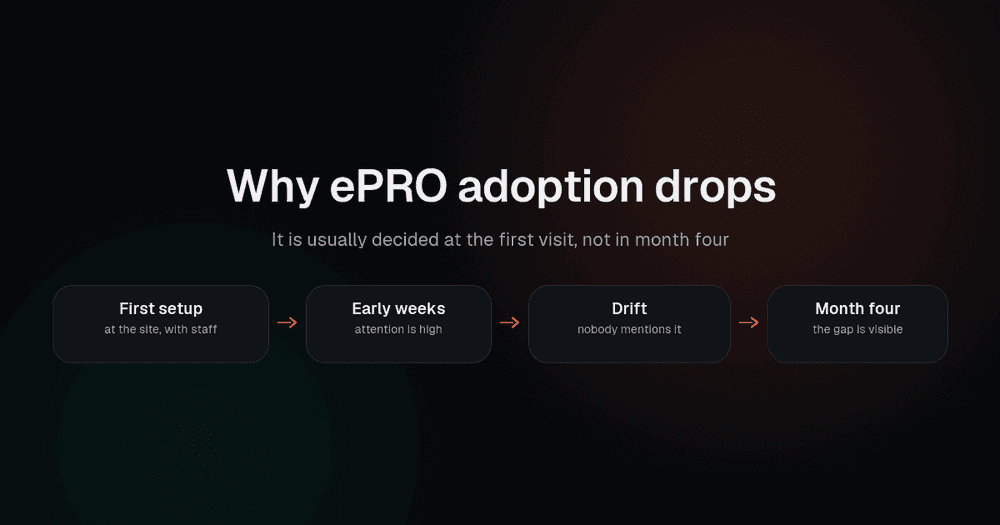
ePRO compliance usually falls because of the workflow around the diary, not because patients lose interest. Diary length and timing, device fit, how much of the first visit was spent on setup, and whether anyone at the site sees a missed entry account for most of it. All four are decided before the first patient enrolls.
Every other data source in a trial is entered by trained staff who are paid to enter it. ePRO is not. The person entering it is the patient, and their reasons for continuing are their own, which changes what can be done about it once it stops.
This guide explains why the drop shows up around month four, what actually moves compliance, and what to check at points early enough to act. It sits under how clinical trial data moves from site entry to submission.
After reading this you will be able to:
- Explain the month-four pattern without reaching for patient motivation
- Identify which of four levers is causing a given compliance problem
- Check compliance at points where there is still a recovery path
- Design a first setup visit that holds up once attention fades
What the Month-Four Drop Looks Like
It is rarely a cliff. It is a slope that becomes visible once someone plots it.
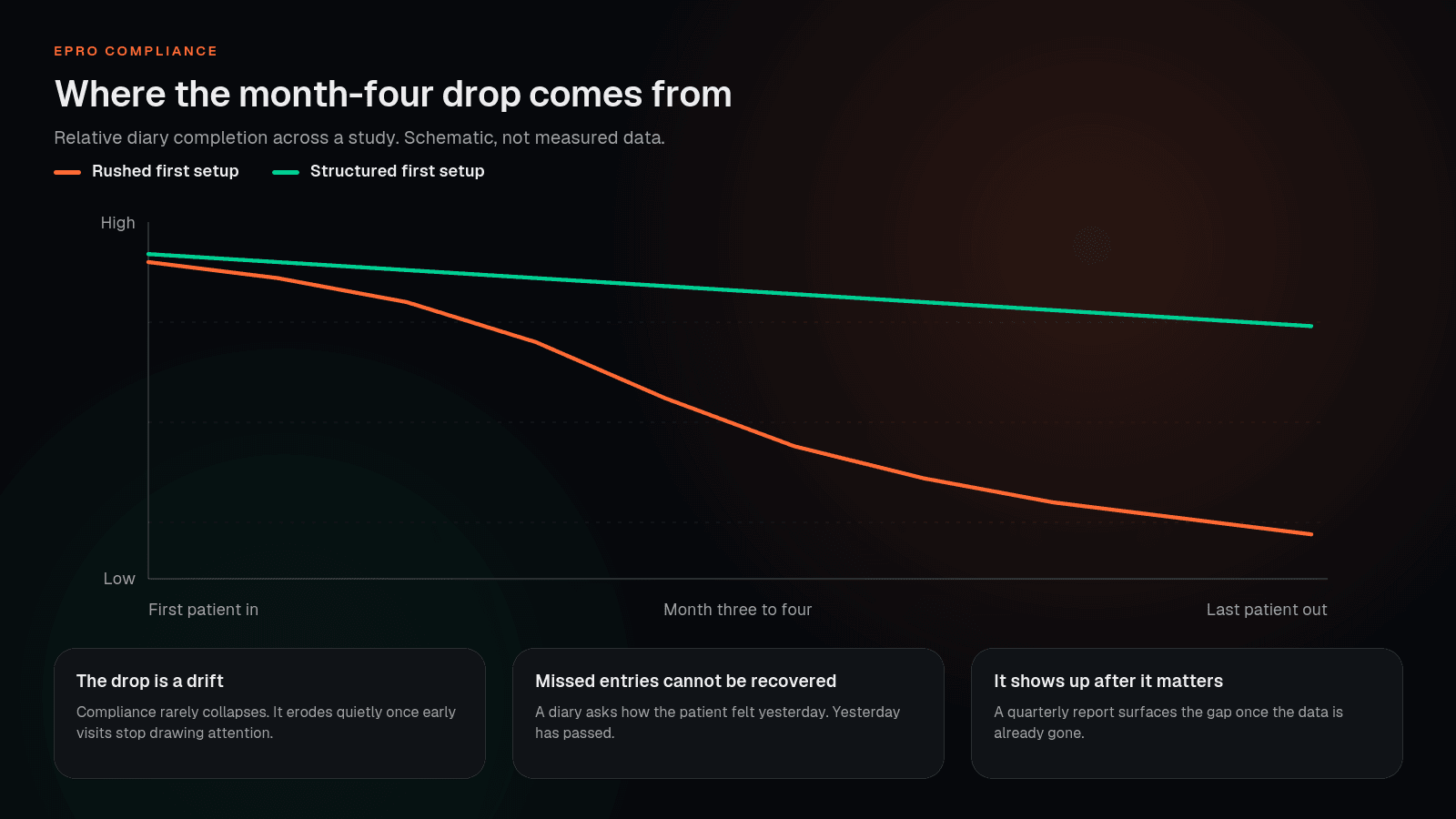
Two features of that shape matter. The first is that both lines start in roughly the same place, because early enthusiasm is not the differentiator. The second is that the gap opens gradually, which is why it tends to surface in a quarterly report rather than in a weekly one, by which point several months of entries are already gone.
Why It Is Not a Motivation Problem
Patients who consent to a trial are, by definition, willing. Treating declining compliance as flagging motivation leads to interventions aimed at the one variable you cannot change, and away from the four you can.
What actually changes between month one and month four is attention. In the early weeks the device is novel, the site mentions it at every contact, and visits are frequent. Later, none of those is true. Anyone whose routine was not properly established at the start has nothing holding it in place, and the difference shows.
The Four Levers That Move Compliance
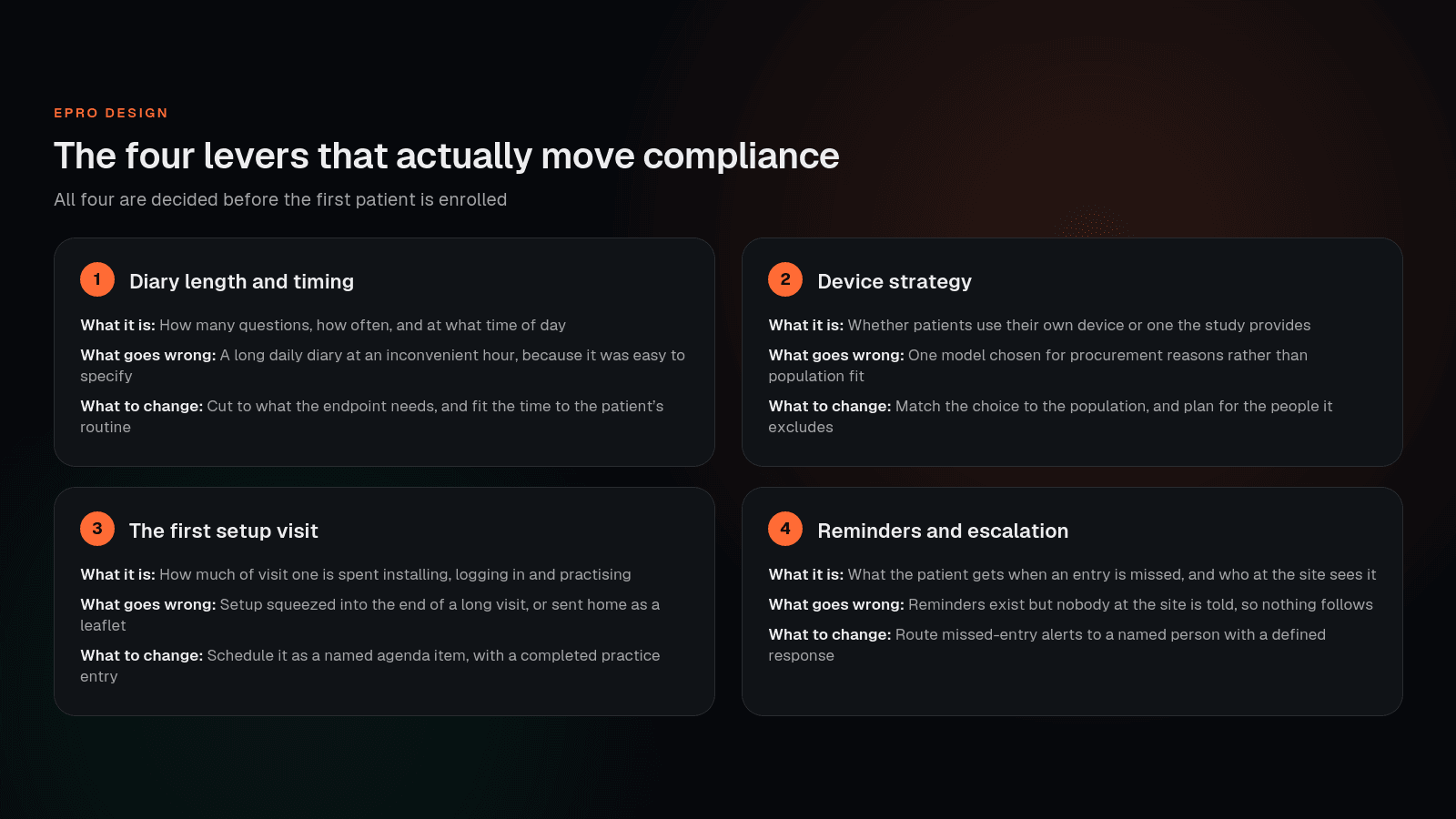
The first lever is the one most often set badly for understandable reasons. Diary content gets specified by people thinking about what would be useful to know rather than what the endpoint requires, and every additional question is free at specification time and costs something every single day thereafter.
The First Visit Decides Most of It
If there is one intervention worth protecting, it is the setup at visit one.
The measure of a good setup is not that the application is installed. It is that the patient has completed a real entry themselves, on the device they will actually use, with someone present in case it goes wrong. That single completed practice entry does more for month four than any reminder configuration.
It has to be on the visit agenda by name. Setup squeezed into the last five minutes of a long first visit, or handed over as a leaflet to read at home, produces exactly the pattern in the chart above.
Device Strategy and Who It Excludes
Provisioned devices give a controlled environment and remove compatibility questions, at the cost of logistics, charging, and asking the patient to carry a second device. Allowing patients to use their own removes that friction for most people and introduces variability, while excluding some patients entirely.
Neither is wrong. What goes wrong is choosing one and treating the people it does not serve as an edge case to be handled later. Plan the alternative path at design time, decide who is responsible for offering it, and make sure site staff know it exists.
What to Check, and When
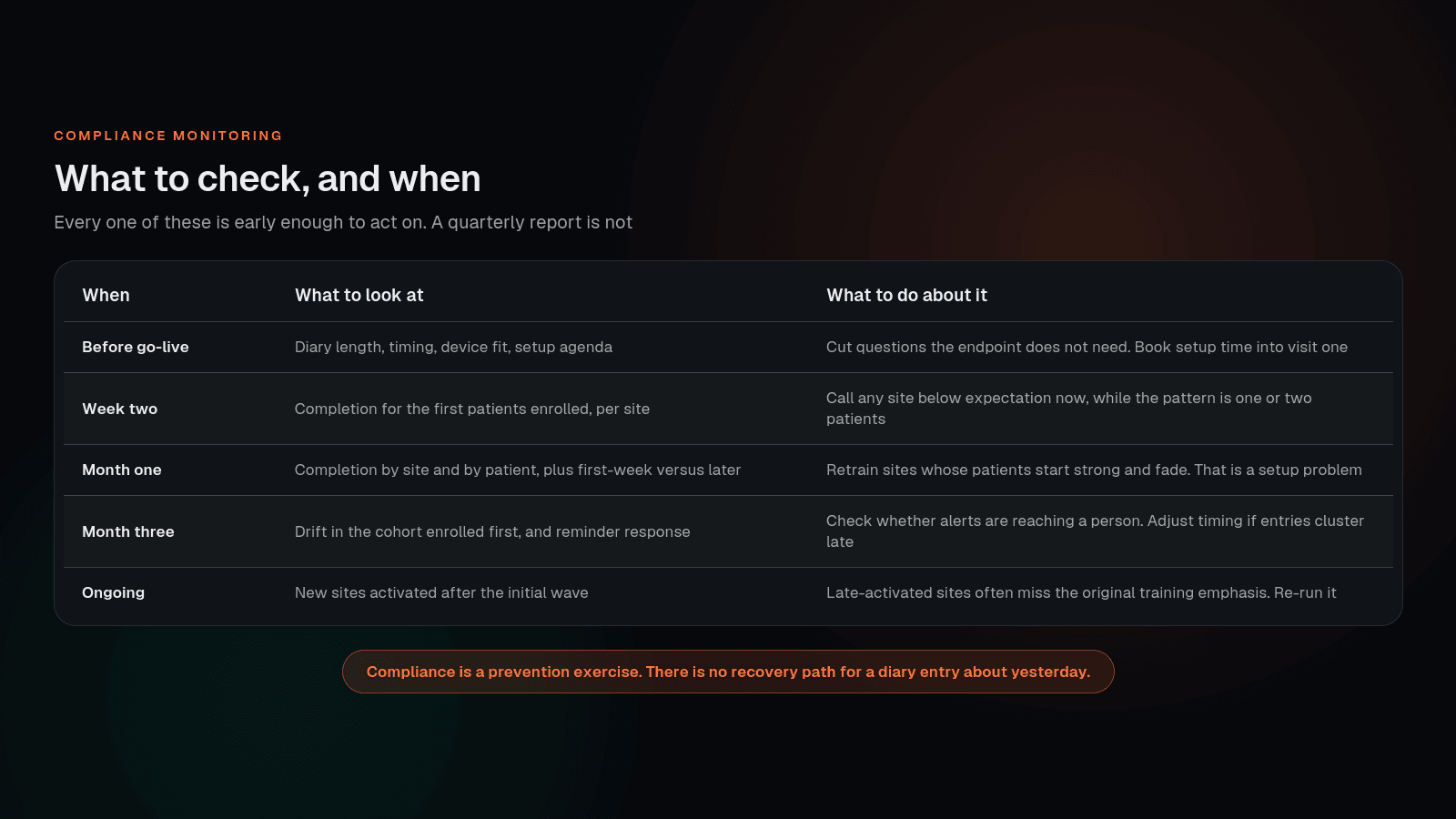
The week-two check is the highest-value one on that list and the most frequently skipped. With only a handful of patients enrolled, a site with a setup problem is visible and correctable, and the conversation is a short call rather than a retraining exercise.
Missing patient-reported data also contributes to the late-study query load, since completion gaps tend to surface in batches during reconciliation. Fixing compliance early reduces work in two places, a pattern covered in why query volume rises late in a study, and what reduces it.
Prevention, Because There Is No Recovery
A missing case report form is a task. Someone can chase it, the source document still exists, and the data can be entered. A missing diary entry is different in kind: the question asked how the patient felt yesterday, and yesterday is gone.
Allowing retrospective completion does not solve this and usually creates a worse problem, because recalled data recorded as contemporaneous is less trustworthy than an honest gap. That asymmetry is the whole argument for treating ePRO as a design and prevention exercise rather than a monitoring one.
Clinera ePRO is the patient-reported capture layer, and Clinera Survey covers the lighter-weight questionnaire cases where a full diary is more than the endpoint needs. The wider data flow these feed into is in what an EDC system does, and the four jobs it cannot do for you.
References
- Patient-Reported Outcome Measures, Use in Medical Product Development. US Food and Drug Administration guidance for industry. www.fda.gov
- ICH E6(R3) Good Clinical Practice. International Council for Harmonisation, adopted 6 January 2025. www.ich.org
- Good Clinical Data Management Practices. Society for Clinical Data Management. scdm.org
- 21 CFR Part 11, Electronic Records; Electronic Signatures. US Code of Federal Regulations, Title 21, Part 11. www.ecfr.gov
This guide describes process and regulatory expectations in general terms and is not legal or regulatory advice. Confirm the current version and applicability of any standard or guidance for your study and region.
Frequently Asked Questions
Why does ePRO compliance drop after a few months?
Because the early visits carry attention that later ones do not. In the first weeks the device is new, the site mentions it at every contact and the patient is still building the habit. Once that attention fades, anyone whose setup was rushed has nothing holding the routine in place. The drop is usually a drift rather than a collapse, which is why it becomes visible around month three or four rather than at any single point.
Is low ePRO compliance a patient motivation problem?
Rarely, in the sense that motivation is not the lever you can pull. Patients in trials are generally willing. What varies is whether the diary fits their day, whether the first setup left them confident, and whether anyone notices when they stop. Those are all design and workflow decisions made by the study team, which is the good news, because they are changeable and motivation is not.
How much of the first visit should be spent on ePRO setup?
Enough that the patient completes a practice entry unaided before they leave, which usually means it needs to be a named item on the visit agenda rather than something squeezed into the final minutes. The test is not whether the app is installed. It is whether the patient has successfully done the thing once, on their own device, with someone available if it goes wrong.
Should we use provisioned devices or let patients use their own?
Both have real trade-offs and the right answer depends on the population. Provisioned devices give you a controlled environment and remove compatibility questions, at the cost of logistics, charging and the patient carrying a second device. Bring-your-own removes that friction for most patients but excludes some and introduces variability. Whichever you choose, plan explicitly for the people it does not serve rather than treating them as an exception.
Can missed diary entries be recovered later?
Generally no, and this is what makes ePRO different from every other data source in a study. A missing case report form is a site task that can be chased. A diary entry asking how the patient felt yesterday cannot be completed accurately a week later, and allowing retrospective entry usually introduces a worse problem than the missing value. This is why ePRO management is a prevention exercise.
Can Nirmitee Healthtech review an ePRO design before go-live?
Yes, and before go-live is when a review is worth most, because diary length, timing, device strategy and the setup agenda are all still changeable. On a live study the equivalent work is a compliance segmentation by site and by week since enrollment, which usually identifies whether the issue is a specific site, the setup process, or the diary itself.