CTMS vs eTMF: Which System Owns Which Document
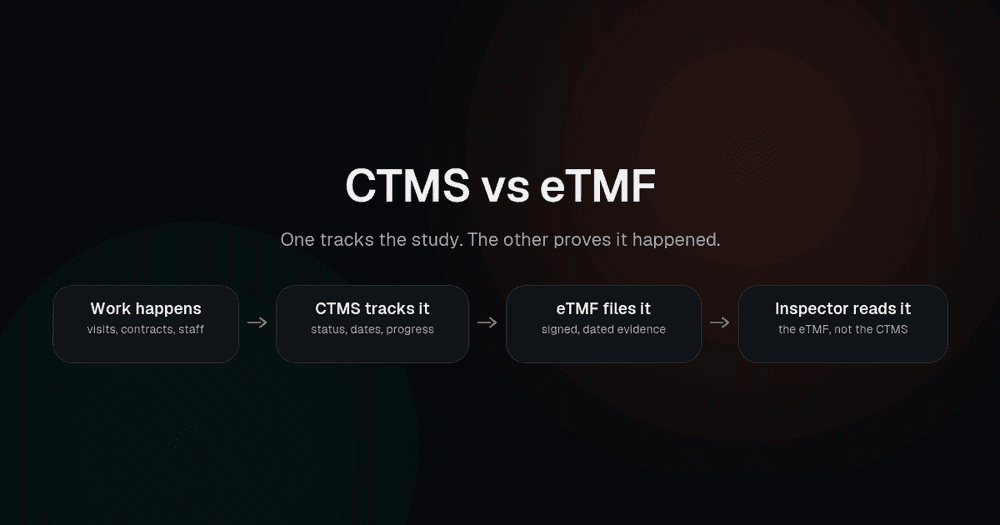
A CTMS tracks where the study is. An eTMF proves what happened. If an inspector would ask to see a document as evidence, the eTMF owns the authoritative copy, even when the CTMS also references it. Storing documents in a CTMS does not remove the need for a trial master file.
This question comes up about twice a month, usually phrased as a cost question: the CTMS has a document library, so why pay for a second system. It is a fair question, and the answer is not that one tool is better. It is that they are built to answer different questions for different readers.
What follows is the document-by-document split, the four differences underneath it, and what to do about the documents that legitimately live in both. It sits under which system owns which part of the study.
After reading this you will be able to:
- Apply a one-question test to decide where any document belongs
- Name the authoritative copy for documents that live in both systems
- Spot the document types currently living in neither
- Explain to a finance stakeholder why the second system is not duplication
The Document-by-Document Split
Start with the answer, then the reasoning.
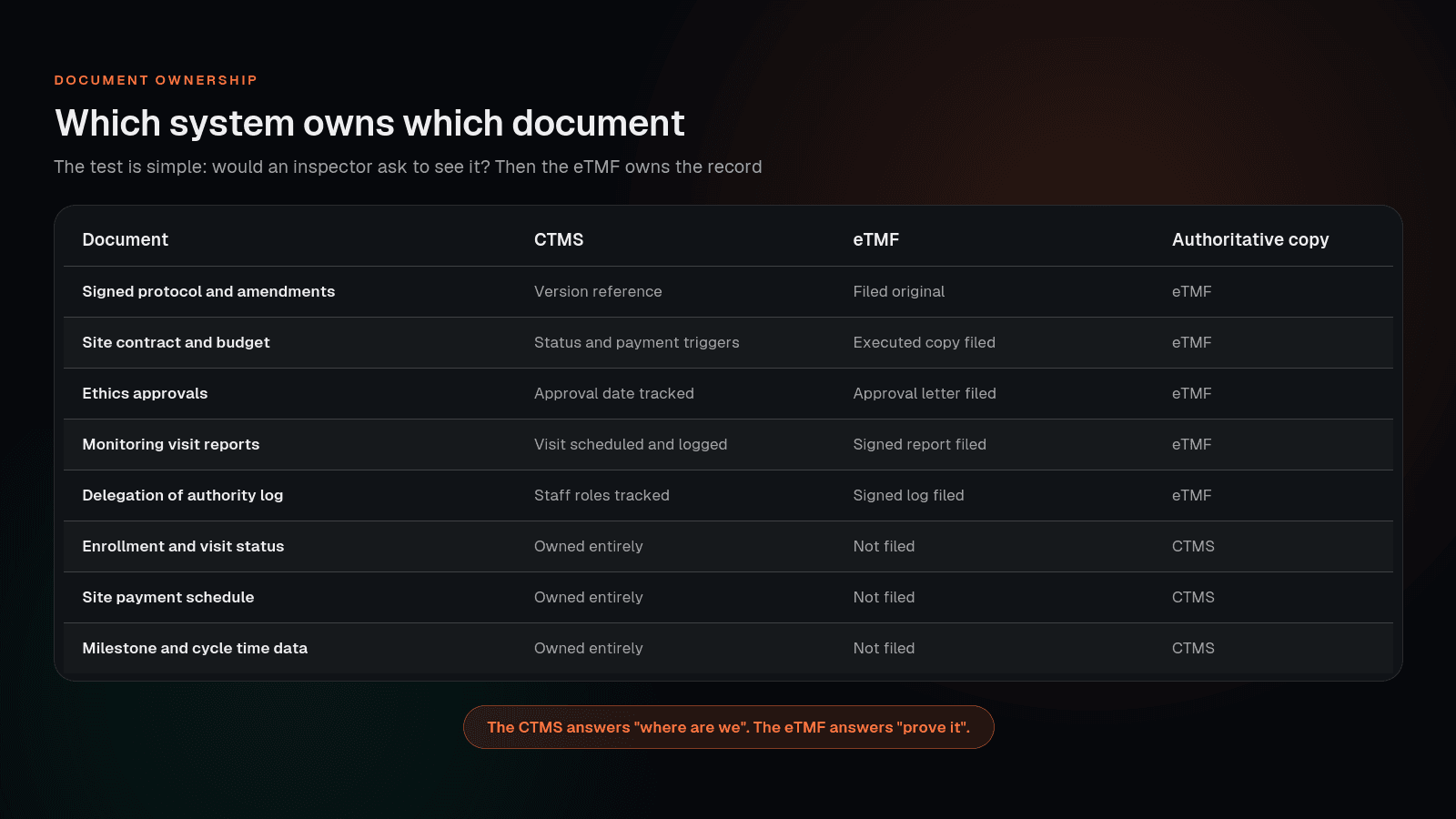
The test behind every row is the same. Would an inspector ask to see this as evidence that regulated activity happened correctly? If yes, the eTMF owns the record. If the document is a working artifact that helps you run the study but proves nothing about compliance, the CTMS owns it outright and the eTMF should not carry it.
That test is more reliable than arguing from system features, because features change between releases and the evidentiary question does not.
Four Differences That Matter
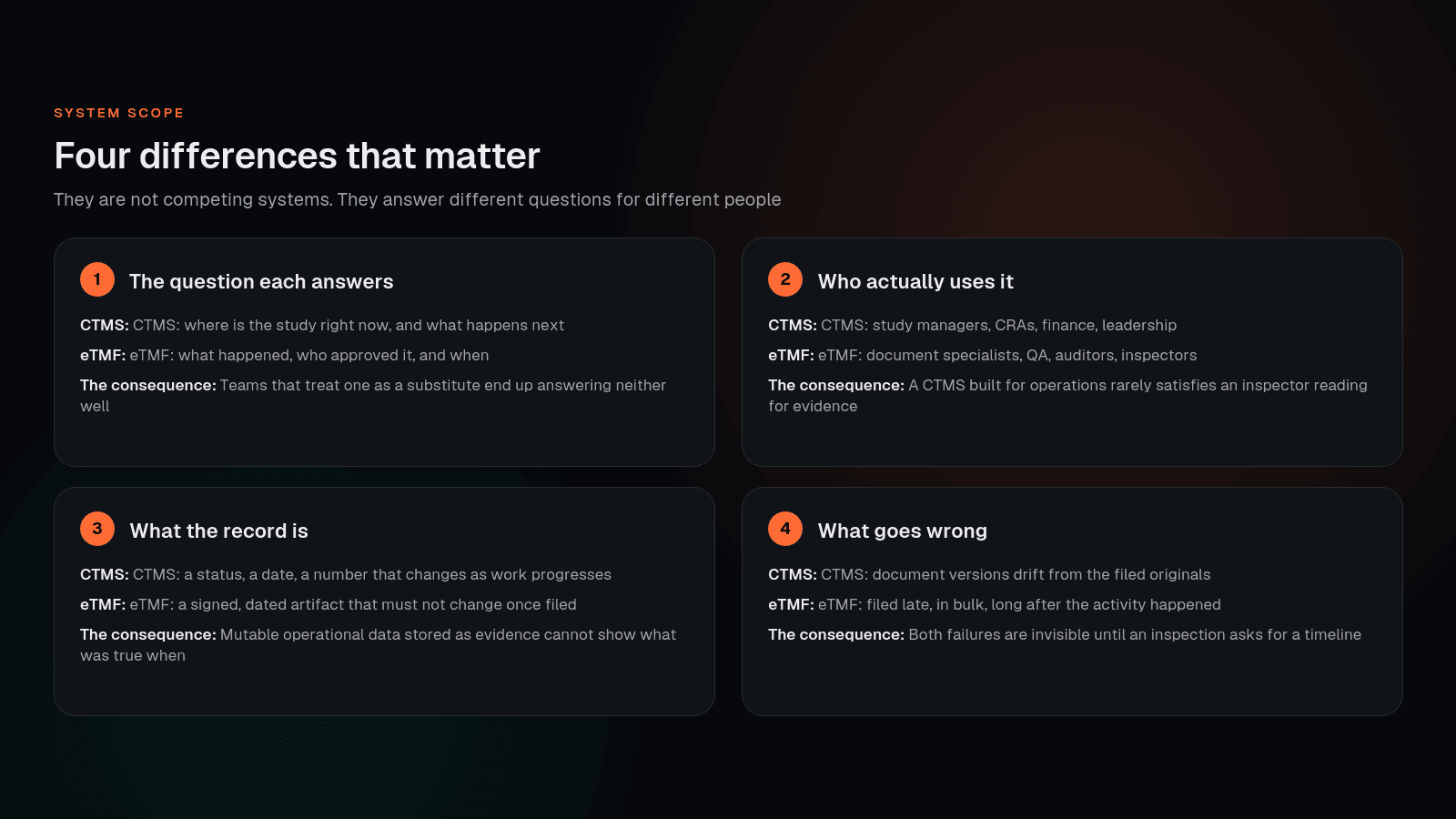
The third row is the one most often missed. A CTMS record is designed to change as work progresses: a visit moves from scheduled to complete, a contract moves from draft to executed. An eTMF record is designed not to change once filed, because its value is that it shows what was true at a point in time. Storing evidence in a system built for mutable status is how a file stops being able to answer the question it exists to answer.
The Overlap Zone
Some documents genuinely belong in both places, and pretending otherwise produces workarounds.
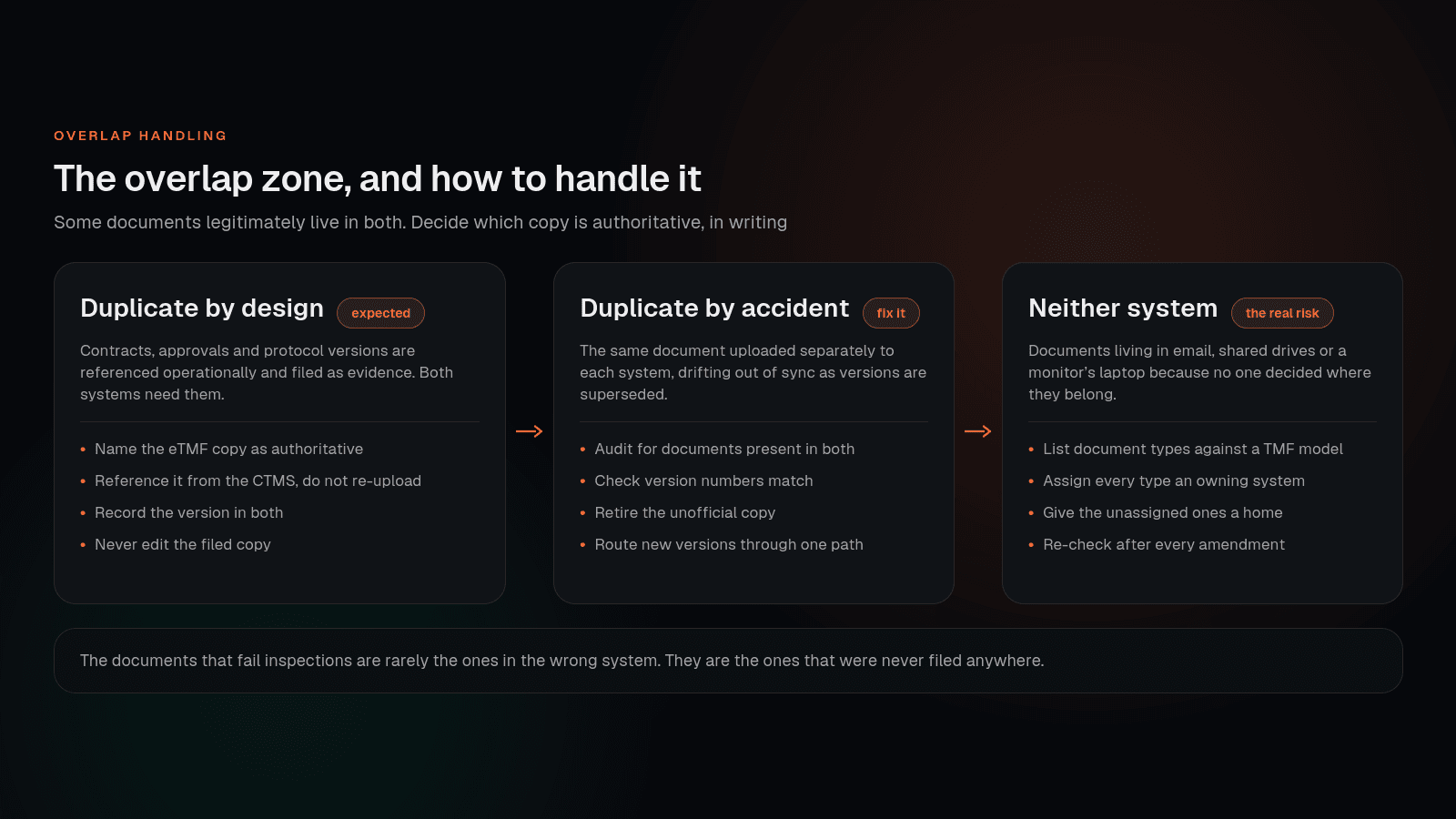
Duplication by design is fine and normal. A site contract is referenced in the CTMS to drive payment triggers and filed in the eTMF as executed evidence. The rule is that one copy is authoritative, it is named as such in writing, and new versions are routed through a single path rather than uploaded twice by different people.
Duplication by accident is the version-mismatch problem, and it surfaces at the worst possible moment. The third category, documents in neither system, is the one that actually produces findings.
Using a Reference Model Without Adopting It Wholesale
The TMF Reference Model gives you a structure and a comprehensive artifact list, which beats starting from an empty folder tree. What it cannot do is tell you which artifacts your study actually generates, or who owns each one.
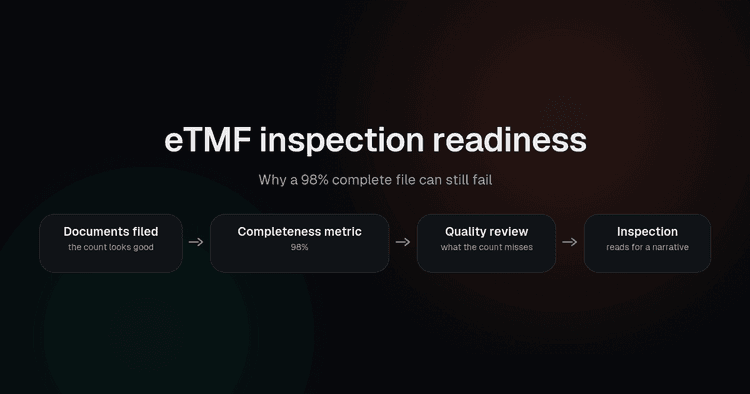
Use it as a checklist rather than a specification. Walk your document types against it, assign each one an owning system and an authoritative copy, and mark the ones that do not apply to this study so that their absence is a decision rather than a gap. That marked-up list is the artifact worth maintaining, and it is what makes a quality review that goes beyond completeness percentages possible.
Where the Site’s Copy Fits
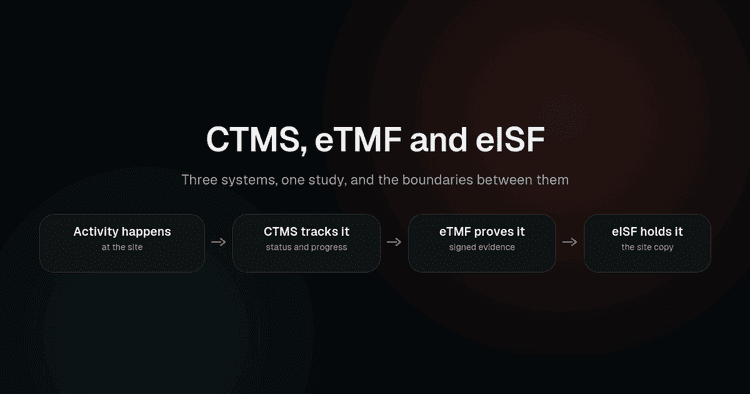
There is a third file in this picture, and leaving it out is why the CTMS-versus-eTMF framing sometimes feels incomplete. The site holds its own investigator site file, and increasingly holds it electronically.
The sponsor eTMF and the site file overlap substantially but are not the same thing, and they have different access requirements: monitors need to see site documents without the site losing control of them. That permissioning problem is covered in giving monitors access without losing document control.
What an Inspector Is Actually Reading For
Inspections do not test whether your systems are modern. They test whether the record supports a narrative: this happened, this person was authorized to do it, this is when it was approved, and here is the signature.
That narrative is built from dates. When was the protocol version approved, when were sites trained on it, when did the first patient consent under it. A CTMS holds those dates as tracked fields that may have been edited, backdated or corrected without explanation. An eTMF holds them as properties of signed artifacts. The difference is not tidiness, it is whether the dates can be relied on at all.
This is also why filing speed matters more than filing completeness. A file assembled in the weeks before an inspection may be complete and still read as reconstructed, because the upload timestamps tell their own story alongside the document dates.
Making the Case to Whoever Controls the Budget
The objection is rarely technical. It is that two systems look like paying twice for document storage, and answering it with a feature comparison tends not to land.
The version that does land is a cost-of-failure comparison. The downside of running without a proper trial master file is not inconvenience, it is a finding that requires a remediation exercise, reconstructing months of filing under time pressure while the study continues. Framed against that, the second system is the cheaper of the two options, and the conversation moves from storage cost to risk.
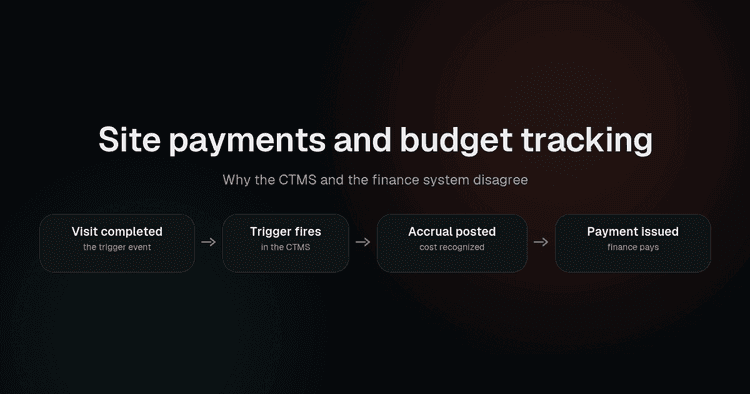
It also helps to be specific about what the CTMS is genuinely better at, because it is better at real things. Operational reporting, cycle time visibility, payment triggers and resourcing are CTMS strengths that an eTMF should never try to cover. The argument is for a boundary, not for more tooling.
What to Do This Week
Six steps, and the first two are the ones that find the real problems.
- List every document type your study generates, from a reference model rather than from memory.
- Mark the ones that currently live in neither system. Start there.
- Assign every type an owning system and an authoritative copy.
- Find documents present in both, and check the version numbers match.
- Define one filing path per type, so nothing is uploaded twice by two people.
- Re-run the list after every protocol amendment, because amendments generate new types.
Clinera CTMS and Clinera eTMF are built to this split rather than to a single merged document store, which is why the boundary question has a clean answer in both.
References
- ICH E6(R3) Good Clinical Practice, essential records for trial conduct. International Council for Harmonisation, adopted 6 January 2025. www.ich.org
- TMF Reference Model. CDISC TMF Reference Model community. www.cdisc.org
- 21 CFR Part 11, Electronic Records; Electronic Signatures. US Code of Federal Regulations, Title 21, Part 11. www.ecfr.gov
This guide describes process and regulatory expectations in general terms and is not legal or regulatory advice. Confirm the current version and applicability of any standard or guidance for your study and region.
Frequently Asked Questions
Do I need an eTMF if I already have a CTMS?
Yes. They answer different questions. A CTMS tracks where the study is: enrollment, visit status, milestones, payments. An eTMF holds the evidence that regulated activity happened correctly, as signed and dated artifacts that must not change once filed. A CTMS with a document library is still an operational tool, and an inspector reading for a timeline of approvals and delegations will ask for the trial master file, not the tracker.
What is the simplest test for which system a document belongs in?
Ask whether an inspector would request it as evidence. If the answer is yes, the eTMF owns the authoritative copy, even when the CTMS also references it. Signed protocols, ethics approvals, executed contracts, monitoring visit reports and delegation logs all pass that test. Enrollment counts, visit schedules, payment triggers and cycle time metrics do not, and those belong entirely to the CTMS.
Can the same document live in both systems?
It can, and for some document types it should. Contracts, approvals and protocol versions are referenced operationally and filed as evidence. What matters is deciding in writing which copy is authoritative, and routing new versions through one path so the two do not drift apart. Duplication by design is fine. Duplication by accident, where someone uploads separately to each system, is how version mismatches reach an audit.
Does the TMF Reference Model tell us what to file?
It gives you a structure and a comprehensive list of artifact types, which is far more useful than starting from a blank folder tree. What it cannot do is decide which artifacts your specific study generates or who owns each one. Use it as the checklist against which you assign every document type an owning system, then adapt rather than adopt it wholesale.
What usually goes wrong in practice?
Two things, and neither is visible until someone asks for a timeline. Documents get filed to the eTMF late and in bulk, long after the activity they evidence, which makes the file look reconstructed rather than contemporaneous. And documents end up in neither system, sitting in email or on a shared drive, because nobody decided where that type belongs. The second is the more common and the more expensive.
Can Nirmitee Healthtech map our documents across both systems?
Yes, and the mapping exercise is usually worth more than the tooling conversation. The work is a pass through your document types against a reference model, assigning each one an owning system and an authoritative copy, then identifying the types currently living nowhere. Clinera CTMS and Clinera eTMF are built to that split, but the map is useful whatever systems you run.