eTMF Inspection Readiness: What Completeness Metrics Miss
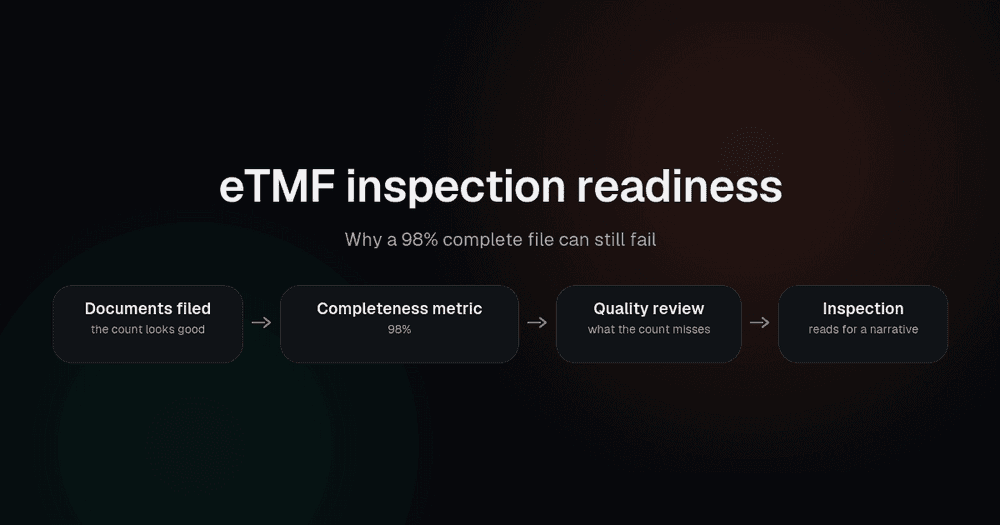
Completeness is a count of filled slots, not a measure of evidence. A trial master file can report 98% complete while containing unsigned drafts, superseded versions, and documents filed months after the activity they evidence. Inspections read for a coherent dated narrative, which a percentage cannot assess.
Completeness dashboards became standard because they are easy to produce and easy to report upward. They are genuinely useful for spotting whole categories that were never started. They are close to useless for predicting whether a file survives scrutiny.
This guide sets out the four things the metric cannot see, why filing timeliness is the one with no remedy, and a sampling-based quality review that finds problems while they are still fixable. It sits under which system owns which part of the study.
After reading this you will be able to:
- Explain to leadership why a high completeness score is not reassurance
- Run a quality review that samples by risk rather than counting slots
- Build an expected artifact list that can reveal what was never generated
- Read a set of documents as one timeline, the way an inspector does
Four Things the Count Cannot See
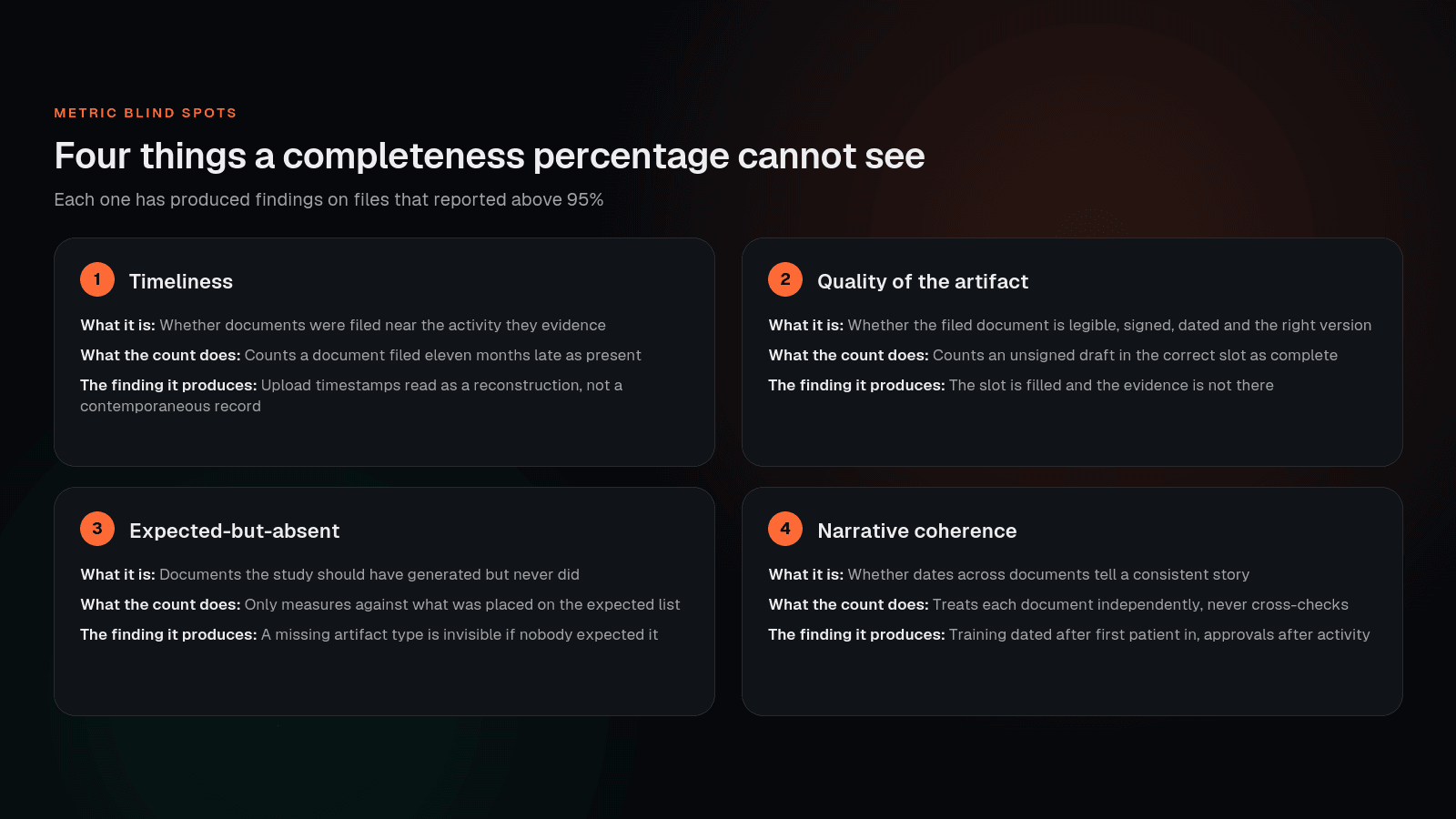
The fourth is the one that surprises teams most. Every other check treats a document as an object to be assessed on its own. An inspection reads documents against each other, looking for whether the dates form a possible sequence of events. Staff trained on a protocol version after they had already enrolled patients under it is not a missing document problem. Every artifact is present, signed and correctly filed, and the file still describes something that should not have happened.
Timeliness, the One With No Remedy
Most quality problems in a trial master file can be corrected. A missing signature can be obtained, a superseded version can be replaced, an illegible scan can be rescanned. Timeliness cannot.
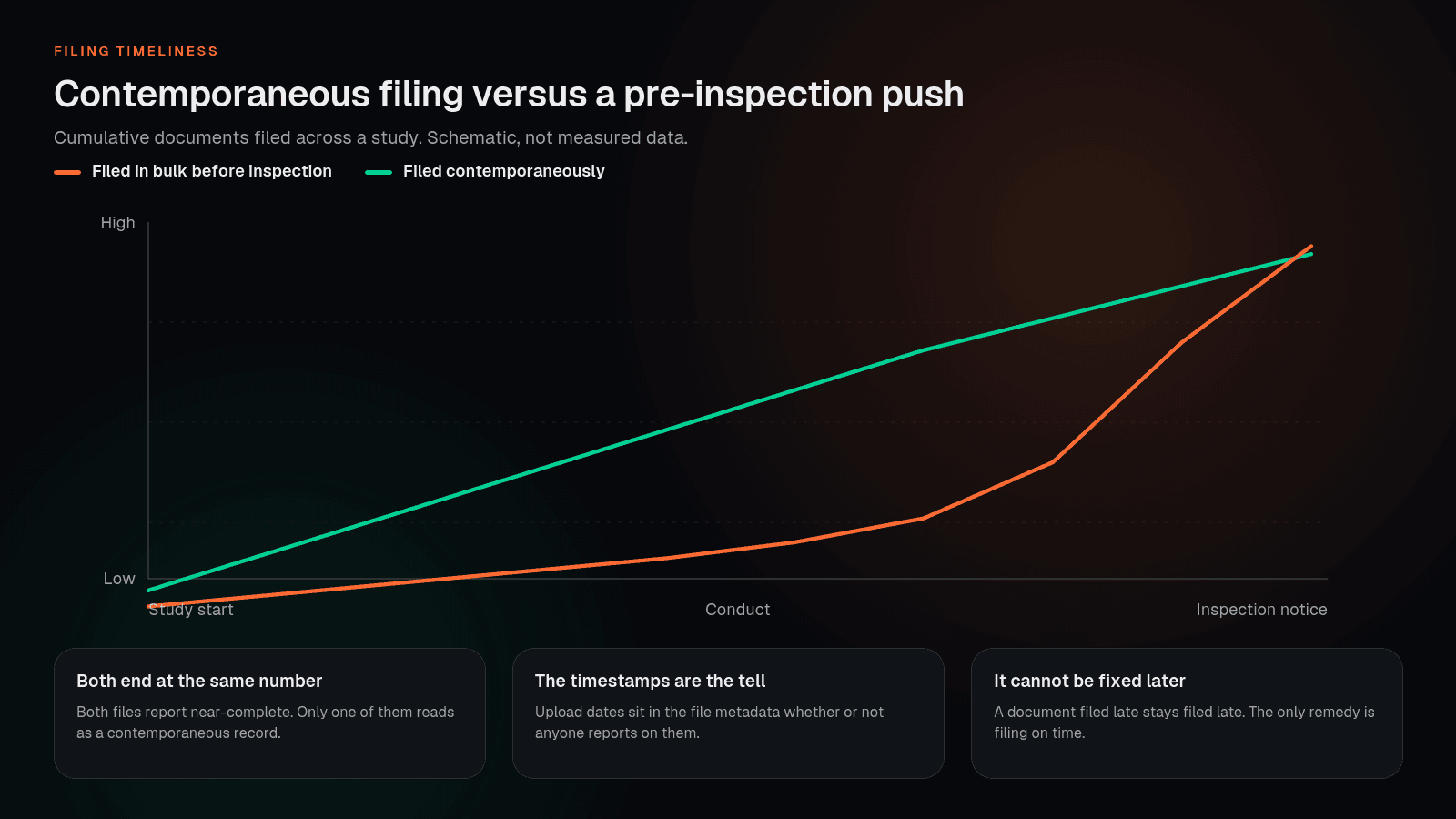
Both lines above end in the same place. Both files would report as near-complete on any dashboard. The difference is entirely in when documents arrived, and that difference is recorded in upload timestamps whether or not anyone chooses to report on it.
This is why the pre-inspection push is a false comfort. It produces a complete file and a metadata trail that says the file was assembled after the inspection was announced, which invites exactly the scrutiny it was meant to avoid.
Building an Expected List That Can Find Absences
A completeness metric measures against a list of expected artifacts. If the list is derived from what is already in the system, the metric can only ever tell you about things you already knew about.
Build the list instead from a reference model and the specific protocol, then mark every artifact type as expected, not applicable, or pending. The not-applicable entries matter as much as the others, because they turn an absence into a recorded decision with a reason attached. An inspector asking why a document type is missing is answered much better by a dated rationale than by a search.
Amendments generate new expected types, which is why the list needs re-running after each one rather than being built once at study start. That maintenance is also what keeps the boundary with the operational system clean, a split covered in which system owns which document.
A Quality Review That Samples
Opening every document in a large file is not realistic, which is often used as an argument for relying on the dashboard. Sampling resolves that.
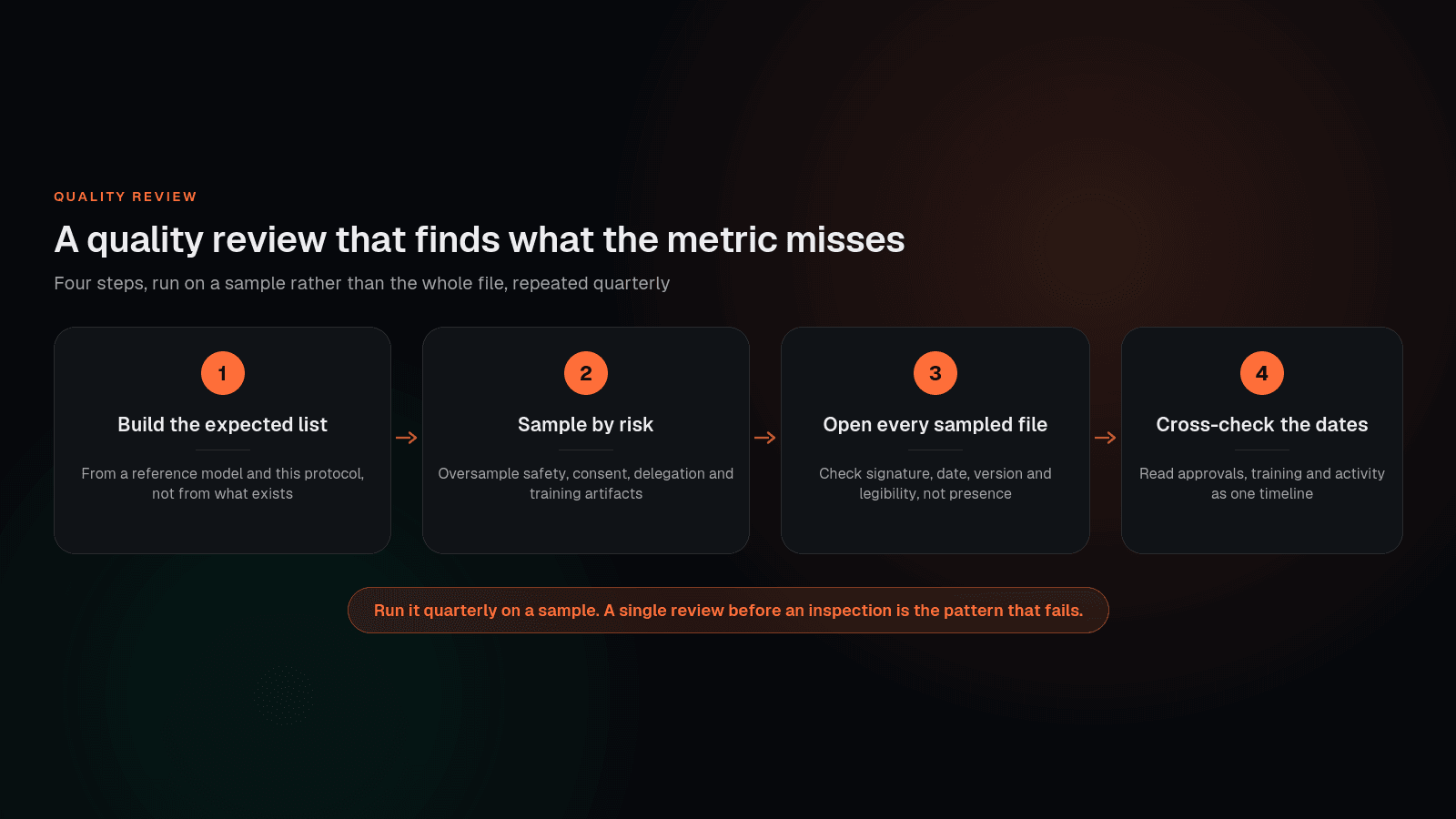
Oversample the artifact types that carry the most inspection weight: safety reporting, informed consent versions, delegation of authority, and training records. These are both the most likely to be examined and the most likely to have date problems, because they are generated by people under time pressure rather than by a system.
Then read the sample as a timeline rather than as a set. The cross-check is the step that finds narrative problems, and it is the step that cannot be automated by a completeness report.
The Findings That Recur
Across published inspection outcomes and audit reports, the same categories come up often enough to be worth checking first.
Delegation logs that were signed once at study start and never updated as staff joined or left, so activities appear to have been performed by people with no recorded authority. Training records that exist for the original protocol but not for subsequent amendments, leaving a gap between the version in force and the version staff were trained on. Consent form versions filed without a clear record of which version each participant actually signed under. And monitoring reports filed as drafts, unsigned, sometimes for visits that took place a year earlier.
None of these is exotic. All of them are invisible to a completeness count, because in every case the slot is filled. They are visible immediately to anyone who opens the documents and reads the dates, which is the entire argument for sampling.
Making It Survive Contact With a Live Study
A quarterly review only happens if someone owns it and it is short enough to keep happening. Two design choices make the difference.
First, name an owner who is not the person doing the filing, because self-review finds less. Second, keep the sample small enough to complete in a day. A review that takes a week gets postponed, and a postponed review becomes an annual review, which becomes a pre-inspection review, which is the pattern this is meant to avoid.
Track two numbers over time rather than one. Completeness still has a role as a coarse signal. Add median days between activity date and filing date, which is the number that actually predicts how the file will read.
Clinera eTMF is built around that review pattern rather than around a completeness dashboard, and clinical and R&D AI covers where automation helps with sampling and date cross-checking at scale.
References
- ICH E6(R3) Good Clinical Practice, trial master file expectations. International Council for Harmonisation, adopted 6 January 2025. www.ich.org
- TMF Reference Model. CDISC TMF Reference Model community. www.cdisc.org
- 21 CFR Part 11, Electronic Records; Electronic Signatures. US Code of Federal Regulations, Title 21, Part 11. www.ecfr.gov
- Annex 11, Computerised Systems. EudraLex Volume 4, Good Manufacturing Practice guidelines. health.ec.europa.eu
This guide describes process and regulatory expectations in general terms and is not legal or regulatory advice. Confirm the current version and applicability of any standard or guidance for your study and region.
Frequently Asked Questions
How can a 98% complete TMF fail an inspection?
Because completeness counts slots filled, and an inspector reads for evidence. A document can occupy the correct slot while being unsigned, undated, illegible, the wrong version, or filed eleven months after the activity it evidences. The metric scores all of those as present. Inspections also read across documents for a coherent timeline, and a percentage treats each artifact independently, so it never notices training dated after first patient in.
What do inspectors actually ask to see?
A narrative supported by dated evidence. Typically that means walking a specific thread: this protocol version was approved on this date, these staff were delegated these duties by this principal investigator, they were trained on this version before they performed these activities, and here are the signatures. The artifacts matter less individually than whether they line up into a consistent account when read together.
Does filing documents late actually matter if they are all there?
Yes, and it is one of the harder findings to argue with, because upload timestamps sit in the file metadata regardless of whether anyone reports on them. A file assembled in the weeks before an inspection may be complete and still read as reconstructed. There is no remediation for it either, since a document filed late stays filed late. The only fix is filing contemporaneously in the first place.
How do we find documents that should exist but never did?
Build the expected list from a reference model and your protocol rather than from what is already in the system, which is the step most teams skip. A completeness metric measures against the expected list it was given, so an artifact type nobody thought of is invisible to it. Marking the types that genuinely do not apply to this study is equally important, because then their absence is a recorded decision rather than a gap.
How often should a TMF quality review run?
Quarterly, on a risk-weighted sample, rather than once as an inspection approaches. A single pre-inspection review finds problems at the point when the cheapest fixes are no longer available, particularly anything related to timeliness. Sampling also makes the exercise sustainable: opening every document in a large file is not realistic, and oversampling safety, consent, delegation and training artifacts catches most of what matters.
Can Nirmitee Healthtech run a TMF quality review on our existing file?
Yes, and it works on whatever system the file currently sits in. The review builds an expected artifact list from your protocol and a reference model, samples by risk, opens the sampled documents to check signature, date, version and legibility, then cross-reads the dates as a single timeline. The output is a findings list ranked by what an inspector would reach first. Clinera eTMF is built around that review rather than around a completeness dashboard.