
Medical Affairs Operations: The Systems Behind Field Medical and MI

Medical affairs operations is the set of processes and systems that move scientific knowledge between a life sciences company and the clinical community: field insights coming in, medical information going out, engagement with experts, and review of scientific and promotional content. Most of its problems sit at four handoffs, where information is captured in one system and expected to be used by a team working in another.
Medical affairs has grown from a support function into one that shapes evidence plans, guideline conversations and how clinicians understand a product's data. Its operating model has not always kept up. Many teams still run on a CRM built for sales, a medical information system that does not talk to it, a review tool that holds approved claims nobody else can see, and a set of spreadsheets for experts and congresses.
This guide maps the four flows that run through the function, where each one breaks, the systems behind them, and how to measure whether they work. Each section links to a guide that goes deeper. The function itself is described on our medical affairs and evidence teams page.
After reading this you will be able to:
- Describe medical affairs operations as four flows with owners and handoffs
- Locate the break point in each flow in your own organization
- Assess whether your systems share the data the flows depend on
- Choose metrics that show effect rather than effort
The Guides in This Cluster
Start with the map, then the reasoning.
| The question it answers | Who it is for | Guide |
|---|---|---|
| Why do field insights stop at the CRM form? | Field medical leaders, insights leads | MSL insight capture, past the CRM form |
| Where does medical information turnaround go? | Medical information managers | Medical information request handling |
| How do we build a KOL list we can defend? | Medical leads, field medical | KOL identification and mapping without guesswork |
| Why does MLR review take so long? | Medical reviewers, content and brand teams | MLR review, where content gets stuck |
| How do we plan a congress around what we need to learn? | Medical leads, scientific communications | Congress planning for medical affairs teams |
| What should we measure instead of activity? | Heads of medical affairs | Medical affairs metrics that are not activity counts |
What Medical Affairs Operations Covers
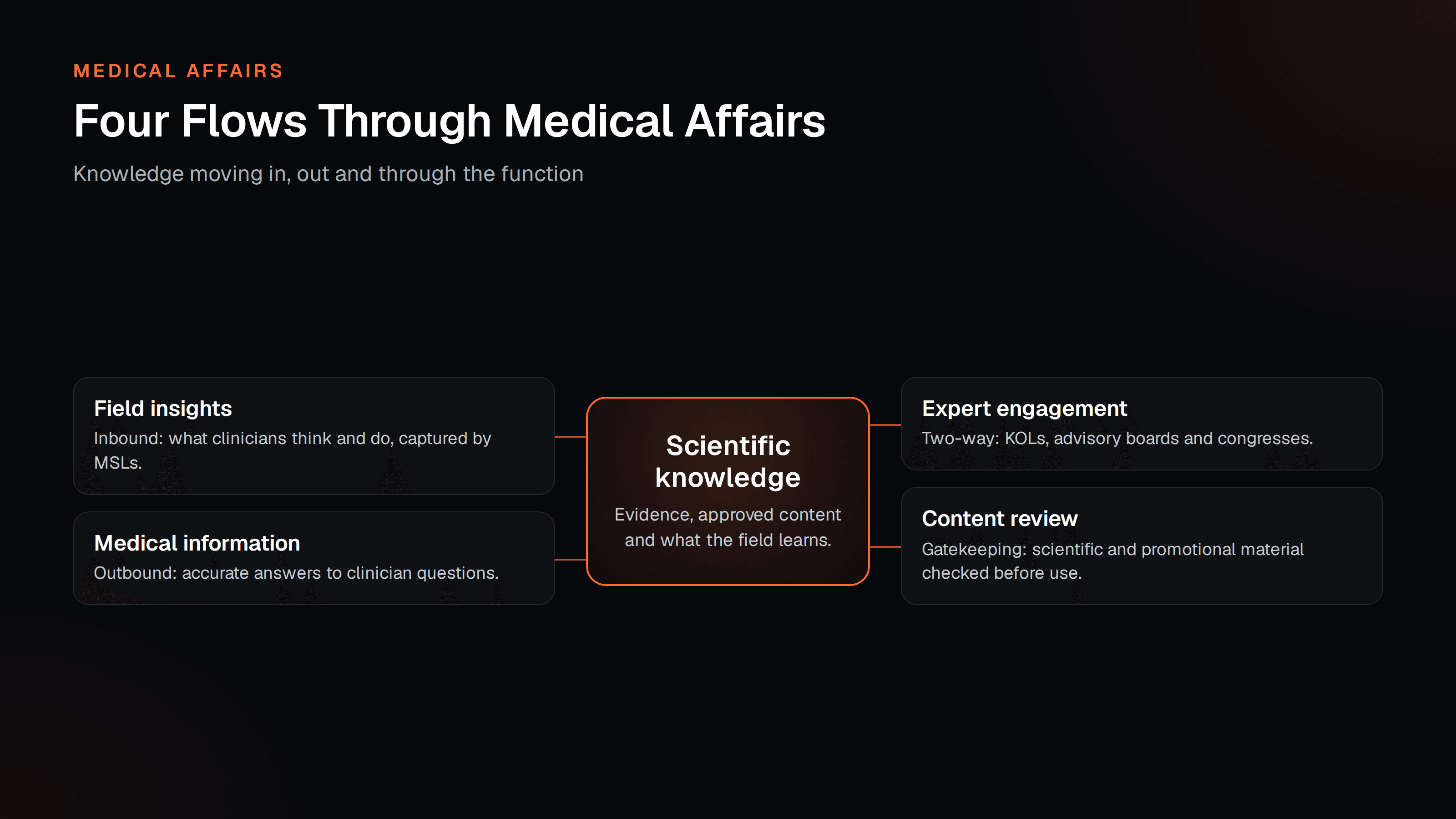
The work divides into four flows. Field insights move inward, from conversations between medical science liaisons and clinicians to the people who set medical strategy. Medical information moves outward, as accurate, non-promotional answers to clinicians' questions. Expert engagement runs both ways, through advisory boards, scientific exchange and congresses. Content review is the gate through which scientific and promotional material passes before use.
Evidence generation, publications and medical education sit alongside these flows and depend on them. An evidence plan is only as good as the insight and medical information data that tell it where the gaps are.
Flow One: Field Insights
MSLs hear things no dataset contains: how clinicians select patients, how they read a subgroup analysis, what worries them about a safety signal. Most organizations capture this, and most lose it, because insights are entered as free text into broad categories and no one owns the themes. The fix is structural: key insight questions in place of topic lists, a short quality bar at entry, and a review cadence that ends in owned actions. The full approach is in MSL insight capture.
Flow Two: Medical Information
Medical information answers clinicians' questions, including unsolicited questions about unapproved uses, and screens every request for adverse events. Its turnaround is usually lost in searching for an approved answer rather than writing one. Question-indexed standard response documents with approval status and expiry, and routing by tier at intake, change the number. See medical information request handling.
Flow Three: Expert Engagement
Expert engagement depends on knowing who matters for which purpose. Lists built from reputation drift toward the same small group; lists built from publication, trial, guideline and digital signals, weighted by objective and validated by the field, can be defended. Congresses concentrate this work into a few days, and plans built backward from the questions the team needs answered produce more than agenda-driven ones. See KOL identification and mapping and congress planning. The KOL intelligence use case shows the data model in practice.
Flow Four: Content Review
Medical, legal and regulatory review protects accuracy and compliance, and is often blamed for delay. The time usually goes on repeated rounds caused by unsupported claims, unlinked references and vague comments. A claims library, claim-level reference linking and reason-coded returns cut the rounds. Medical content and promotional content should follow separate paths. See MLR review.
The Four Places the Flow Breaks
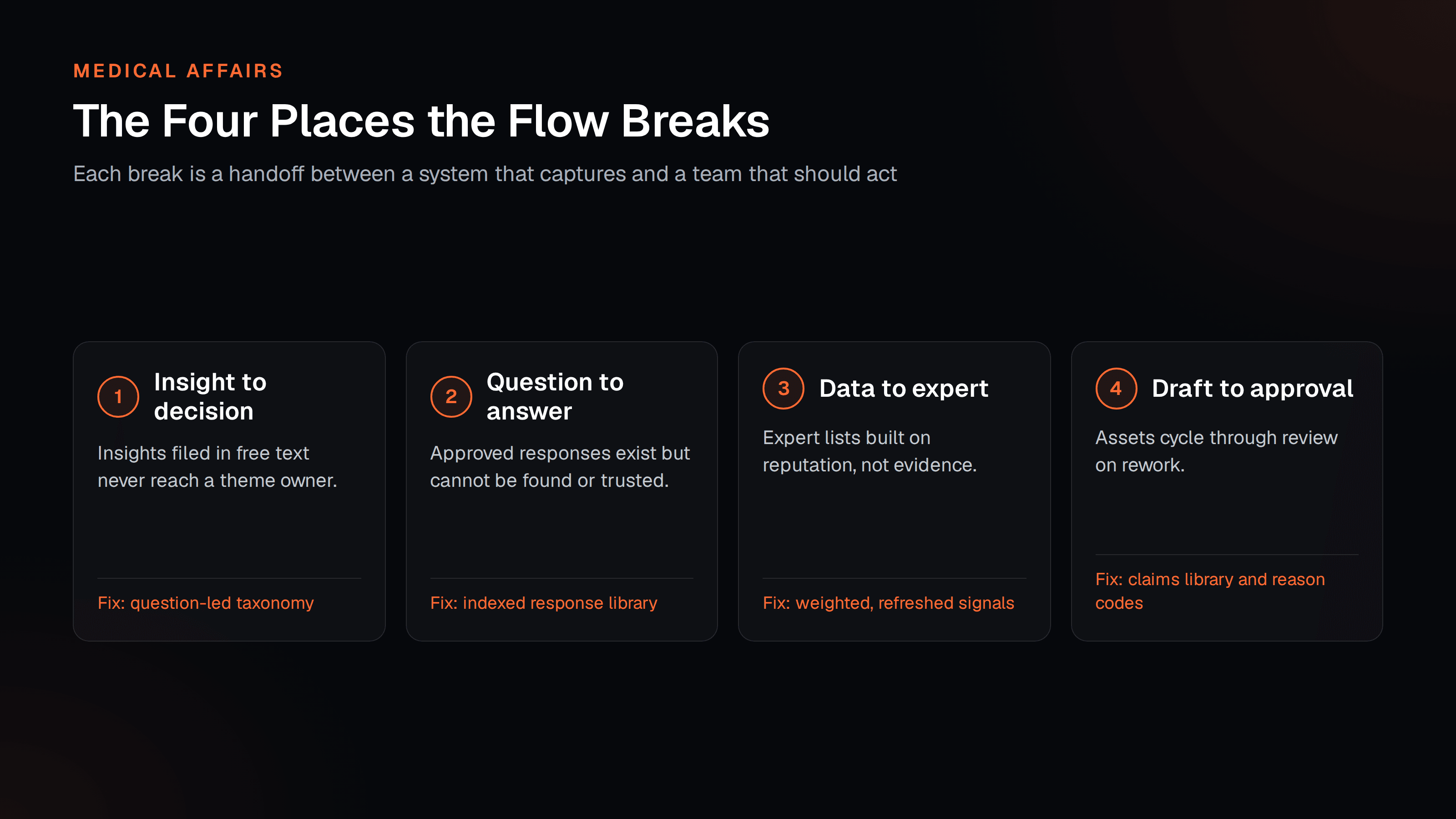
The pattern across all four is the same. Information is captured in a form that suits the system holding it, not the team that needs to act on it. That is why adding people to the team that owns each flow rarely helps: the problem is at the handoff, not inside the team.
The flows also feed each other. Recurring medical information questions are insights. Insights identify experts. Congress conversations generate medical information requests. Approved medical responses are the best source of accurate wording for review. An operating model that treats them separately loses these connections.
The Technology Stack
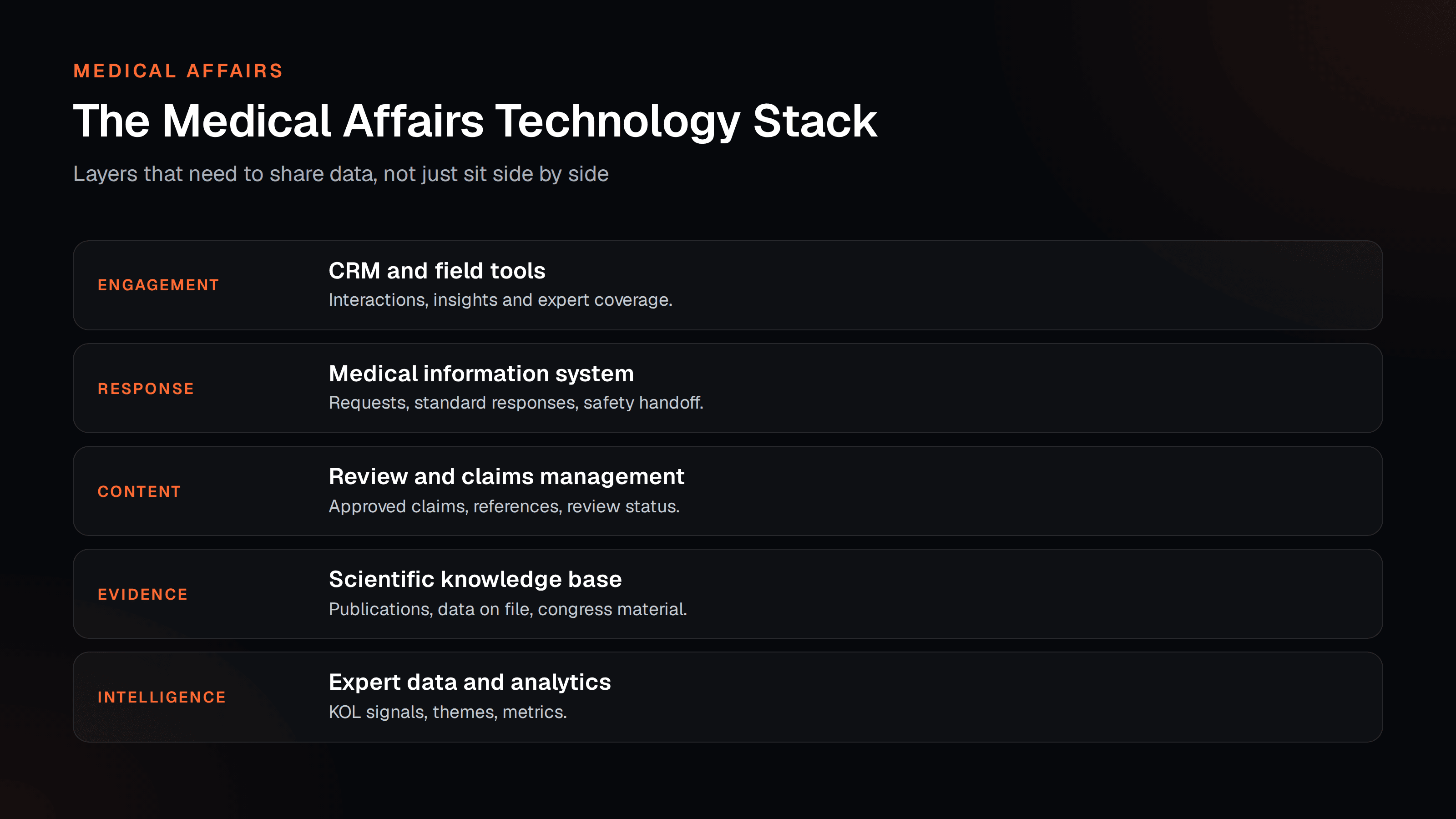
Most medical affairs stacks have all five layers. Fewer have them sharing data. The practical test is whether a person in one flow can see what the others know: whether an MSL preparing for a meeting can see the expert's recent medical information questions, or whether a reviewer can see that a claim matches an approved response.
AI is most useful where it bridges layers: retrieval across approved content with citations and permission controls, clustering insights into candidate themes for medical review, and checking drafts against the claims library before submission. In each case a qualified person keeps the decision. Our medical affairs AI capability describes how we build these, and Simulex uses approved messaging and recurring clinician questions to help field teams practice realistic scientific and clinical conversations.
Measuring Whether It Works
If the scorecard counts interactions, meetings and sessions attended, it measures effort. Metrics that show effect include insights that led to action, evidence gaps closed, medical information quality by tier, coverage of priority experts, delivery of the scientific plan and clinician perception. Each needs records many teams do not yet keep, which is a useful indicator of where to start. See medical affairs metrics beyond activity counts.
Where to Start
Pick the flow where the break is most visible and fix the handoff before the tooling.
- Write five to eight key insight questions and attach an owner to each
- Index standard response documents by question and add approval status and expiry
- Document the criteria behind the expert list and set a refresh cadence
- Count review rounds per asset and classify return reasons
- Set congress objectives as questions before the abstract deadlines
- Replace one activity metric with an outcome metric and build the record behind it
References
- Medical Affairs Professional Society (MAPS), standards and resources for medical affairs practice. medicalaffairs.org
- Communications From Firms to Health Care Providers Regarding Scientific Information on Unapproved Uses of Approved/Cleared Medical Products: Questions and Answers. US Food and Drug Administration, final guidance, January 2025. www.fda.gov
- Responding to Unsolicited Requests for Off-Label Information About Prescription Drugs and Medical Devices. US Food and Drug Administration, draft guidance, December 2011. www.fda.gov
- PhRMA Code on Interactions with Health Care Professionals. Pharmaceutical Research and Manufacturers of America. www.phrma.org
- Open Payments. Centers for Medicare and Medicaid Services. www.cms.gov
This guide describes process and regulatory expectations in general terms and is not legal or regulatory advice. Confirm the current version and applicability of any code or guidance for your products and markets.
Frequently Asked Questions
What is medical affairs operations?
Medical affairs operations covers the processes, systems and governance that let a medical affairs function work: capturing field insights, handling medical information requests, managing expert engagement and congresses, reviewing scientific and promotional content, and measuring performance. It sits between the scientific work of the function and the tools and data that support it.
What systems does a medical affairs team use?
Typical systems include a CRM or field medical platform for interactions and insights, a medical information system for requests and standard responses, a content review and claims management tool, a scientific knowledge base for publications and data on file, and expert data and analytics tools. The most common problem is that these layers do not share data.
How is medical affairs different from commercial?
Medical affairs engages in non-promotional scientific exchange, answers clinicians' questions accurately and in a balanced way, supports evidence generation and gathers insight. Commercial teams promote approved uses of products. The separation matters for compliance and credibility, so medical teams should not carry sales targets and their materials follow a non-promotional review path.
Where do medical affairs workflows usually break?
Most problems appear at handoffs: insights that never reach a theme owner, approved answers that cannot be found quickly, expert lists built on reputation rather than evidence, and content that cycles through review because of rework. In each case information is captured in a form that suits the system holding it, not the team that needs to act.
How can AI help medical affairs teams?
AI is most useful for retrieving approved scientific content with citations and permission controls, grouping field insights into candidate themes, drafting adapted responses for specialist review, enriching expert profiles and checking drafts against approved claims before review. In regulated medical work a qualified person should approve every output that reaches a clinician or a decision.
How does Nirmitee Healthtech work with medical affairs teams?
We build medical affairs systems around the four flows: insight capture and synthesis, medical information retrieval, KOL intelligence and content operations, with source citations, permissions and expert review built in. Simulex supports field readiness with practice conversations grounded in approved messaging. Our medical affairs AI capability page has more detail.