
MLR Review: Where Medical and Promotional Content Gets Stuck

MLR cycles stretch because assets go round more than once, not because each review is slow. Most extra rounds are triggered by unsupported claims, missing or mismatched references, and comments too vague to act on. Reduce the rounds per asset with a pre-approved claims library, references linked at the claim level, a pre-submission check and rejection reasons that name the fix, and the cycle time follows.
Medical, legal and regulatory review exists to make sure content is accurate, balanced, substantiated and lawful. Nobody disputes that purpose. The frustration is with how long it takes, and the usual response is to ask reviewers to move faster. That rarely works, because reviewers are seldom the bottleneck. The time sits in queues between rounds and in rework.
This guide looks at where MLR time goes, the structural fixes that cut rounds, and how to route review by risk. It applies to promotional content and to scientific material produced by medical affairs, which follows a related but distinct path. It is part of the medical affairs operations guide.
After reading this you will be able to:
- Measure MLR in rounds per asset rather than days alone
- Build a claims library that removes repeated substantiation debates
- Write rejection reasons that authors can act on first time
- Route assets by risk with criteria agreed in advance
What MLR Review Is For
Each reviewer looks for something different, and returns content for different reasons.
| Reviewer | What they check | Common reason to return |
|---|---|---|
| Medical | Scientific accuracy, balance, fair representation of data | Claim overstates the evidence or omits a relevant limitation |
| Legal | Legal exposure, intellectual property, contracts, privacy | Comparative or absolute language, third-party material without rights |
| Regulatory | Consistency with labeling and advertising rules | Missing fair balance or required safety information, off-label implication |
In the US, prescription drug advertising rules are set out in 21 CFR Part 202, and promotional materials for approved drugs are submitted to FDA at first use under 21 CFR 314.81. In the UK, the ABPI Code requires promotional material to be certified by designated signatories. Other markets have their own codes, which is why global content often goes through local review again.
Where Cycle Time Actually Goes
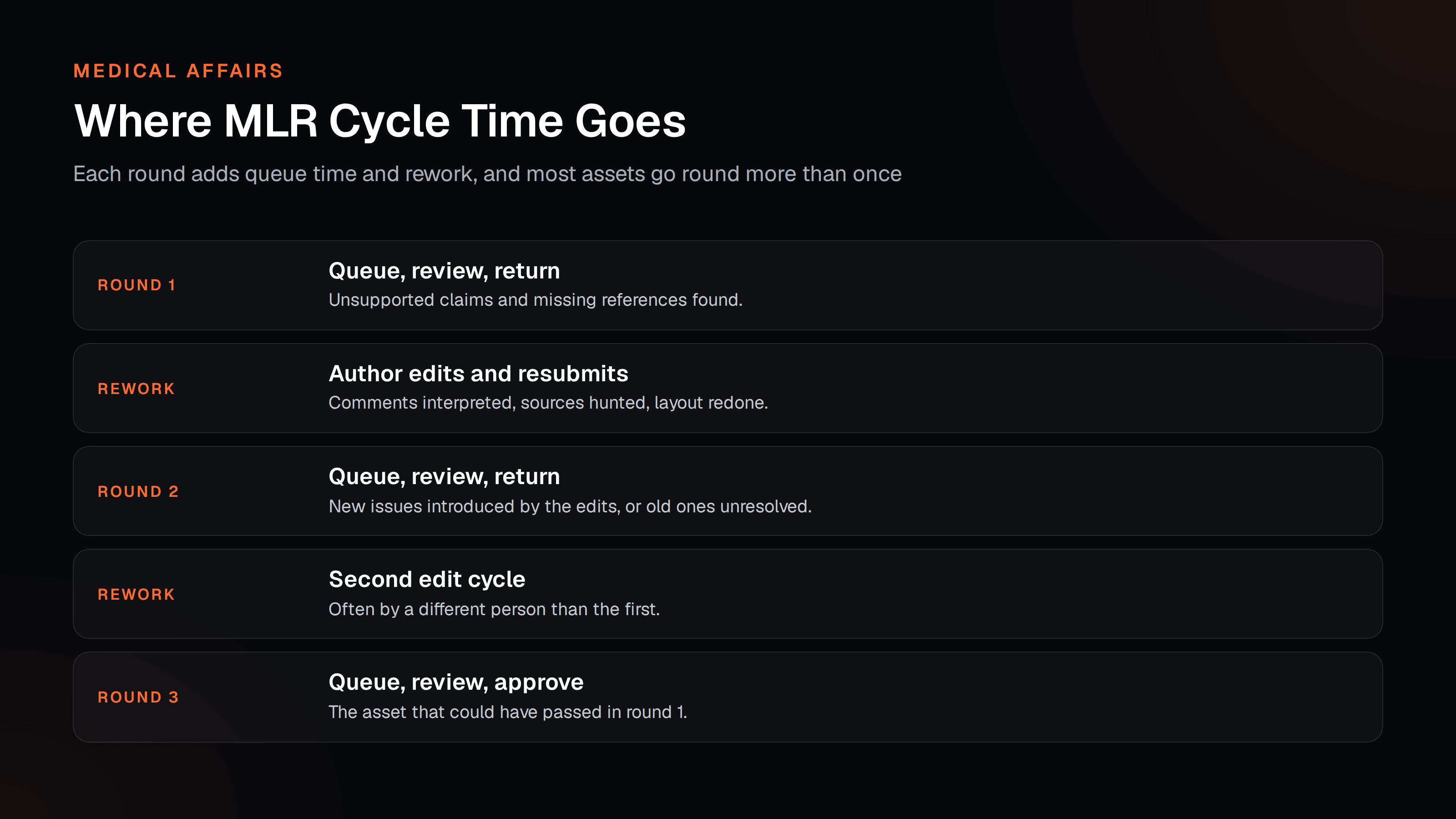
Two numbers explain most MLR performance: rounds per asset and time in queue per round. If an average asset goes through three rounds and waits several days in the queue each time, the elapsed time is dominated by waiting and rework, not reviewing. Cutting one round saves more than any change to review speed.
Most systems already record enough to measure this. Count submissions per asset, classify the reasons each was returned, and the pattern usually shows that a small number of reasons cause most returns.
The Claims Library
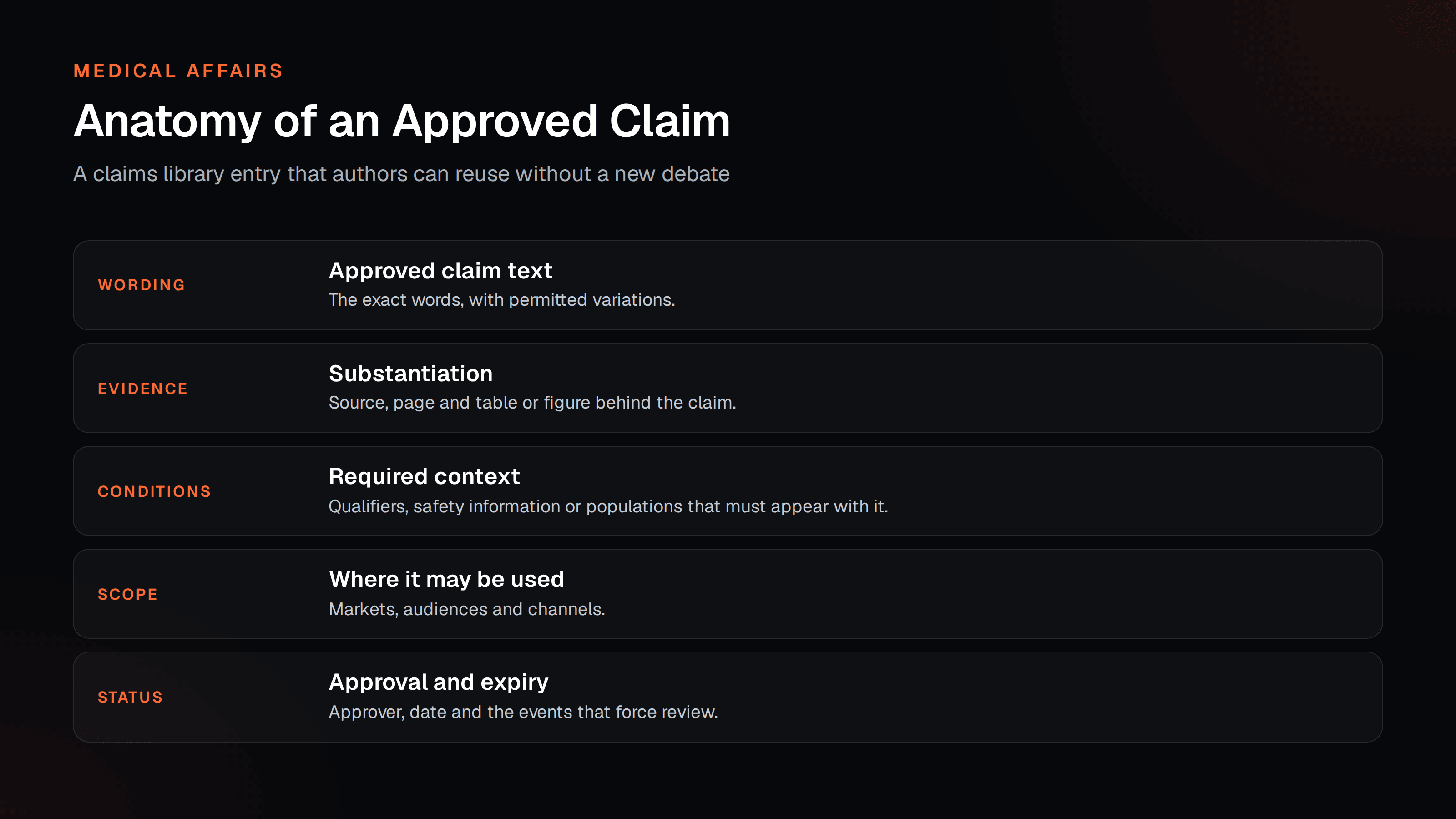
Without a claims library, every asset re-argues the same statements. An author writes a claim, the medical reviewer asks for support, the author finds a reference, the reviewer disagrees with the wording, and the cycle repeats on the next asset that uses a similar claim.
A library of approved claims, each with its substantiation, required context, scope and expiry, moves that debate upstream and settles it once. Authors build from approved claims. Reviewers then focus on whether the claim is used in the right context, with the right qualifiers, which is a faster and more useful review.
Reference Linking at the Claim Level
A reference list at the end of an asset is not substantiation. The reviewer needs to see which source supports which statement, and where in that source. Linking each claim to the page, table or figure behind it, with the passage highlighted, removes one of the most common return reasons. It also makes later updates easier, because when a source changes, every asset using it can be found.
Rejection Reasons That Name the Fix
A comment such as "please revise" or "not supported" starts a guessing game. Comments that name the problem and the fix end it: "the claim states superiority; the cited trial supports non-inferiority, use approved claim 14 instead." A short set of standard reason codes, each with an expected action, also makes the return data usable, because reasons can be counted and the most frequent ones fixed at the source through templates, training or the claims library.
A pre-submission check by the author, against the same reason codes, catches many issues before the asset enters the queue.
Tiering Review by Risk
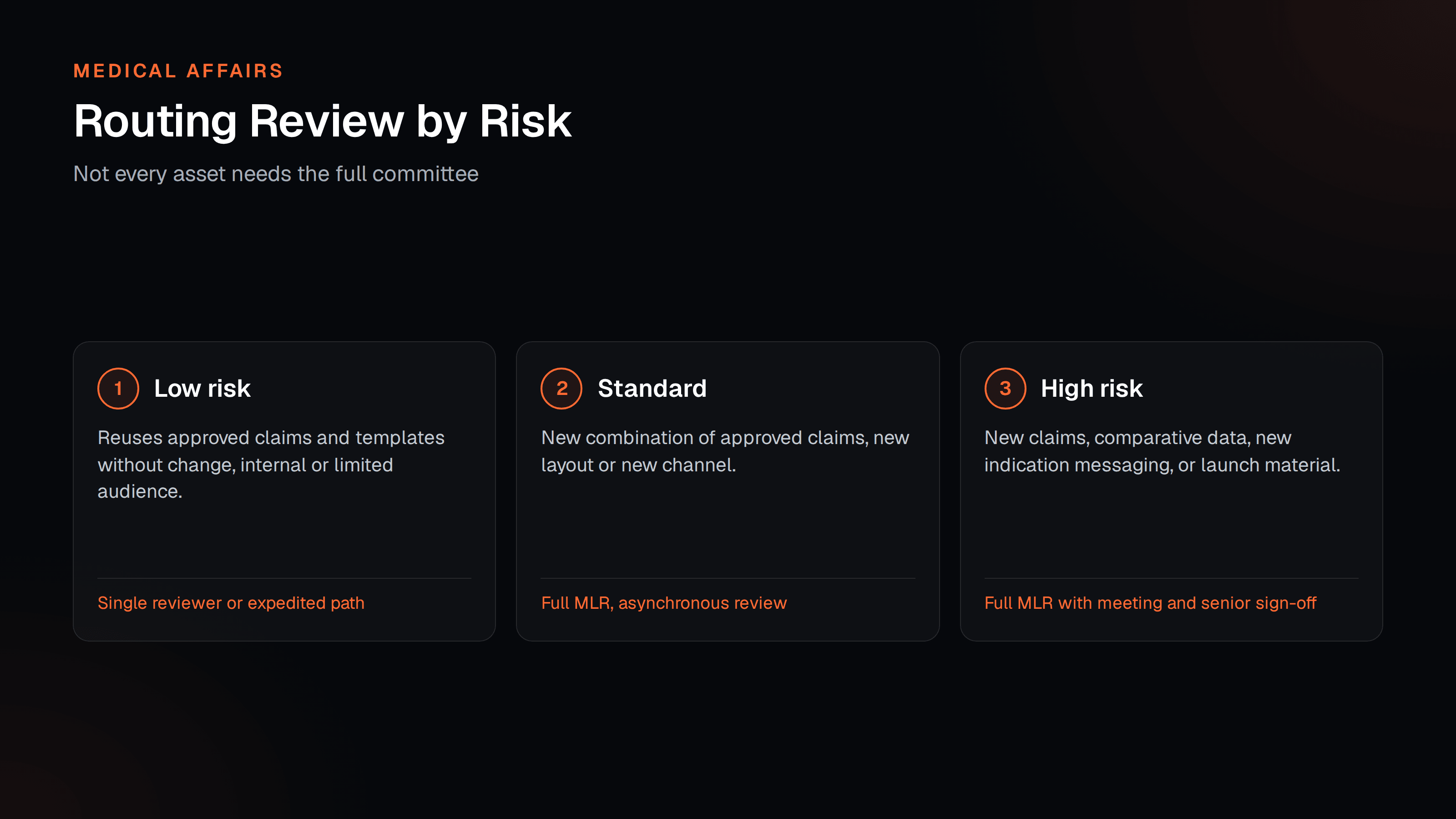
Sending every asset through the same full process treats a reformatted approved leaflet the same as new launch messaging. Risk-based routing reserves committee time for material that warrants it. The criteria must be agreed with legal and regulatory and documented, and they must be conservative where claims, comparisons or safety information are new.
Medical and Promotional Content Are Not the Same Queue
Scientific material produced by medical affairs, such as standard response documents, congress materials and scientific slide decks, is non-promotional and should be reviewed against that purpose. Mixing it into the promotional queue slows it down and risks importing promotional framing. Proactive scientific communication on unapproved uses has its own expectations, set out in FDA's January 2025 final guidance on such communications.
The two queues still share infrastructure. The same evidence library and reference links can support both, and approved medical responses, covered in medical information request handling, are often the best source of accurate wording.
Measuring the Process
- Rounds per asset, by asset type
- First-pass approval rate
- Return reasons by code, trended monthly
- Time in queue versus time in review
- Assets in circulation using expired claims or sources
These measures show where to act. A high rate of reference-related returns points to linking; repeated wording disputes point to the claims library. Wider measures for the function are covered in medical affairs metrics beyond activity counts.
Where Technology Helps
Software can check a draft against the claims library, flag statements without a linked reference, suggest the matching approved claim, and confirm that required safety information is present. These checks are most useful before submission, where they prevent rounds rather than speed them up. Final judgment stays with the reviewers. Our medical affairs AI capability and commercial excellence AI capability cover content operations built on approved evidence and review status.
A Checklist for Fewer MLR Rounds
- Rounds per asset measured and reported
- Approved claims library with substantiation, context, scope and expiry
- References linked to the passage behind each claim
- Standard reason codes with an expected fix for each
- Author pre-submission check against the same codes
- Risk-based routing with written criteria agreed by legal and regulatory
- Separate review path for non-promotional medical content
- Expiry tracking that finds every asset using a changed source
References
- 21 CFR Part 202, Prescription drug advertising. Electronic Code of Federal Regulations. www.ecfr.gov
- 21 CFR 314.81, Other postmarketing reports, including submission of promotional materials. Electronic Code of Federal Regulations. www.ecfr.gov
- ABPI Code of Practice for the Pharmaceutical Industry. Prescription Medicines Code of Practice Authority. www.pmcpa.org.uk
- Communications From Firms to Health Care Providers Regarding Scientific Information on Unapproved Uses of Approved/Cleared Medical Products: Questions and Answers. US Food and Drug Administration, final guidance, January 2025. www.fda.gov
- EFPIA Code of Practice. European Federation of Pharmaceutical Industries and Associations. www.efpia.eu
This guide describes process and regulatory expectations in general terms and is not legal or regulatory advice. Confirm the current version and applicability of any code or guidance for your products and markets.
Frequently Asked Questions
What does MLR stand for in pharma?
MLR stands for medical, legal and regulatory review. It is the process a pharmaceutical or medical device company uses to check that promotional and many non-promotional materials are scientifically accurate, balanced, substantiated, legally sound and consistent with labeling and applicable regulations or codes before they are used. Some companies call it PRC, for promotional review committee.
Why does MLR review take so long?
Usually because assets go through several rounds, each with time waiting in the queue and time spent on rework. Common causes of extra rounds are claims without adequate support, references that are missing or do not match the statement, and comments too vague to act on. Reducing rounds per asset generally shortens cycle time more than asking reviewers to work faster.
What is a claims library?
A claims library is a managed set of pre-approved statements about a product, each held with its supporting evidence, required qualifiers or safety context, permitted markets and channels, and an approval and expiry status. Authors build content from approved claims, so reviewers check how a claim is used rather than re-substantiating it every time.
Can some materials skip full MLR review?
Many companies use risk-based routing so that low-risk items, such as reformatted material that reuses approved claims unchanged, follow an expedited path, while new claims, comparative content and launch materials receive full review. The criteria should be documented and agreed with legal and regulatory, and local regulations or codes may limit what can be expedited.
Do medical affairs materials go through MLR?
Medical affairs materials such as standard response documents, scientific slide decks and congress content are usually reviewed, but against a non-promotional purpose and often through a separate medical review path. Keeping them apart from the promotional queue helps preserve their scientific character and avoids delays caused by promotional review priorities.
How does Nirmitee Healthtech approach MLR workflows?
We build pre-submission checks against approved claims, claim-level reference linking and reason-coded review data, so authors fix common issues before content enters the queue and teams can see why assets are returned. Reviewers keep full control of decisions. The approach is covered on our medical affairs and commercial excellence AI capability pages.