
Medical Affairs Metrics That Are Not Activity Counts

Interaction counts measure effort, not effect. Medical affairs metrics that survive a leadership review tie activity to an outcome: insights that led to action, evidence gaps closed, medical information quality, depth of exchange with priority experts, delivery of the scientific plan, and clinician perception. Each needs specific data behind it, which is why so many teams fall back to counting calls.
Medical affairs has a measurement problem that commercial functions do not. Its purpose is non-promotional, so it cannot be measured on sales, and many of its effects take years to show. The easiest numbers to produce are activity counts: interactions per MSL, meetings held, sessions attended. They are also the easiest to dismiss, because they say nothing about whether the work mattered.
This guide sets out six metrics that connect to outcomes, the data each requires, how to keep them appropriate for a non-promotional function, and how to build a scorecard leadership will read. It is part of the medical affairs operations guide.
After reading this you will be able to:
- Explain why activity counts fail as performance measures
- Choose metrics that connect medical work to outcomes
- Identify the data each metric needs before committing to it
- Build a short scorecard with definitions and owners
Why Activity Counts Persist
Activity counts persist because the data already exists. Every interaction is logged in the CRM, so the number is free. Outcome metrics need records that many teams do not keep: which insights led to which decisions, which evidence gaps were closed, whether a response answered the question. The way out is to build those records, not to find a cleverer way to present activity.
There is also a risk in the wrong metrics. Targets on interaction volume push field teams toward short, frequent contacts with accessible clinicians, which is the opposite of substantive scientific exchange.
Six Metrics That Hold Up
| Metric | What it shows | Common trap |
|---|---|---|
| Insight to action | Whether field insight changes what the function does | Counting insights submitted instead of actions taken |
| Evidence gap closure | Progress on the questions current data cannot answer | No register of gaps, so closure cannot be shown |
| Medical information quality | Speed and accuracy of responses to clinicians | One blended turnaround figure across all request types |
| Priority expert coverage | Whether exchange reaches the right experts with depth | Counting contacts with anyone, rather than priority experts |
| Scientific plan delivery | Publications, congress presence and materials delivered as planned | Counting outputs without checking they were planned |
| External perception | How clinicians rate the credibility and usefulness of medical engagement | Unstructured anecdotes in place of consistent feedback |
Activity, Output, Outcome

Activity still has a place as context. A theme with no supporting interactions is not credible, and coverage of priority experts depends on interactions happening. The problem is reporting activity as if it were performance. A useful scorecard shows activity only where it explains an output or outcome.
The Data Each Metric Needs
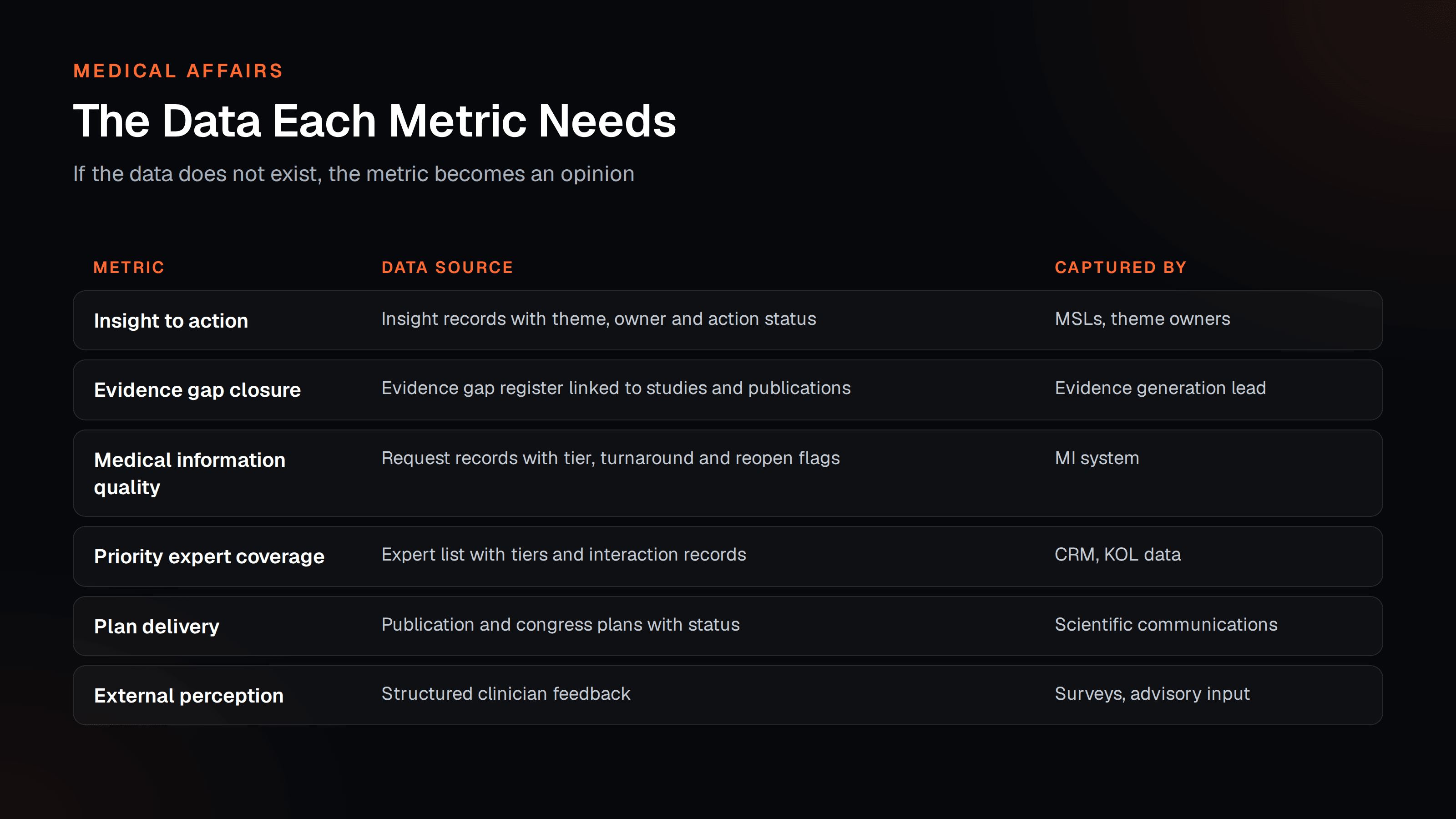
Most of these records come from processes covered elsewhere in this cluster. Insight to action depends on the theme ownership described in MSL insight capture. Medical information quality relies on tiered request data, covered in medical information request handling. Priority expert coverage needs a defensible expert list, covered in KOL identification and mapping. Congress outcomes come from the action tracking in congress planning.
Keeping Metrics Non-Promotional
Medical affairs metrics must not drift toward sales measures. MSL objectives and incentives should not be tied to prescribing, product sales or commercial targets in a territory, and expert engagement should rest on scientific need. Industry codes such as the PhRMA Code set expectations on interactions with health care professionals, and enforcement interest in arrangements that may induce prescribing, illustrated by the HHS Office of Inspector General's 2020 Special Fraud Alert on speaker programs, makes the point concrete.
That does not mean medical affairs cannot show value. It means the value is expressed in scientific terms: better evidence, better answers, better understanding of practice.
Building the Scorecard
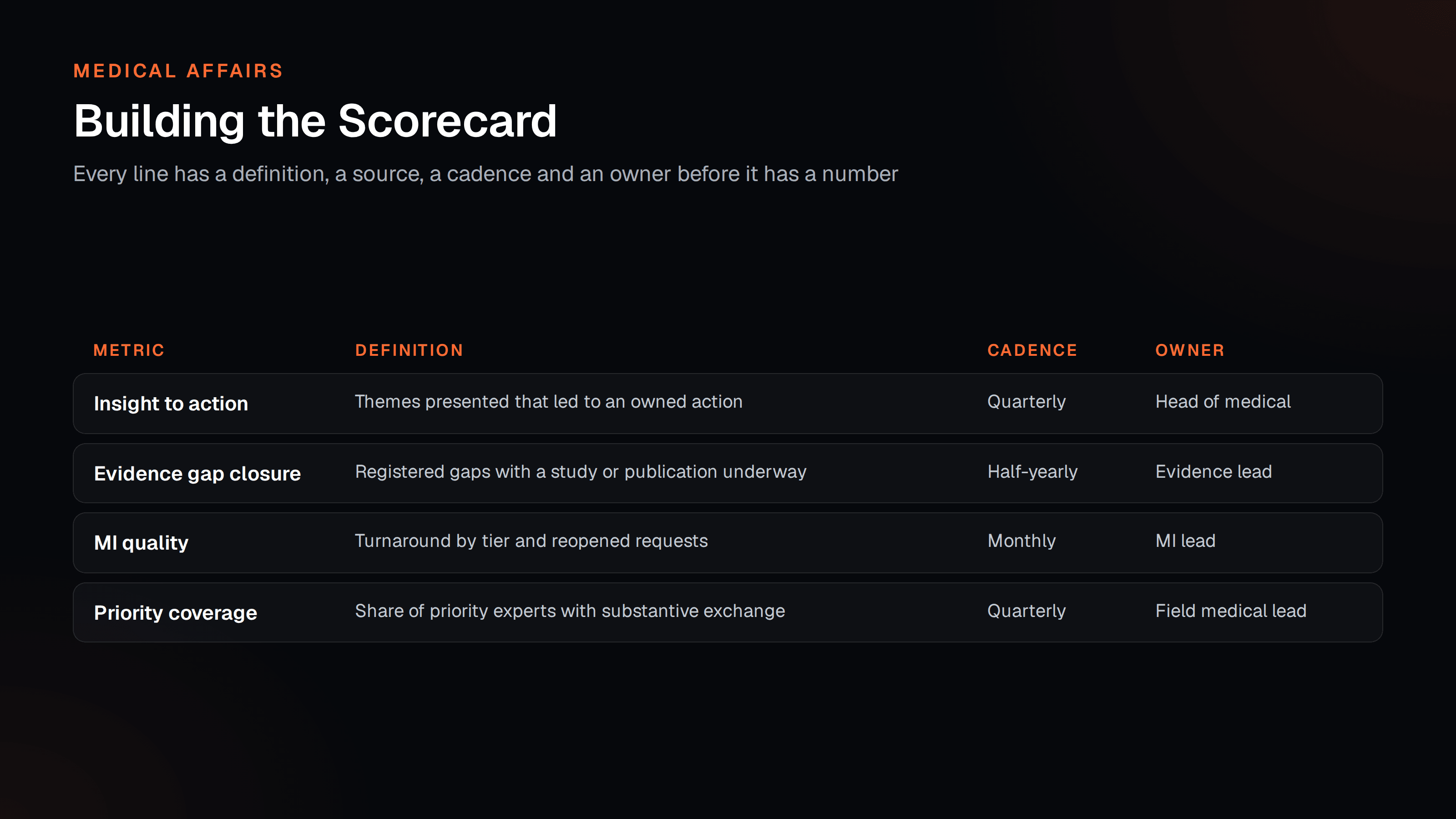
Start small. Four to six metrics, each with a written definition, a data source, a reporting cadence and an owner, will be read. Twenty metrics will be skimmed. Agree the definitions before the first report, because changing them later makes trends meaningless.
Expect the first quarter's numbers to be incomplete. If insight records have not carried an owner or action status, insight to action cannot be calculated until they do. That gap is itself useful: it shows which processes need to change before the function can demonstrate its effect.
Reporting to Leadership
Numbers alone rarely persuade. Pair each metric with one or two concrete examples: a theme that led to a new study, a recurring question that produced a new standard response, an expert identified at a congress who now advises on a program. Professional bodies such as the Medical Affairs Professional Society publish material on demonstrating medical affairs value that can help frame the discussion internally.
Our medical affairs AI capability includes reporting built on these records, so that metrics come from the work itself rather than from a separate data entry exercise.
A Checklist for Medical Affairs Metrics
- Four to six metrics, at least half of them outcome measures
- A written definition, source, cadence and owner for each
- Insight records that carry theme, owner and action status
- An evidence gap register linked to studies and publications
- Medical information data reported by tier
- Priority expert list used as the denominator for coverage
- No metric or incentive linked to prescribing or sales
- Each metric paired with a concrete example in reports
References
- Medical Affairs Professional Society (MAPS), standards and resources for medical affairs practice. medicalaffairs.org
- PhRMA Code on Interactions with Health Care Professionals. Pharmaceutical Research and Manufacturers of America. www.phrma.org
- Special Fraud Alert: Speaker Programs. HHS Office of Inspector General, November 16, 2020, republished in the Federal Register, August 23, 2022. www.federalregister.gov
- EFPIA Code of Practice. European Federation of Pharmaceutical Industries and Associations. www.efpia.eu
This guide describes process and regulatory expectations in general terms and is not legal or regulatory advice. Confirm the current version and applicability of any code or guidance for your products and markets.
Frequently Asked Questions
What KPIs should MSLs be measured on?
Useful MSL measures focus on quality and effect: insights submitted that were tied to key questions and led to action, substantive exchange with priority experts, follow-up on evidence questions, and contribution to evidence generation. Interaction counts can provide context but are weak as targets, because they encourage frequent, short contacts rather than substantive scientific exchange.
Why are activity metrics a problem in medical affairs?
They measure effort rather than effect and are easy to inflate. Targets on interaction volume can push teams toward accessible clinicians and brief contacts, which does little for scientific exchange. They also make it hard to defend the function's budget, because they show what the team did without showing what changed as a result.
Can medical affairs be measured on sales?
Medical affairs should not be measured on sales or prescribing, and MSL incentives should not be tied to commercial targets. The function is non-promotional, and linking it to sales outcomes undermines its credibility and creates compliance risk under industry codes and anti-kickback considerations. Value should be shown in scientific terms such as evidence, response quality and insight.
How do you measure the quality of medical insights?
Track how many insights were tied to a current key question, grouped into themes, presented with an owner, and led to an action such as a study, a new standard response or a training change. Quality can also be checked through triage, for example the share of entries that meet the agreed fields. Raw insight counts say little on their own.
How many metrics should a medical affairs scorecard have?
Four to six is a practical number for leadership reporting, with at least half measuring outputs or outcomes rather than activity. Each should have a written definition, a data source, a reporting cadence and an owner. Larger scorecards tend to be skimmed and drift back toward activity counts because those are easiest to fill.
How does Nirmitee Healthtech help with medical affairs measurement?
We build the underlying records, such as insight themes with owners, tiered medical information data and expert coverage, so metrics come from the work rather than separate reporting. Dashboards then show outcomes alongside the activity that explains them. More detail is on our medical affairs AI capability page.