
MSL Insight Capture: Why Field Insights Stop at the CRM Form

MSL insight capture fails at the taxonomy layer, not in the field. Liaisons hear useful things and record them, but into free-text boxes and category lists too broad to aggregate, so nothing reaches the people who could act on it. A workable insight process fixes the structure first: a short, question-led taxonomy, a quality bar at entry, a fixed review cadence, and a named owner for every theme.
Most medical affairs leaders can point to the insight database. Fewer can name a decision it changed last quarter. That gap is rarely about effort. Medical science liaisons spend a meaningful part of each week on documentation, and much of what they write is genuinely new: a shift in how a specialty sequences therapy, a recurring safety question, a misreading of a subgroup analysis.
The problem is what happens after the form is saved. This guide covers what counts as an insight, where capture breaks, how to build a taxonomy that aggregates, and the review cadence that turns single observations into decisions. It sits under the medical affairs operations guide, which maps how insights connect to medical information, expert engagement and content review.
After reading this you will be able to:
- Separate insights from activity notes so the database holds what it should
- Rebuild a category list around the questions the medical plan needs answered
- Set a quality bar MSLs can meet in a few minutes per entry
- Run a review cadence that ends in owned actions and feedback to the field
What Counts as an Insight
Insight databases fill with material that is not insight, and the noise hides the signal. A useful working definition separates three things.
| Type | Example | Where it belongs |
|---|---|---|
| Activity | Met a hepatologist, discussed the phase 3 data | Interaction record in the CRM |
| Observation | The clinician asked about dosing in renal impairment | Medical information request or interaction note |
| Insight | Three centers in the region now defer therapy until a second biomarker test, which the label does not require | Insight record, tagged to a key question |
An insight is new to the organization, explains a behavior or belief, and could plausibly change what medical affairs does. If an entry would not change anything even if a hundred MSLs reported it, it is an activity note with a different label.
Where Insight Capture Breaks
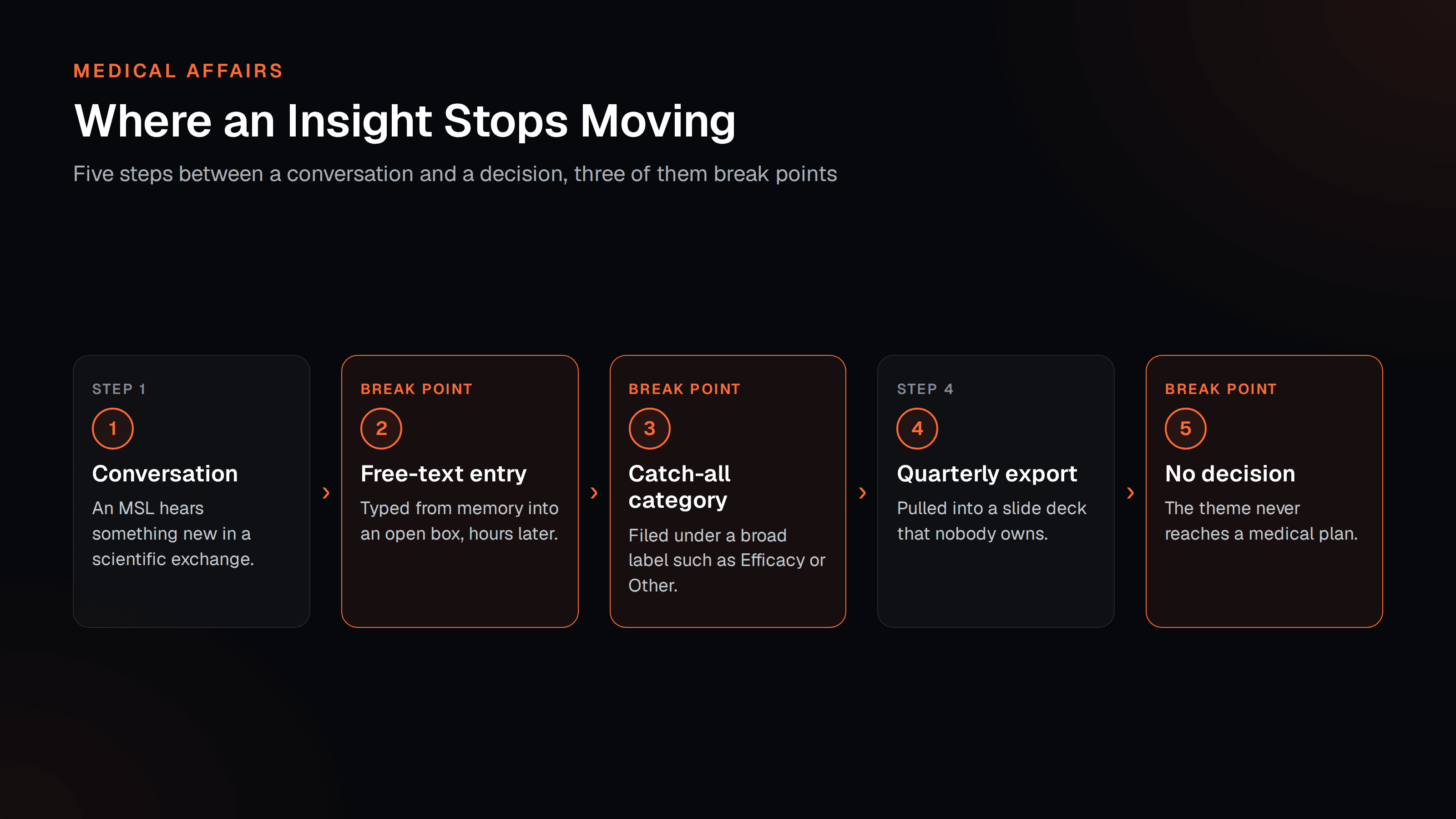
The first break is free text. An open box invites a paragraph written from memory at the end of the day, and paragraphs do not aggregate. Two liaisons describing the same pattern in different words become two unrelated records.
The second is the catch-all category. Lists built from topics, such as efficacy, safety, competitor or other, fill unevenly. One bucket ends up holding most records, and anyone trying to answer a specific question has to read all of them.
The third is ownership. When no one is named as responsible for a theme, the quarterly export becomes a slide, the slide is noted, and the meeting moves on. MSLs notice this quickly, and the quality of what they submit falls to match.
Build the Taxonomy From Questions, Not Topics
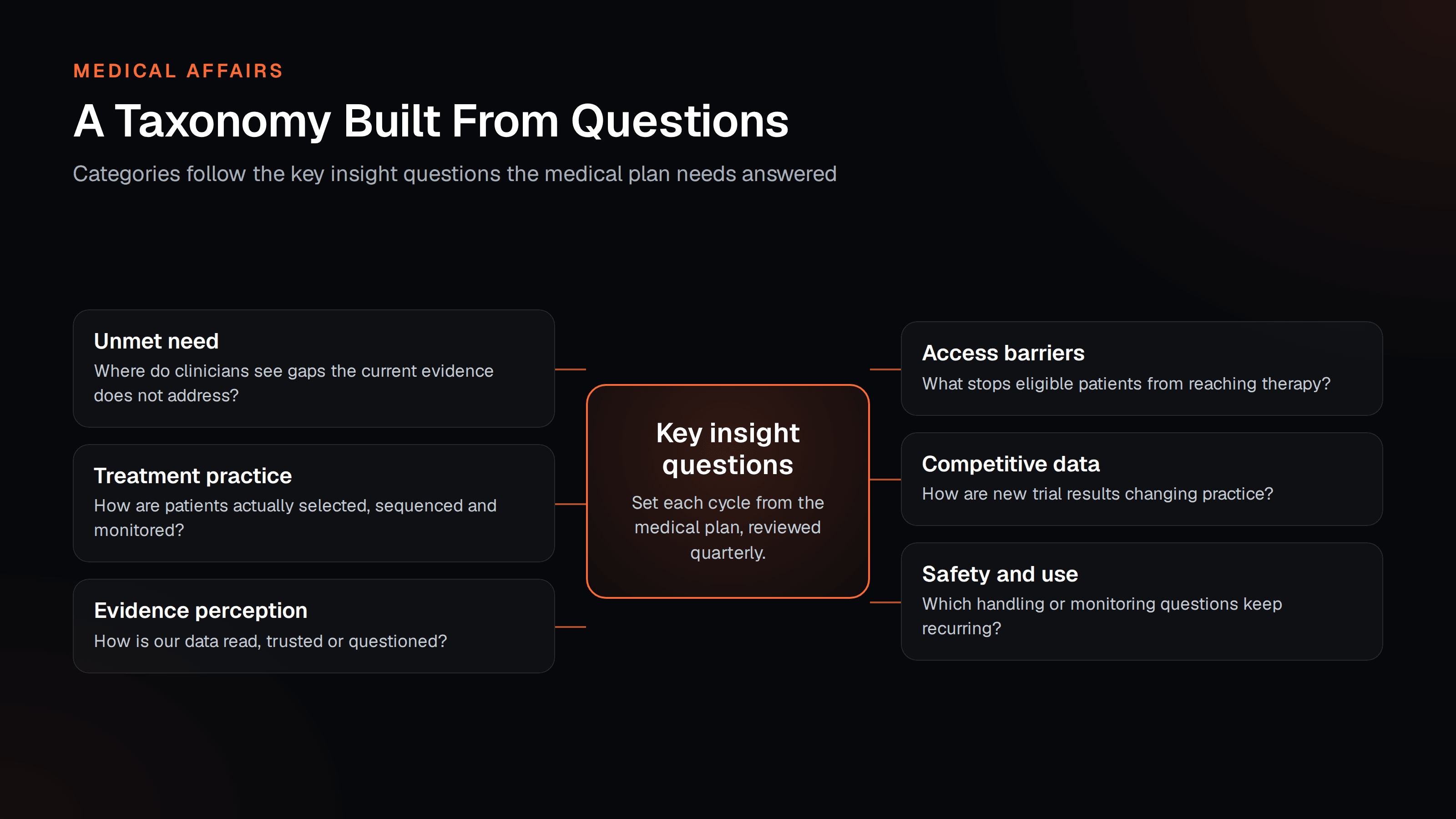
The fix most teams reach for is more categories. It usually makes things worse. A better starting point is the set of key insight questions the medical plan needs answered this cycle, kept to five to eight, written as questions, and reviewed at least quarterly.
Questions do three things a topic list cannot. They tell the MSL what to listen for, they give every record a reason to exist, and they make aggregation meaningful because records answering the same question can be compared. A record that answers none of the current questions is still allowed, tagged as emerging, and those are often the most valuable ones.
A Quality Bar at the Point of Entry
Liaisons will meet a quality bar if it is short and the reason for it is visible. Five fields cover most of what reviewers need:
- Source type: the role and setting of the person, without identifying them where policy requires it
- Context: what prompted the comment, such as a data readout, a patient case or a guideline update
- What was said: as close to verbatim as memory allows
- Why it matters: one sentence on what it might change
- Key question: which question it answers, or emerging
Capture within a day of the exchange matters as much as the fields. Mobile entry and voice-to-text help here, but only if the structure travels with them. A transcribed paragraph still lands as free text unless something maps it to the fields.
From Single Insights to Themes
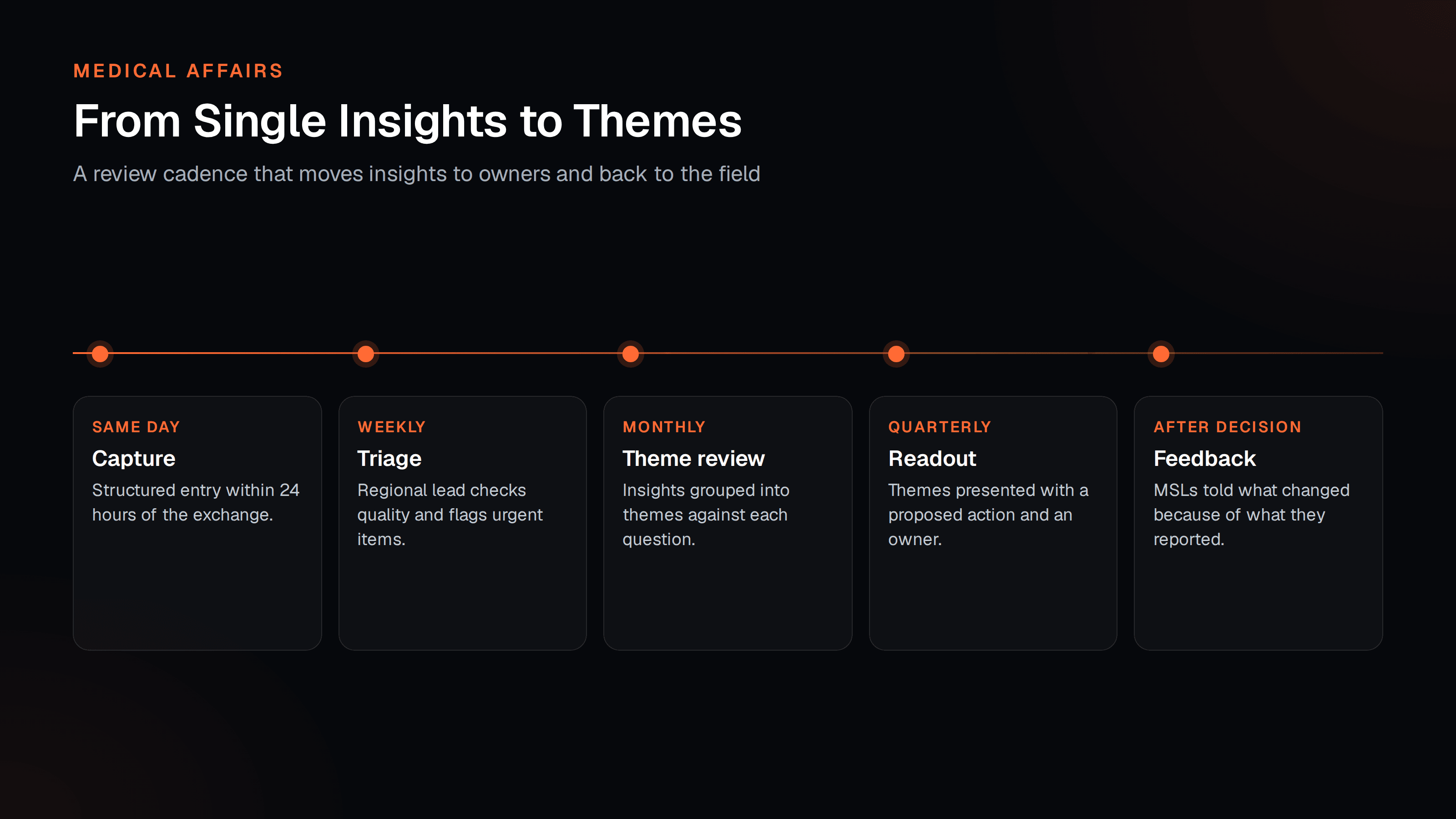
A single insight is an anecdote. Five similar insights from three regions within a month are a theme, and themes are what a medical plan can act on. The review cadence is what converts one into the other.
Weekly triage catches quality problems and urgent items early, which keeps the monthly review from becoming a data cleaning exercise. The monthly theme review groups records against each key question. The quarterly readout presents themes with a proposed action and a named owner: a new evidence generation idea, an update to a standard response document, a training need, or a question for the next advisory board.
Closing the Loop With the Field
The step most often skipped is telling MSLs what happened. A short note each quarter, listing the themes raised and what changed as a result, does more for insight quality than any training session. Liaisons who see their reports reach a decision write better reports.
The same loop connects insight capture to other parts of the function. Recurring clinician questions belong in the medical information library, covered in where medical information turnaround goes. Insights about who is shaping practice in a region feed KOL identification and mapping.
Where Technology Helps and Where It Does Not
Software can make structured capture faster, suggest the right key question from the text, and cluster similar records so reviewers start from candidate themes rather than a raw list. Language models are useful for the clustering step, provided a medical reviewer confirms each theme and the underlying records stay visible.
What software cannot do is decide which questions matter or who owns the answer. A tool layered over a topic list and no review cadence produces faster free text. Our medical affairs AI capability starts from the taxonomy and the review roles for that reason, and the KOL intelligence use case shows how insight records and expert profiles connect.
A Checklist for Your Insight Process
- Five to eight key insight questions, written as questions, reviewed quarterly
- A separate place for activity notes and medical information requests
- Five entry fields, including which question the insight answers
- Capture expected within one day of the exchange
- Weekly triage, monthly theme review and quarterly readout on the calendar
- A named owner for every theme presented
- A quarterly note to the field on what changed
- Insight quality measured, not insight count, as described in medical affairs metrics beyond activity counts
References
- Medical Affairs Professional Society (MAPS), standards and resources for medical affairs practice. medicalaffairs.org
- Communications From Firms to Health Care Providers Regarding Scientific Information on Unapproved Uses of Approved/Cleared Medical Products: Questions and Answers. US Food and Drug Administration, final guidance, January 2025. www.fda.gov
- PhRMA Code on Interactions with Health Care Professionals. Pharmaceutical Research and Manufacturers of America. www.phrma.org
This guide describes process and regulatory expectations in general terms and is not legal or regulatory advice. Confirm the current version and applicability of any code or guidance for your products and markets.
Frequently Asked Questions
What is an MSL insight?
An MSL insight is a new understanding, gathered in scientific exchange, that explains how clinicians think or act and could change what medical affairs does. It differs from an activity record, which logs that a meeting happened, and from a medical information request, which asks for an answer. A useful test is whether the entry would change a plan if many liaisons reported the same thing. If it would not, it belongs somewhere else.
How many insight categories should a medical affairs team use?
Fewer than most teams have. Five to eight categories framed as key insight questions, plus an emerging tag for anything new, usually work better than long topic lists. Questions tell liaisons what to listen for and make records comparable. Long lists fill unevenly, push most entries into one or two buckets, and make every review start with re-reading the whole database.
Who should own medical insights once they are captured?
Each theme needs a named owner, usually the medical lead for the therapy area or the person responsible for the related part of the medical plan. Field leaders own quality and triage. Without named theme owners, insight readouts become presentations that are noted and not acted on, and liaisons stop investing effort in what they submit.
Can MSL insights be shared with commercial teams?
Aggregated themes are commonly shared across functions, but practices vary by company and region and should follow your internal policy and applicable codes. The usual safeguards are sharing themes rather than individual records, removing anything that identifies a clinician, and keeping the MSL role non-promotional. Insights should not be collected with a commercial objective, and liaisons should not carry sales targets.
Can AI summarize or cluster MSL insights?
Yes, and clustering is one of the more useful applications. A model can group similar records and suggest candidate themes so reviewers do not start from a raw list. The safeguards are that a medical reviewer confirms each theme, the source records remain visible and traceable, and the model works only on data the reviewers are permitted to see. It speeds the review; it does not replace it.
How does Nirmitee Healthtech approach insight capture?
We start from the key insight questions, the entry fields and the review roles, then build capture, clustering and reporting around them, with medical reviewers confirming every theme. The aim is that each insight can be traced from the conversation to the decision it informed. The approach is described on our medical affairs AI capability page.