
Congress Planning for Medical Affairs Teams

Congress planning works better backward. Start from the insights and scientific exchanges the team needs from the meeting, then decide which sessions, posters, experts and booth conversations serve them. Agenda-first plans fill calendars and produce session summaries. Objective-first plans produce a post-congress report that changes a medical plan.
Major medical congresses consume a large share of a medical affairs team's year: abstract planning, poster production, staffing, expert meetings, booth preparation, travel. The usual planning document starts from the program, assigns people to sessions, and ends with a recap that summarizes what was presented. Much of that summary was available from the congress website.
This guide reverses the order. It covers setting the questions first, building coverage from them, capturing insight on the floor, staying within the rules for scientific exchange, and writing a report that ends in actions. It is part of the medical affairs operations guide.
After reading this you will be able to:
- Set congress objectives as questions with owners
- Build a coverage plan from those questions rather than the agenda
- Capture structured insight on site, not from memory afterward
- Produce a post-congress report that leads to decisions
Why Agenda-First Plans Underdeliver
Starting from the program optimizes for coverage, which is not the same as learning. Teams spread across every session that seems relevant, attend the same high-profile presentations as everyone else, and return with notes on content that will be published anyway. What gets missed is the part only people in the room can gather: how clinicians reacted, what they asked, what worried them, and who is emerging.
Start With the Questions
The same key insight questions that drive field capture, described in MSL insight capture, should drive congress planning, narrowed to what this particular meeting can answer.
| Objective | Question for this congress | Evidence on the floor | Owner |
|---|---|---|---|
| Understand reception of new data | How are clinicians interpreting the new trial results? | Discussant comments, questions from the audience | Medical lead |
| Refine evidence plans | Which questions does current evidence leave open? | Expert meetings, poster discussions | Evidence generation lead |
| Identify experts | Who is presenting new, relevant work? | Oral abstracts, early-career sessions | Insights lead |
| Support scientific exchange | What do visitors ask at the medical booth? | Booth questions, medical information requests | Booth lead |
The Planning Timeline
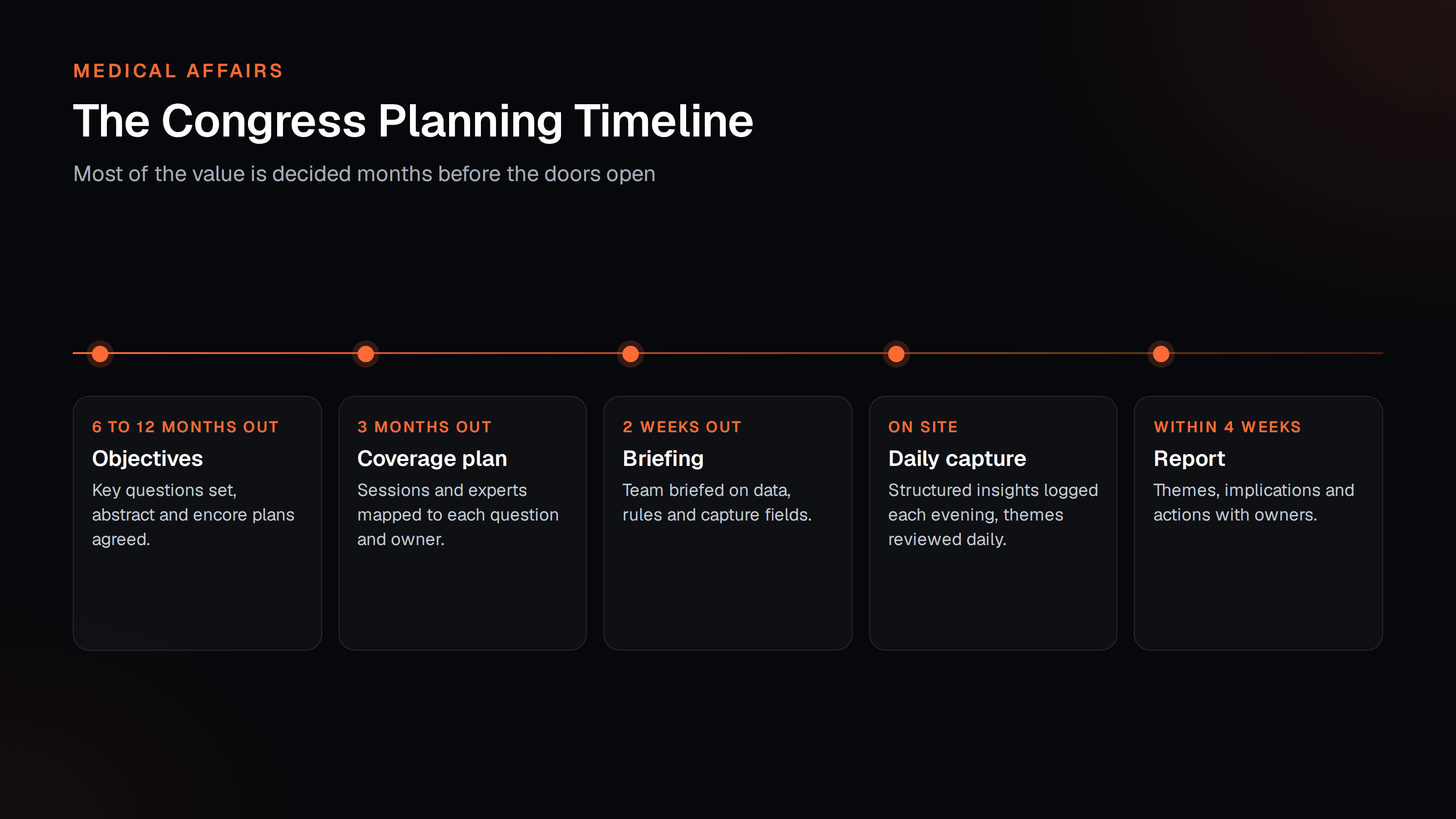
Abstract decisions are made many months ahead, which is why objectives must be set early. Publication planning should follow recognized authorship and transparency standards, such as the recommendations of the International Committee of Medical Journal Editors, and encore presentations need to be planned with the congress rules in mind.
Coverage: Who Goes Where
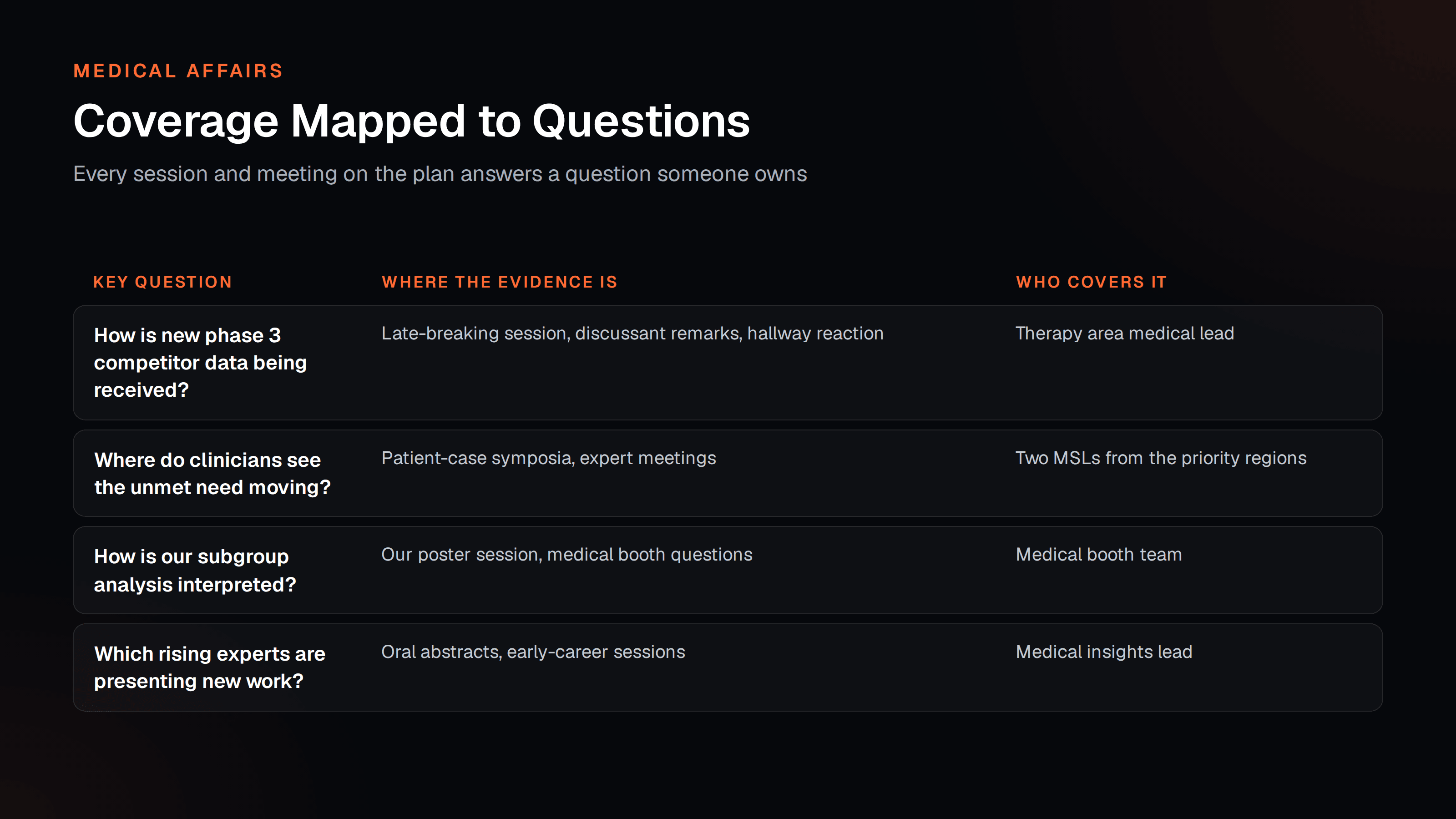
Coverage built from questions is usually smaller and sharper than coverage built from the agenda. It also makes staffing decisions easier to explain. Expert network maps help here: knowing which clinicians connect to which audiences shows which conversations are worth seeking out. That mapping is covered in KOL identification and mapping.
Capturing Insight on the Floor
Insight captured from memory a week later is weaker and harder to compare. The working pattern is short structured entries each evening using the same fields as field capture, tagged to the congress questions, followed by a brief daily review of emerging themes so coverage can shift on day two if something unexpected appears.
Questions asked at the medical booth that need a formal answer should be logged as medical information requests and handled through the normal process, not answered informally and lost. That process is covered in medical information request handling.
Medical Booth and Scientific Exchange Rules
Congresses concentrate the compliance questions medical affairs handles every day. The medical presence should be clearly separated from promotional activity, staffed by medical personnel, and non-promotional in content and tone. Unsolicited questions about unapproved uses can be answered appropriately, as described in FDA's 2011 draft guidance on unsolicited requests. Proactive sharing of scientific information on unapproved uses follows FDA's January 2025 final guidance on such communications.
Hospitality, meetings with experts and any payments are governed by industry codes, including the PhRMA, EFPIA and IFPMA codes, and by the congress organizer's own rules. International meetings bring several codes into play at once, so the briefing before the meeting should state which apply.
The Post-Congress Report That Gets Read
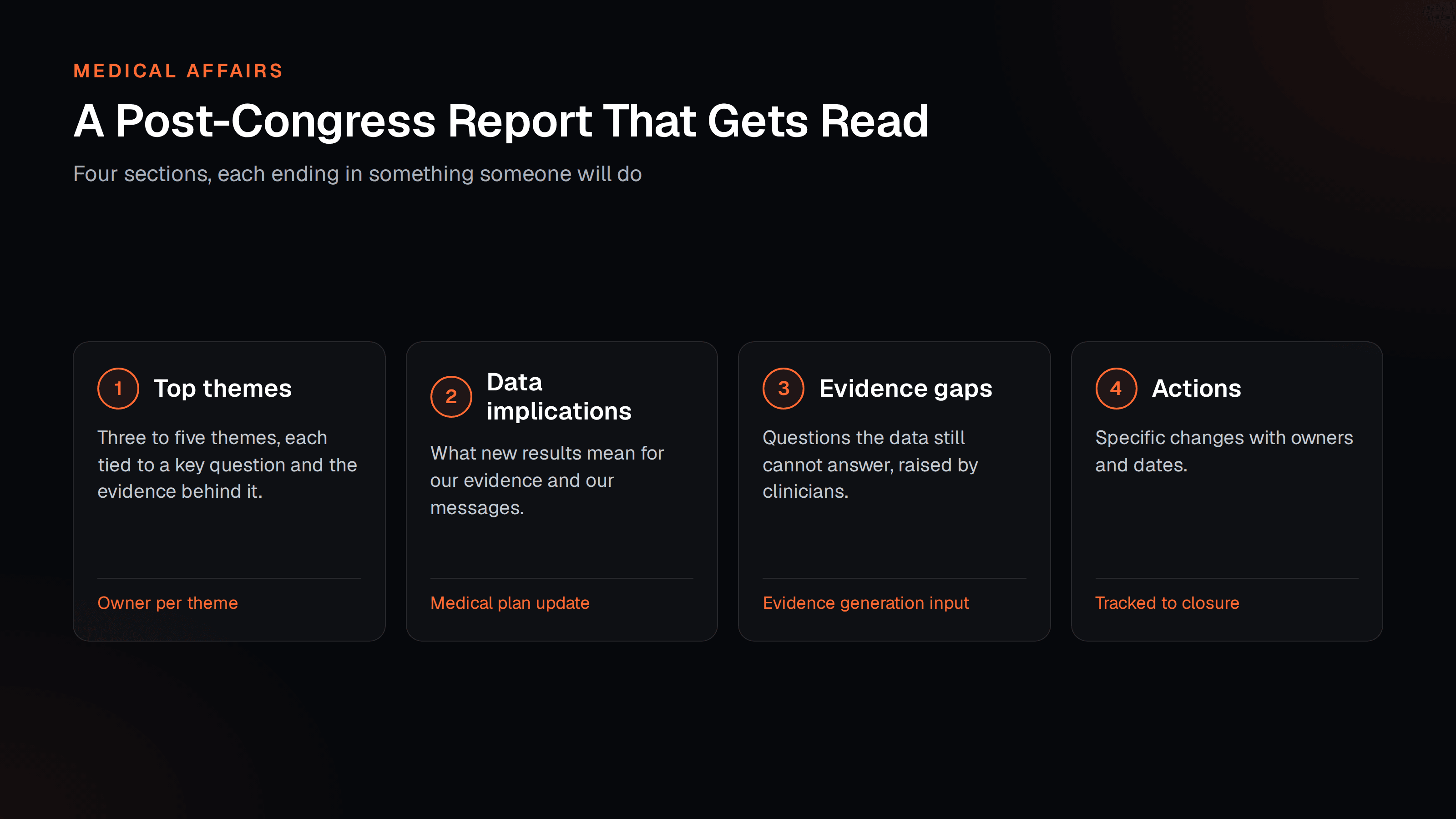
Leadership does not need a session-by-session summary. It needs to know what the team learned that it did not know before, what that means, and what will change. Writing the report within a few weeks, while the actions are still relevant, matters as much as its structure. Tracking those actions to closure gives a congress metric more meaningful than attendance, in line with the measures in medical affairs metrics beyond activity counts.
A Congress Planning Checklist
- Key questions for the congress agreed and owned
- Abstract and encore plans aligned with publication standards
- Coverage plan mapped from questions, not the agenda
- Pre-congress briefing covering data, applicable codes and capture fields
- Structured capture each evening, with a daily theme review
- Booth questions logged as medical information requests where needed
- Report within four weeks, ending in owned actions
- Actions tracked to closure
References
- Recommendations for the Conduct, Reporting, Editing, and Publication of Scholarly Work in Medical Journals. International Committee of Medical Journal Editors. www.icmje.org
- Communications From Firms to Health Care Providers Regarding Scientific Information on Unapproved Uses of Approved/Cleared Medical Products: Questions and Answers. US Food and Drug Administration, final guidance, January 2025. www.fda.gov
- Responding to Unsolicited Requests for Off-Label Information About Prescription Drugs and Medical Devices. US Food and Drug Administration, draft guidance, December 2011. www.fda.gov
- PhRMA Code on Interactions with Health Care Professionals. Pharmaceutical Research and Manufacturers of America. www.phrma.org
- EFPIA Code of Practice. European Federation of Pharmaceutical Industries and Associations. www.efpia.eu
- IFPMA Code of Practice. International Federation of Pharmaceutical Manufacturers and Associations. www.ifpma.org
This guide describes process and regulatory expectations in general terms and is not legal or regulatory advice. Confirm the current version and applicability of any code or guidance for your products and markets.
Frequently Asked Questions
What should a medical affairs congress plan include?
A useful plan includes the key questions the team wants answered at the meeting, abstract and presentation plans, a coverage plan mapping sessions and experts to those questions, staffing and booth arrangements, a briefing on applicable codes and data, a capture method for insights, and a deadline and structure for the post-congress report.
How far in advance should congress planning start?
Planning for major congresses often starts six to twelve months ahead, because abstract submission deadlines fall well before the meeting. Coverage planning and staffing typically firm up around three months out, with a team briefing in the final couple of weeks. Starting late usually means the agenda drives the plan rather than the team's objectives.
How do medical affairs teams capture insights at congresses?
The most reliable approach is short structured entries each evening using the same fields as field insight capture, tagged to the congress questions, with a brief daily review of emerging themes. Capturing from memory after the meeting produces weaker, less comparable records and misses the chance to adjust coverage during the congress.
Can a medical booth discuss off-label data?
Medical staff can respond to unsolicited questions about unapproved uses in a balanced, non-promotional way, consistent with FDA draft guidance on unsolicited requests and the rules of the congress. Proactive sharing of scientific information on unapproved uses is governed separately. The medical booth should be clearly separated from promotional activity, and local codes may impose further limits.
What makes a good post-congress report?
A good report is short and decision-focused. It presents three to five themes tied to key questions, explains what new data means for the company's evidence and messages, lists evidence gaps raised by clinicians, and ends with specific actions, each with an owner and a date. Session-by-session summaries are better kept as an appendix, if at all.
How does Nirmitee Healthtech support congress work?
We build structured insight capture, theme synthesis and expert intelligence that medical teams can use before, during and after a congress, with medical reviewers confirming every theme. The same tools support field insight and KOL mapping year round. More detail is on our medical affairs and evidence teams page.