
Medical Information Request Handling: Cutting Response Turnaround

Most medical information turnaround is spent establishing whether an approved answer already exists, not writing one. Requests wait while someone searches the standard response library, confirms the document is current, and checks that it fits the question and the requester. Turnaround falls when the library is searchable by question, every document carries an approval state and expiry, and routing decides the tier at intake.
Medical information teams are measured on response time, and the instinct when the number slips is to add people. That helps briefly. The structural delay is elsewhere: in libraries organized as folders, in documents whose status has to be confirmed by email, and in requests that reach the right specialist only after a first person has searched and failed.
This guide follows a request from intake to record, looks at where the days go, and covers the library structure, routing and measures that change the number. It is part of the medical affairs operations guide.
After reading this you will be able to:
- Locate where turnaround time is actually spent in your process
- Structure standard response documents so they can be found and trusted
- Route requests by tier at intake rather than after a failed search
- Use request data as a signal for content and field teams
Where the Days Go
Break a typical request into its stages and the writing is rarely the long part.
| Stage | What happens | Common cause of delay |
|---|---|---|
| Intake | Request logged and requester identified | Missing details, follow-up needed to clarify the question |
| Screening | Adverse event and product complaint check | Unclear criteria, so cases are escalated defensively |
| Search | Look for an approved, current answer | Library organized by product folder, not by question |
| Confirmation | Check status, version and regional scope | Status held outside the document, confirmed by email |
| Response | Send, adapt or research | Requests reach the right specialist late |
| Review | Medical sign-off where needed | Reviewers receive work without the sources attached |
The Lifecycle of a Request
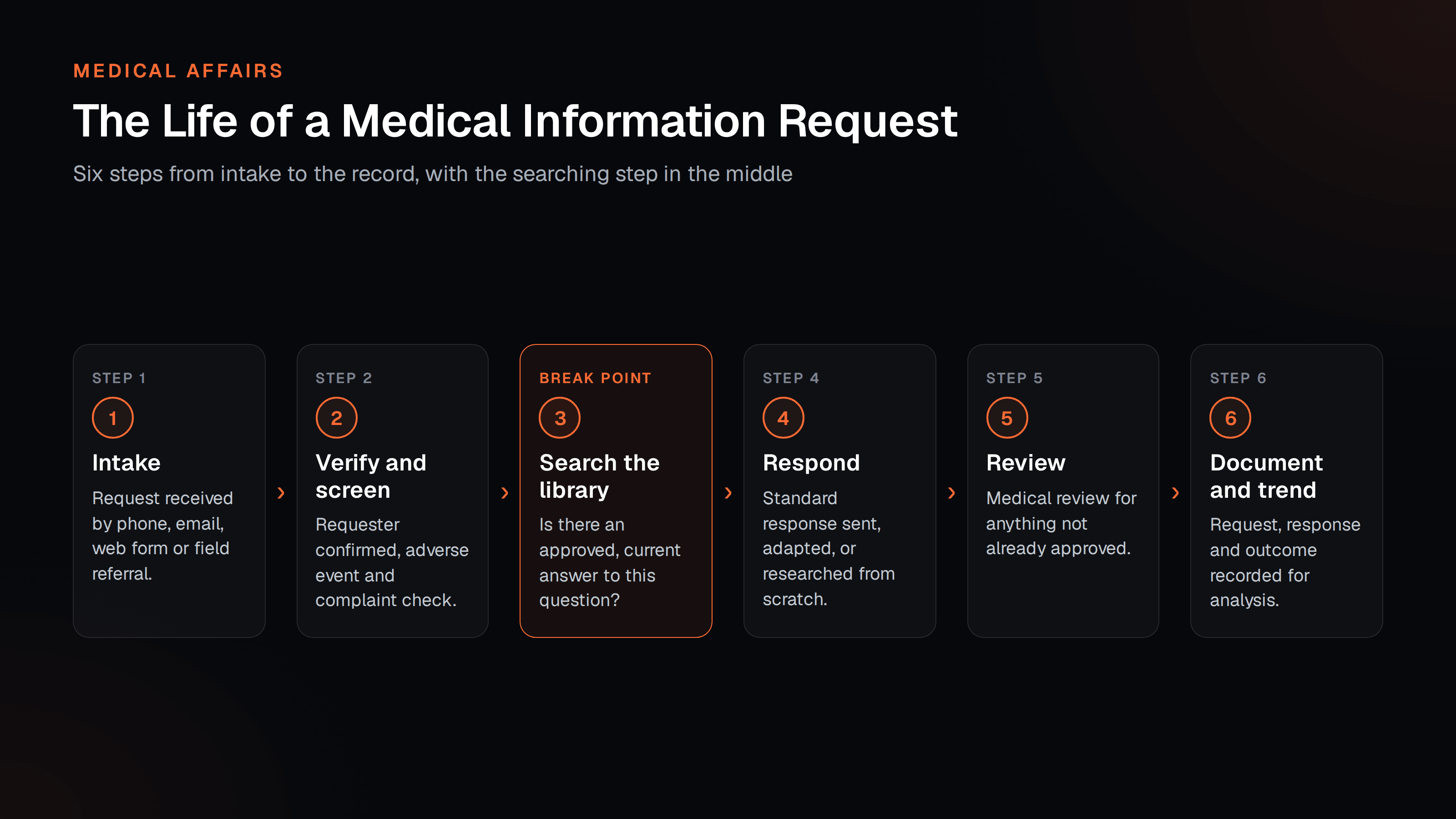
Every request follows broadly the same path, whatever the channel. What varies is how much of it is repeated. When a contact center agent searches, fails, and passes the request to a specialist who searches again, the search step happens twice and the clock runs throughout.
The record at the end matters as much as the response. Each request documents what was asked, who asked, what was sent and when. That record supports compliance, and it is also one of the richest sources of clinician questions the organization has.
Safety and Quality Checks That Cannot Be Skipped
Speed improvements must never come from the screening step. A request that mentions a patient experience may contain an adverse event, and that information has to reach pharmacovigilance within the timelines that apply. In the US, postmarketing reporting obligations for approved drugs are set out in 21 CFR 314.80, with comparable requirements in other regions. Product quality complaints have their own route.
The practical answer is clear screening criteria applied at intake, a defined handoff to safety with acknowledgment, and a record that links the medical information case to the safety case. Clear criteria reduce defensive escalation, which is itself a source of delay.
Standard Response Documents as a Library, Not a Folder
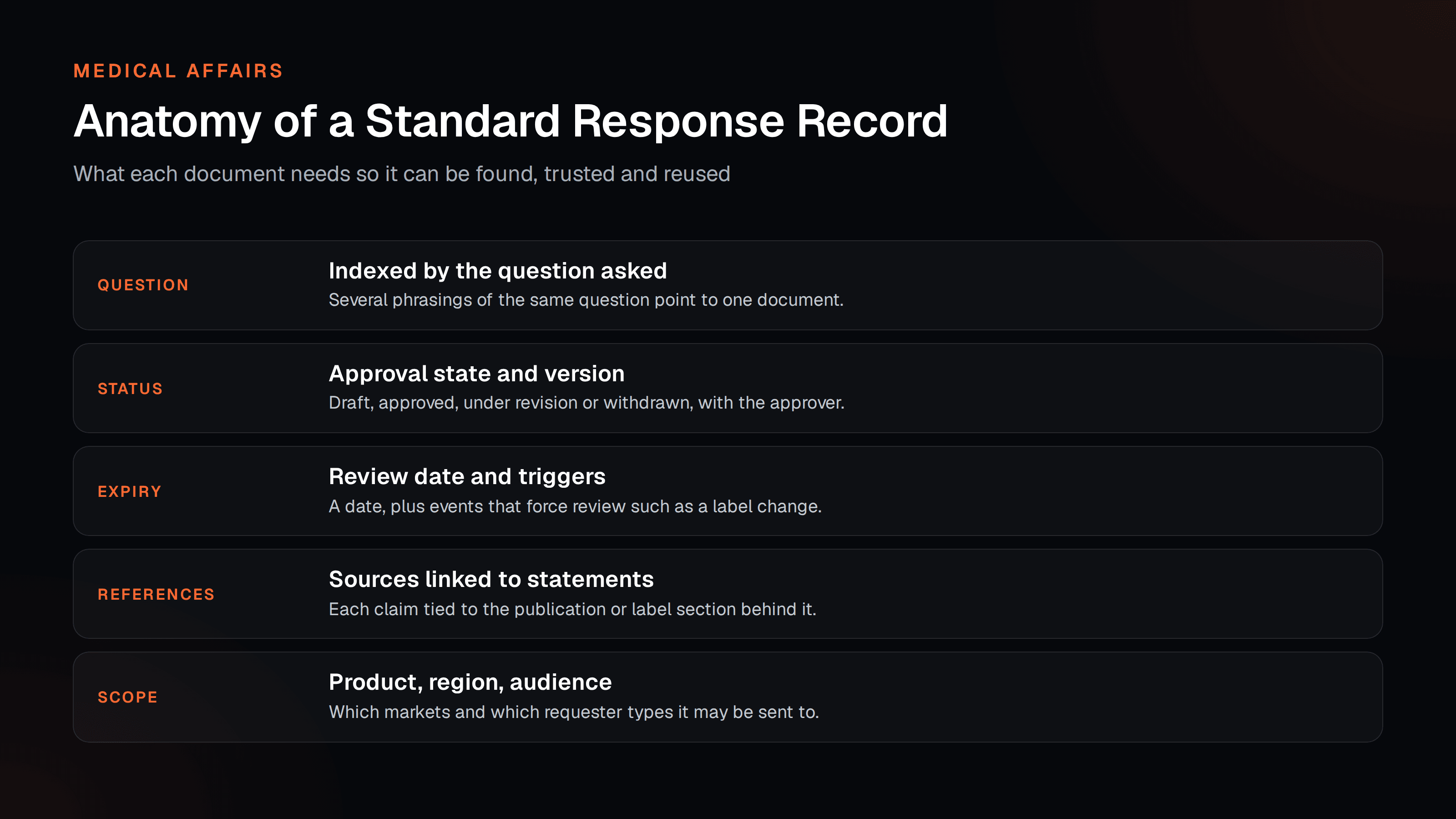
Most turnaround gains come from this section. A standard response document that is indexed by the questions it answers can be found by an agent in the first search. One that carries its own approval state and review date does not need an email to confirm it can be sent. One with references linked to each statement can be adapted without repeating the literature search.
Expiry deserves particular attention. Documents should carry a review date and a list of events that force earlier review, such as a label update, new trial data or a safety communication. An expired or superseded document sent in good faith is a quality event.
Routing by Tier
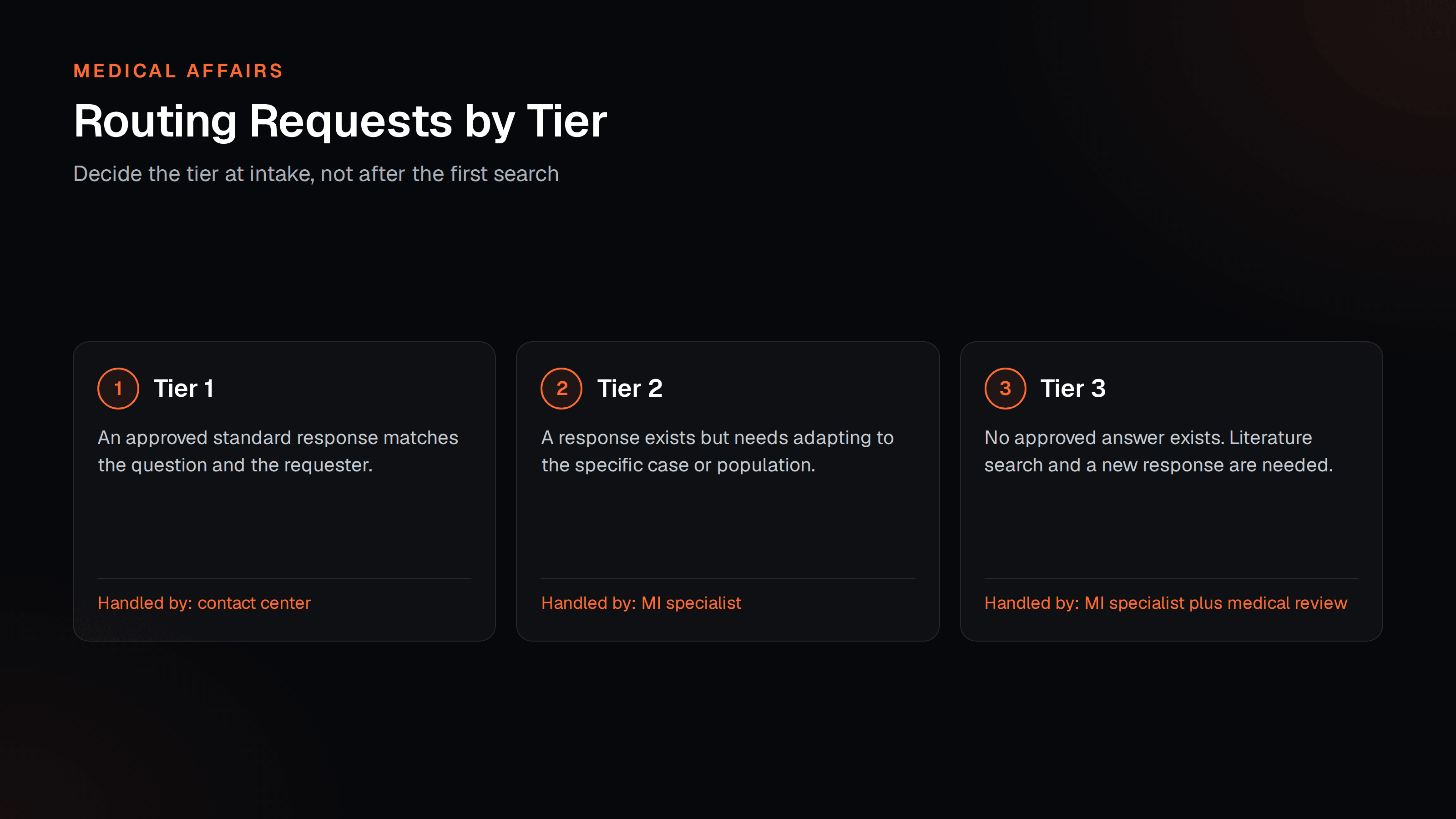
Routing at intake removes the failed first search. If the intake step can match the question against the library, the request goes straight to the tier that can answer it. Tier 1 is sent by the contact center. Tier 2 goes to a specialist with the closest document attached. Tier 3 goes to a specialist with a literature search request and a reviewer assigned from the start.
Unsolicited Requests and Off-Label Questions
Medical information exists in part to answer questions the promotional channel cannot, including questions about uses outside the approved labeling. FDA's 2011 draft guidance on unsolicited requests describes responses that go only to the person who asked, are prepared by medical or scientific staff, are truthful, balanced and non-promotional, and are documented. A request prompted by the company is not unsolicited, which is why field referrals need to record who initiated the question.
Proactive sharing of scientific information on unapproved uses is a separate matter, addressed in FDA's January 2025 final guidance on such communications. Keeping the two processes distinct in the system, with different templates and approvals, avoids confusion about which rules apply. Regional codes, including those of EFPIA member associations, add their own requirements.
What to Measure
Overall turnaround is a lagging number. Measures that explain it include:
- Turnaround by tier, since a blended average hides where time is lost
- The share of requests answered from an existing document on first search
- Requests reopened because the response did not fit the question
- Documents past their review date
- Tier 3 questions by theme, which show where the library has gaps
The last measure connects medical information to the rest of the function. Recurring questions without an approved answer are content work for the medical writers, and patterns in what clinicians ask are insight for field teams, covered in MSL insight capture. Responses that become promotional or educational material pass through review, covered in where MLR review gets stuck.
Where Technology Earns Its Place
Retrieval across approved content is the strongest use case. A system that searches by meaning rather than keyword, returns only documents the requester type may receive, shows approval status and expiry, and cites the source of each statement removes most of the search step. Drafting a tier 2 adaptation for a specialist to edit is a reasonable next step, provided a person approves every response.
Our medical affairs AI capability covers medical information workflows built this way. Recurring clinician questions are also useful training material: Simulex grounds practice conversations in approved FAQs and response frameworks, so field teams rehearse the questions clinicians are actually asking.
A Checklist for Medical Information Turnaround
- Adverse event and complaint screening criteria written and applied at intake
- Standard response documents indexed by question, with several phrasings each
- Approval state, version, expiry and scope held on each document
- References linked to statements, not listed at the end
- Tier decided at intake
- Turnaround reported by tier
- Tier 3 themes reviewed monthly for content gaps
- Solicited and unsolicited requests recorded distinctly
References
- Responding to Unsolicited Requests for Off-Label Information About Prescription Drugs and Medical Devices. US Food and Drug Administration, draft guidance, December 2011. www.fda.gov
- Communications From Firms to Health Care Providers Regarding Scientific Information on Unapproved Uses of Approved/Cleared Medical Products: Questions and Answers. US Food and Drug Administration, final guidance, January 2025. www.fda.gov
- 21 CFR 314.80, Postmarketing reporting of adverse drug experiences. Electronic Code of Federal Regulations. www.ecfr.gov
- EFPIA Code of Practice. European Federation of Pharmaceutical Industries and Associations. www.efpia.eu
This guide describes process and regulatory expectations in general terms and is not legal or regulatory advice. Confirm the current version and applicability of any code or guidance for your products and markets.
Frequently Asked Questions
What is a standard response document in medical information?
A standard response document is a pre-approved, referenced answer to a question clinicians commonly ask about a product. It is reviewed by medical staff, scoped to particular markets and requester types, and given a review date. Medical information teams send it as is or adapt it to a specific case, which is much faster than researching each question from scratch.
What is a good turnaround time for medical information requests?
There is no single standard, because turnaround depends heavily on complexity. Requests answered from an approved document are often handled the same day or the next, while questions needing new research and medical review take longer. Reporting turnaround by tier is more useful than one blended target, because it shows whether delays come from searching, adapting or researching.
How should medical information handle off-label questions?
Unsolicited questions about unapproved uses can be answered, but the response should go only to the person who asked, be prepared by medical or scientific staff, be accurate and balanced, and be documented, as described in FDA draft guidance from 2011. Questions prompted by the company are not unsolicited. Local codes and regulations add requirements outside the US.
What happens if a medical information request contains an adverse event?
The adverse event must be identified at intake and passed to pharmacovigilance within the applicable reporting timelines, while the medical question is answered separately. Good practice is clear screening criteria, a documented handoff with acknowledgment, and a link between the medical information case and the safety case so both can be traced.
Can AI answer medical information requests?
AI is useful for retrieving approved content and drafting adapted responses, but a qualified person should approve every response before it is sent. The system should only retrieve documents the requester type may receive, show each document's approval status and expiry, and cite the source behind each statement. Screening for adverse events still needs a human-controlled process.
How does Nirmitee Healthtech help medical information teams?
We build question-indexed response libraries, intake routing and retrieval that respects approval status, expiry and scope, with medical review kept in the loop. The aim is to remove the repeated search step and turn request data into a signal for content and field teams. Details are on our medical affairs AI capability page.