
KOL Identification and Mapping Without Guesswork

A defensible KOL list is built from evidence of influence, not from who the team already knows. Score candidates on publications, trial involvement, guideline and society roles and, where it is relevant, digital reach. Weight those signals by the objective of the engagement, have the field validate the result, and refresh it on a schedule. Lists built on reputation drift toward the same small group and miss rising and regional experts.
Ask a medical affairs team how its key opinion leader list was built and the honest answer is often some version of: it was inherited, then edited. Names were added after memorable meetings and rarely removed. The result is a list that over-represents a handful of national figures, engages them repeatedly, and misses the clinicians who are shaping practice in a region or will be in three years.
This guide covers the signals that indicate influence, how to weight them, how to tier without creating a ranking nobody trusts, and the compliance guardrails around the list. It sits under the medical affairs operations guide.
After reading this you will be able to:
- List the evidence sources behind each type of influence
- Weight signals differently for trials, guidelines, education and evidence generation
- Tier experts with criteria that can be explained and defended
- Keep the list current and the selection process documented
Why Reputational Lists Drift
Reputation is a lagging signal. The clinicians everyone already knows earned that position through work done years ago, and they are often the most heavily engaged by every company in the therapy area. A list built from reputation therefore concentrates engagement where marginal value is lowest.
It also creates a compliance exposure. When selection rests on familiarity, it is hard to show that an expert was chosen for a legitimate need rather than for other reasons. Documented, evidence-based criteria answer that question before anyone asks it.
The Signals That Indicate Influence
| Signal | Typical source | What it shows | Limitation |
|---|---|---|---|
| Publications | PubMed and journal indexes | Scientific contribution, topics, recency | Volume rewards large groups; authorship position matters |
| Trial involvement | ClinicalTrials.gov and other registries | Investigator experience, site capability | Registry entries often list only the lead investigator |
| Guidelines and societies | Guideline author lists, society committees | Influence on standards of care | Small pool, changes slowly |
| Congress roles | Faculty and chair lists | Peer recognition, education reach | Favors established speakers |
| Digital activity | Scientific posts, podcasts, online talks | Reach among peers, especially early-career | Follower counts do not equal clinical relevance |
| Field knowledge | MSL observation and insight records | Local practice influence and referral patterns | Subjective unless structured |
No single signal is sufficient. Publication counts favor clinicians at large academic centers; trial registries undercount sub-investigators; field knowledge is invaluable but uneven. Combining them is what makes the list defensible.
Weighting Signals by Objective
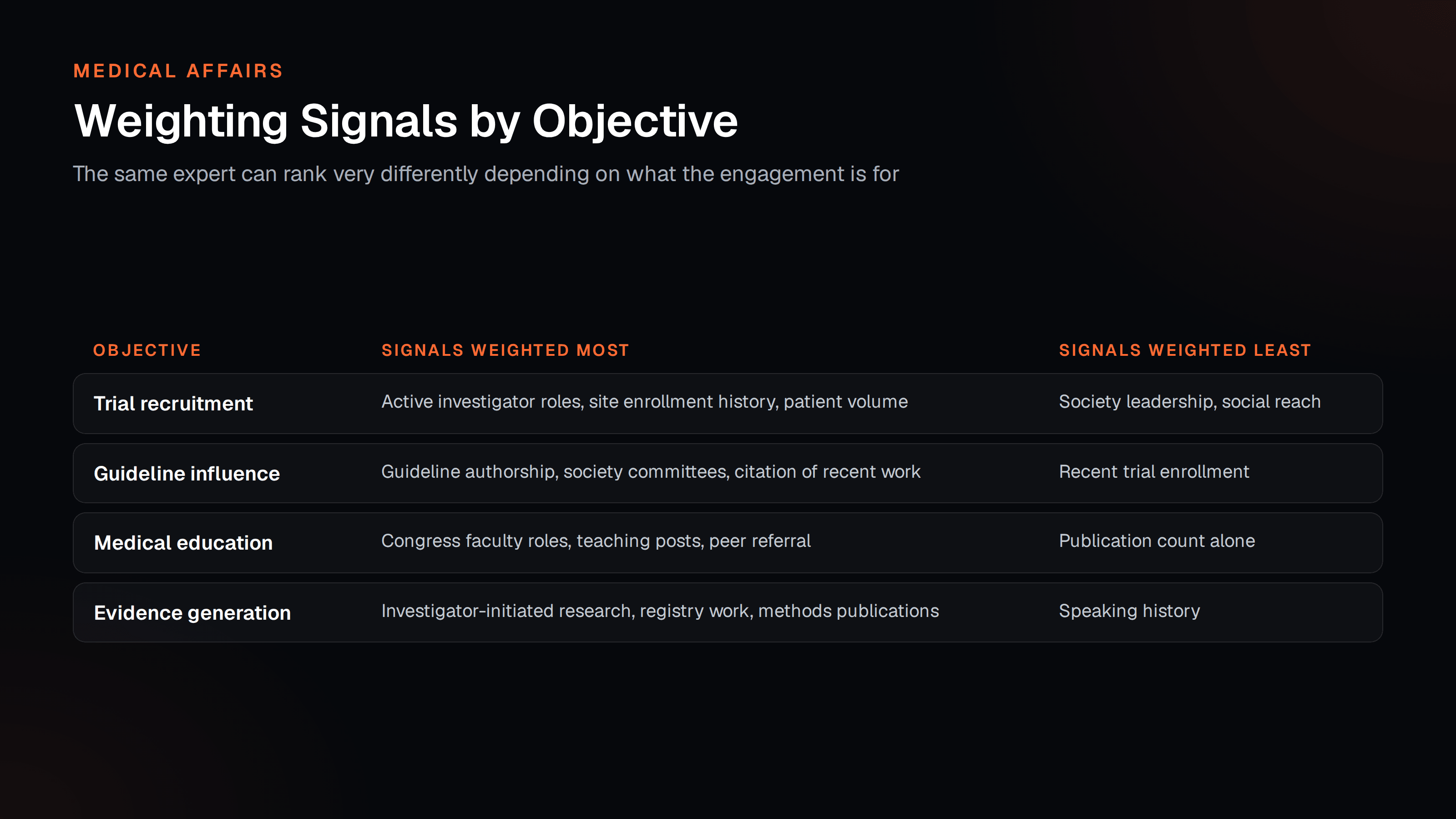
A single ranked list implies there is one kind of influence. There are several, and the expert who matters most for recruiting a trial is often not the one who matters most for a guideline update. Holding the underlying signals once and applying different weights per objective gives several defensible views from the same data.
Tiering Without Creating a Ranking Nobody Trusts
Tiers are useful for planning coverage and frequency, and harmful when they become a scoreboard. A few practices keep them useful. Publish the criteria for each tier internally so the field understands why someone sits where they do. Use bands rather than precise scores, since the data does not support precision. Keep a separate category for rising experts, defined by recent trajectory rather than accumulated standing, and for regional experts whose influence is concentrated in one geography.
Field validation is the step that builds trust. MSLs see things the data does not, such as a clinician who chairs the regional tumor board or one who has stepped back from research. A structured way for the field to confirm or challenge the data, with reasons recorded, keeps the list honest. Those observations often arrive as insights, covered in MSL insight capture.
Mapping Networks, Not Just Names
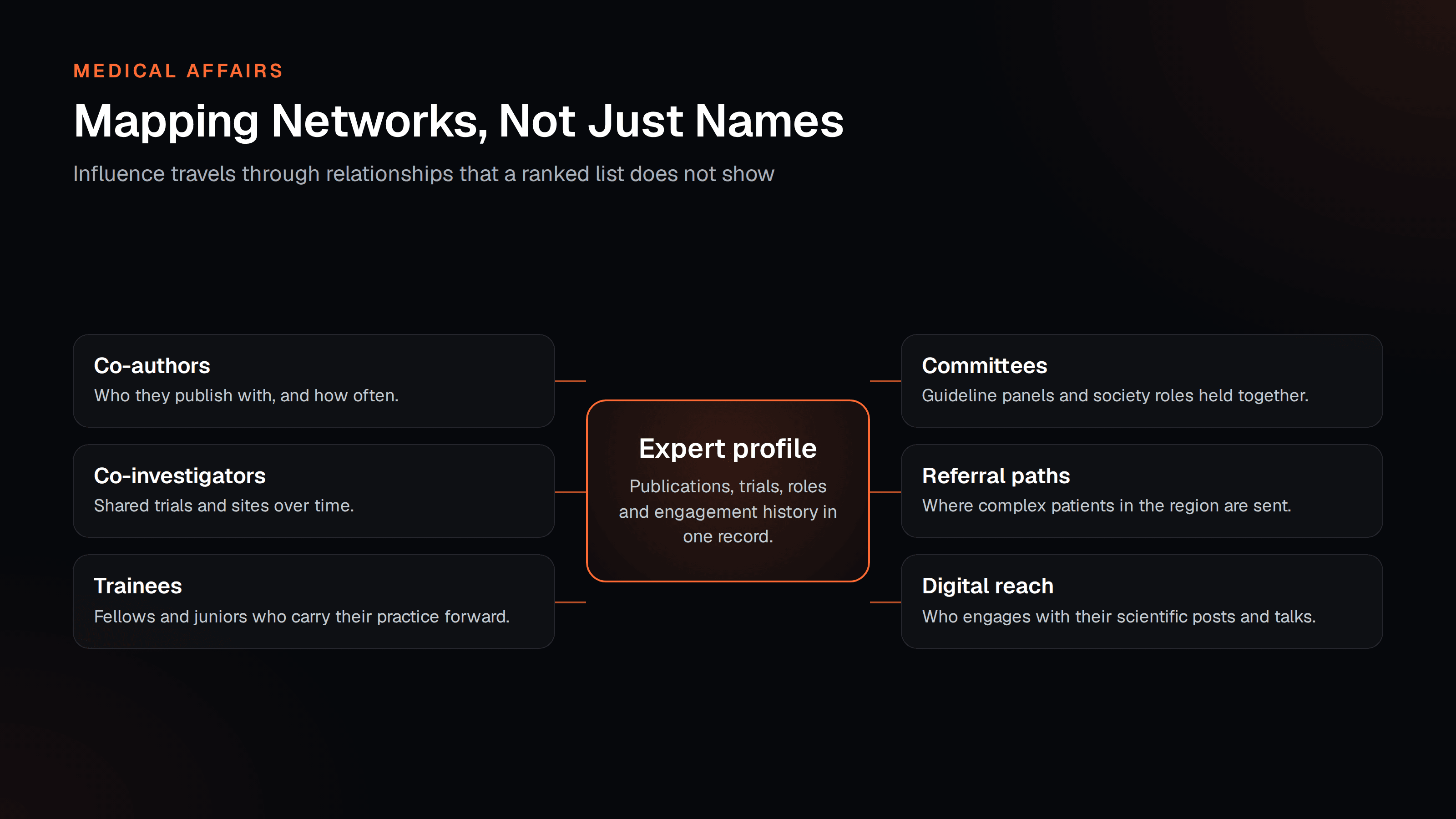
Influence moves through co-authorship, shared trials, training relationships and referral paths. Mapping those connections shows clusters, bridges between institutions, and clinicians who sit at the center of a regional network without appearing at the top of any national ranking. It also helps congress and advisory planning, covered in congress planning for medical affairs, because it shows which experts reach which audiences.
Digital Opinion Leaders
Clinicians increasingly build influence through scientific posts, podcasts and online education. Measuring them by follower count repeats the reputation problem in a new channel. Better measures are relevance of content to the therapy area, engagement from other clinicians rather than the general public, and consistency over time. Digital reach belongs alongside the other signals, weighted by objective, not as a separate list.
Compliance Guardrails
The list itself is a compliance artifact. Selection criteria should be documented and tied to a legitimate scientific need. Engagements that involve payment need fair market value, a written agreement and, in the US, reporting under the Open Payments program administered by CMS. The HHS Office of Inspector General's 2020 Special Fraud Alert on speaker programs is a reminder that selecting experts for reasons connected to prescribing creates risk.
Medical and commercial uses of expert data should be governed separately. Medical affairs identifies experts for scientific exchange, advisory input and research; that purpose should not quietly become a targeting list. Industry codes, including the PhRMA and EFPIA codes, set further expectations on how companies interact with health care professionals.
Keeping the List Current
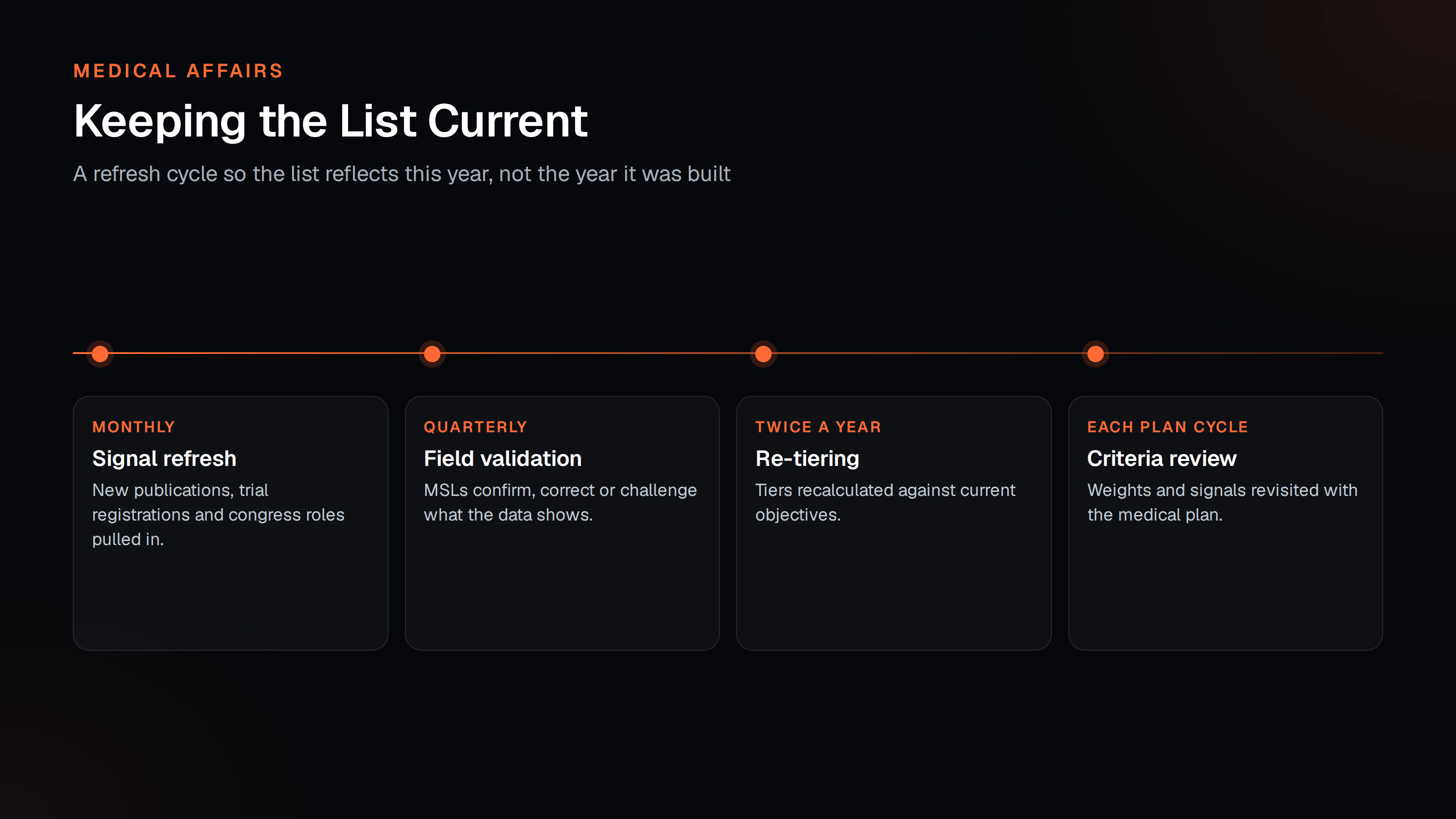
A list built once decays within a year. Automated signal refresh keeps the data current; field validation and re-tiering keep it meaningful. Reviewing criteria alongside each medical plan cycle keeps the weights aligned with what the function is trying to achieve. The KOL intelligence use case shows how profile data, publications, trials and engagement history can be unified for this, and our medical affairs AI capability covers the broader workflow.
A Checklist for a Defensible KOL List
- Signals drawn from at least four independent sources
- Weights defined per objective and documented
- Tiers expressed as bands, with published criteria
- Separate categories for rising and regional experts
- Structured field validation with reasons recorded
- Network view alongside the ranked view
- Selection rationale tied to legitimate need, with transparency reporting where payments occur
- Monthly signal refresh and re-tiering at least twice a year
References
- PubMed. US National Library of Medicine. pubmed.ncbi.nlm.nih.gov
- ClinicalTrials.gov. US National Library of Medicine. clinicaltrials.gov
- Open Payments. Centers for Medicare and Medicaid Services. www.cms.gov
- Special Fraud Alert: Speaker Programs. HHS Office of Inspector General, November 16, 2020, republished in the Federal Register, August 23, 2022. www.federalregister.gov
- PhRMA Code on Interactions with Health Care Professionals. Pharmaceutical Research and Manufacturers of America. www.phrma.org
This guide describes process and regulatory expectations in general terms and is not legal or regulatory advice. Confirm the current version and applicability of any code or guidance for your products and markets.
Frequently Asked Questions
What criteria are used to identify a key opinion leader?
Common criteria include publication record, clinical trial involvement, guideline and society roles, congress faculty positions, peer referral and, increasingly, scientific digital activity. The most defensible approach combines several of these from independent sources and weights them by the purpose of the engagement, rather than relying on reputation or a single score.
How often should a KOL list be updated?
Signal data such as new publications, trial registrations and congress roles is best refreshed monthly, with field validation each quarter and re-tiering about twice a year. Selection criteria should be reviewed with each medical plan cycle. A list that is only rebuilt every few years will miss rising experts and keep engaging clinicians whose influence has moved on.
What is the difference between a KOL and a digital opinion leader?
A traditional KOL is usually identified through publications, trials, guidelines and academic roles. A digital opinion leader builds influence among peers through online channels such as scientific posts, podcasts and virtual education. Many clinicians are both. Digital activity is best measured by relevance and clinician engagement rather than follower count, and included as one signal among several.
Can medical affairs share its KOL list with commercial teams?
Policies differ, and many companies keep medical and commercial uses of expert data separate. Medical affairs identifies experts for scientific exchange, advisory input and research, and that purpose should be documented. Using a medical list for commercial targeting can blur the non-promotional role of medical affairs, so any sharing should follow internal policy and applicable industry codes.
Do KOL engagements need to be reported?
In the US, payments and other transfers of value from manufacturers to physicians and certain other practitioners are reported under the Open Payments program run by CMS. Many other countries have their own disclosure rules or industry code requirements. Engagements should also rest on a documented legitimate need, a written agreement and fair market value compensation.
How does Nirmitee Healthtech support KOL identification?
We build expert intelligence that unifies publications, trial data, roles, networks and engagement history, applies documented weights per objective, and gives the field a structured way to validate the result. Medical reviewers stay in control of selection. The KOL intelligence use case on our site describes the approach in more detail.