Clinical Data Query Management: Why Query Volume Rises Late in a Study
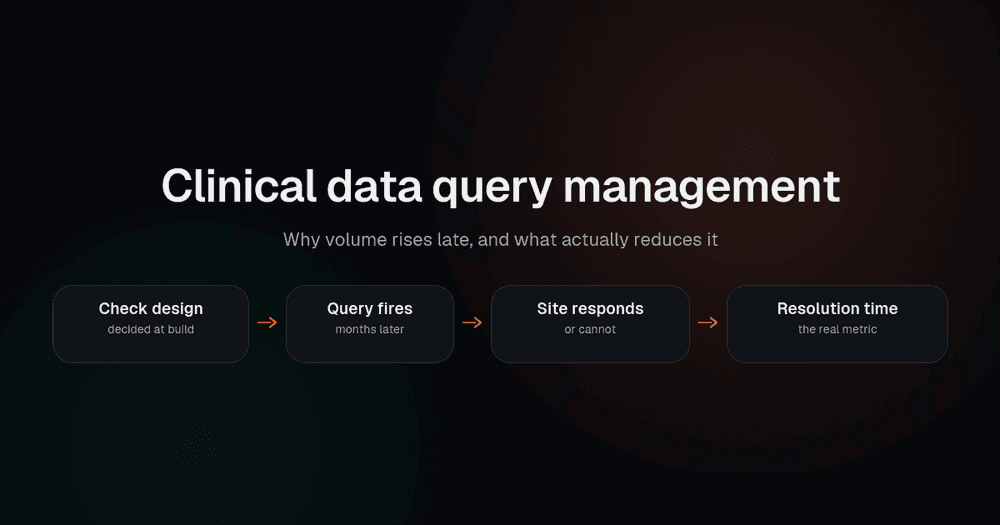
Query volume rises late in a study for four predictable reasons: cumulative checks need history before they can fire, window and completeness checks aggregate, reconciliation queries arrive with batched external data, and deferred manual review lands at once. All four are set by edit check design at build time, not by site performance.
The standard reading of a late query spike is that sites got sloppy as the study went on. It is almost never that. The same sites, given a differently designed check set, produce a different curve, and the decisions that shape that curve were made before the first patient consented.
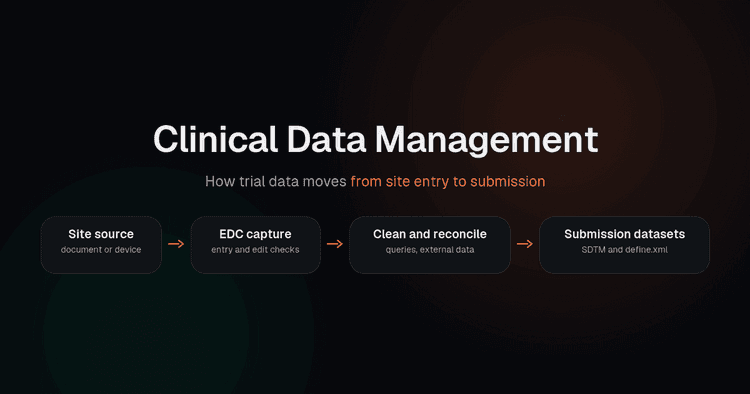
This guide explains the four mechanisms, shows what a check written for the site workflow looks like next to the same check written for the protocol, and argues for resolution time as the metric worth watching. It sits under how clinical trial data moves from site entry to submission.
After reading this you will be able to:
- Explain a late query spike without blaming the sites
- Rewrite a check so a coordinator can close it in one cycle
- Choose metrics that say something about answerability, not just volume
- Run a check review that catches noise before go-live rather than after
What a Late Spike Looks Like
Two studies, same sites, same therapeutic area, different check sets.
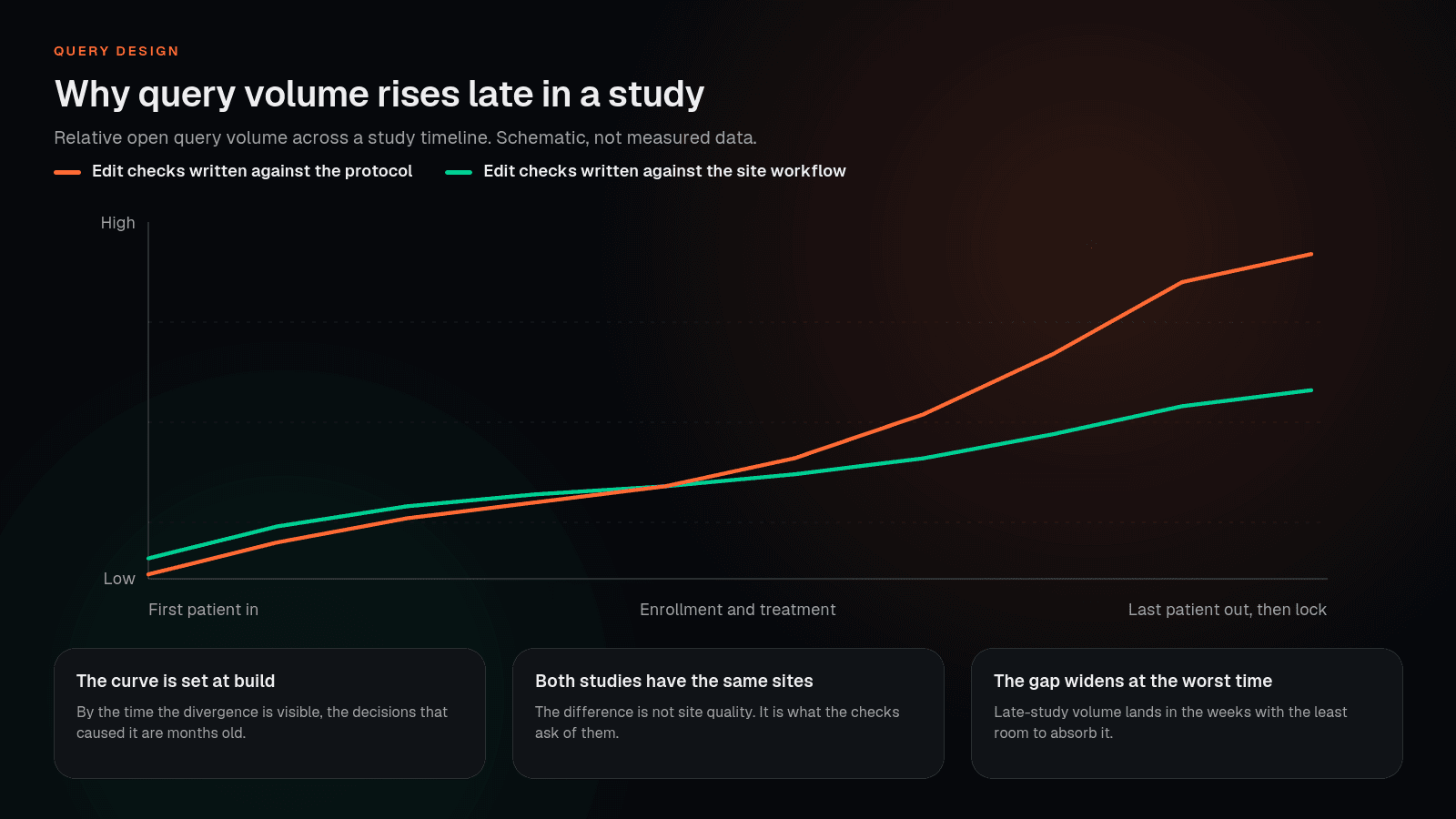
The important feature of that picture is when the two lines separate compared with when the cause occurred. By the time anyone is looking at a query backlog, the design decisions behind it are several months old and largely irreversible without revalidation.
The Four Mechanisms Behind It
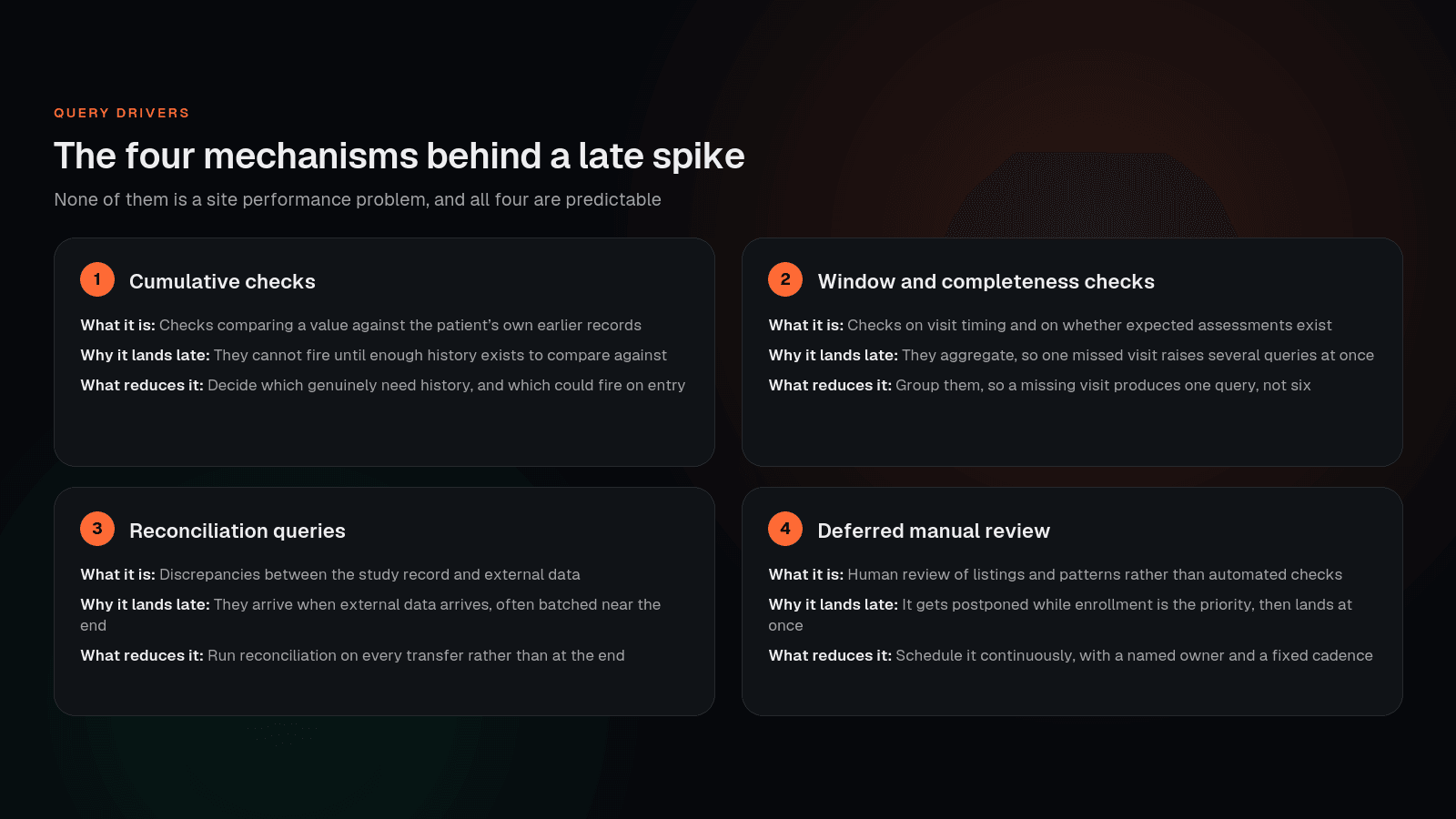
Notice that three of the four are structural rather than accidental. Cumulative checks must wait for history. Reconciliation must wait for the transfer. What is controllable is how much of the load those mechanisms carry, and whether the queries they produce are answerable when they arrive.
The fourth, deferred manual review, is the one entirely within your control, and it is the one most often allowed to accumulate. Review scheduled continuously with a named owner converts a late cliff into a steady cost.
The Same Check, Written Two Ways
The distinction is not technical correctness. Both columns below are correct. Only one of them can be closed by the person receiving it.
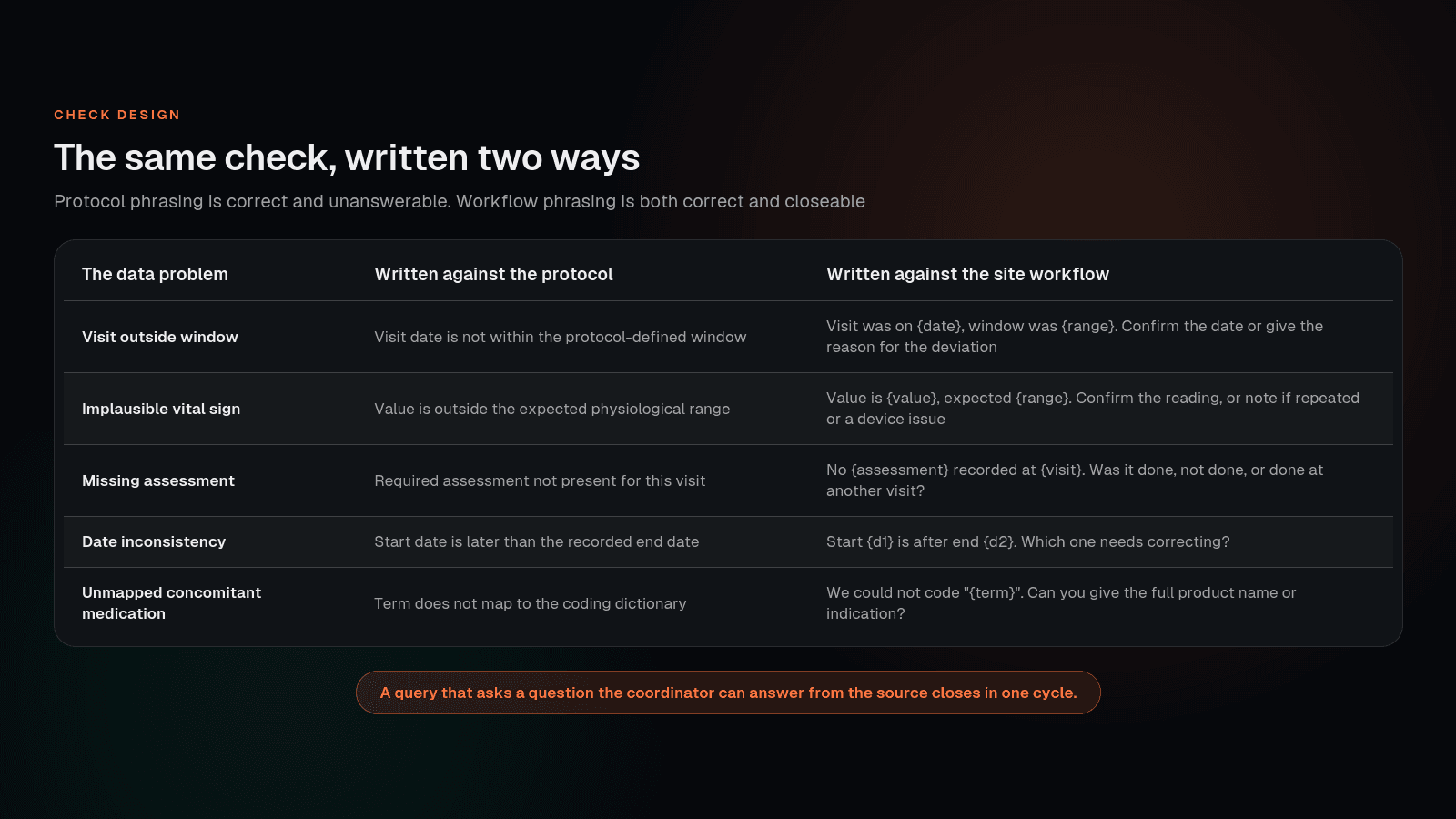
The pattern in the right-hand column is consistent: state what was observed, state what was expected, ask a specific question, and leave room for the legitimate reason. A query that offers the coordinator a way to record "yes, that is right, and here is why" closes in one cycle. A query that simply asserts a rule violation generates a comment and then a second query.
This is also why the check specification should be reviewed before configuration rather than after, a step covered in every step between final protocol and first patient in.
Resolution Time Is the Metric
Raw query count measures how much the checks fired. It says almost nothing about data quality and nothing at all about whether firing was useful.
Resolution time measures something better: whether the question could be answered. A tail of queries sitting open for many weeks is not usually a sign of unresponsive sites. It is a sign that those particular queries asked for something the coordinator could not produce from the source document. Segmenting resolution time by check type turns that into an actionable list, because it names the checks to rewrite.
Repeat rate is the second metric worth having: the same query raised against the same site for the same reason, more than twice, is a check problem rather than a site problem.
Not Every Discrepancy Needs a Query
A discrepancy is a condition in the data. A query is a message to a human being about it. Treating those as the same thing is one of the larger sources of avoidable volume.
Some discrepancies are better handled as a listing reviewed by data management, some as a batched discussion at a monitoring visit, and some genuinely need a query to a coordinator. Deciding which is which during check specification, rather than defaulting everything to a query, reduces site load without reducing detection. The wider question of what the platform decides versus what you decide is covered in what an EDC system does, and the four jobs it cannot do for you.
Query Burden Is a Site Relationship Metric
Sites remember. A coordinator who spent a year answering queries that felt pointless carries that into the next feasibility conversation, and it shows up as slower start-up and lower enrollment willingness on your next protocol.
That is a commercial argument for check design, not only a data quality one. Make it explicitly when the check set is being specified. It is the argument that tends to win time for the review step.
A Check Review Before Go-Live
Seven questions, asked of every check in the set.
- What will a coordinator do when this fires?
- Can they answer it from the source document alone?
- Does the text state the observed value and the expectation?
- Is there a legitimate reason this could fire, and can they record it?
- Does this need to be a query, or is a data management listing enough?
- Could this fire several times for one underlying issue, and should it be grouped?
- Does it need patient history to evaluate, and if so, was that deliberate?
Run it again after the first month of live data, because some checks are only revealed as noisy by real records. Clinera EDC is the platform layer where the checks are configured, and clinical and R&D AI covers where automation helps with review and reconciliation load.
References
- ICH E6(R3) Good Clinical Practice. International Council for Harmonisation, adopted 6 January 2025. www.ich.org
- Good Clinical Data Management Practices. Society for Clinical Data Management. scdm.org
- Oversight of Clinical Investigations, A Risk-Based Approach to Monitoring. US Food and Drug Administration guidance for industry. www.fda.gov
- CDASH, Clinical Data Acquisition Standards Harmonization. CDISC foundational standards. www.cdisc.org
This guide describes process and regulatory expectations in general terms and is not legal or regulatory advice. Confirm the current version and applicability of any standard or guidance for your study and region.
Frequently Asked Questions
Why does query volume rise late in a study?
Four mechanisms, and none of them is declining site performance. Cumulative checks cannot fire until a patient has history to compare against. Window and completeness checks aggregate, so one missed visit raises several queries. Reconciliation queries arrive when external data arrives, which is often in batches near the end. And manual review gets postponed while enrollment is the priority, then lands all at once. All four are predictable at build time.
Is a high query rate a sign of poor site performance?
Usually not on its own. Query rate measures how much the checks fired, which is mostly a property of how the checks were written. A study can have a high query count and excellent sites, or a low count and real data problems that nothing was configured to catch. If you want a number that says something about site performance, look at resolution time and at repeat queries on the same issue rather than raw volume.
What is a good query resolution time?
Rather than a universal target, look at the shape of your own distribution. A tail of queries taking many weeks usually means those queries were not answerable as written, because a coordinator who can answer from source does so quickly. Segmenting resolution time by check type is more informative than the average: it tells you which checks are producing questions the site can close and which are producing questions it cannot.
How do you write an edit check that generates fewer queries?
Write it against what the site will see rather than what the protocol says. State the observed value and the expectation, then ask a specific question with an answerable set of responses. Include the reason a deviation might legitimately exist, so the coordinator can record that rather than guess at what you want. A check phrased as a question closes in one cycle; a check phrased as an assertion generates a comment and a second query.
What is the difference between a query and a discrepancy?
A discrepancy is the data condition, a value that is out of range, missing or inconsistent with another record. A query is the communication raised about it. Not every discrepancy needs to become a query: some are better handled by a data management review, a listing or a batch discussion with the site. Treating every discrepancy as an automatic query is a common source of avoidable volume.
Can Nirmitee Healthtech review an existing check set on a live study?
Yes, and a live study is actually the better case, because real query and resolution data is available to review against. The work is a pass through the existing checks segmented by resolution time and repeat rate, identifying which are producing closeable questions and which are not, followed by a rewrite of the ones that are not. It does not require changing platform.