
Agentic AI In Pharma And MedTech: Why 2026 Is Shifting From AI Assistants To AI Workflows
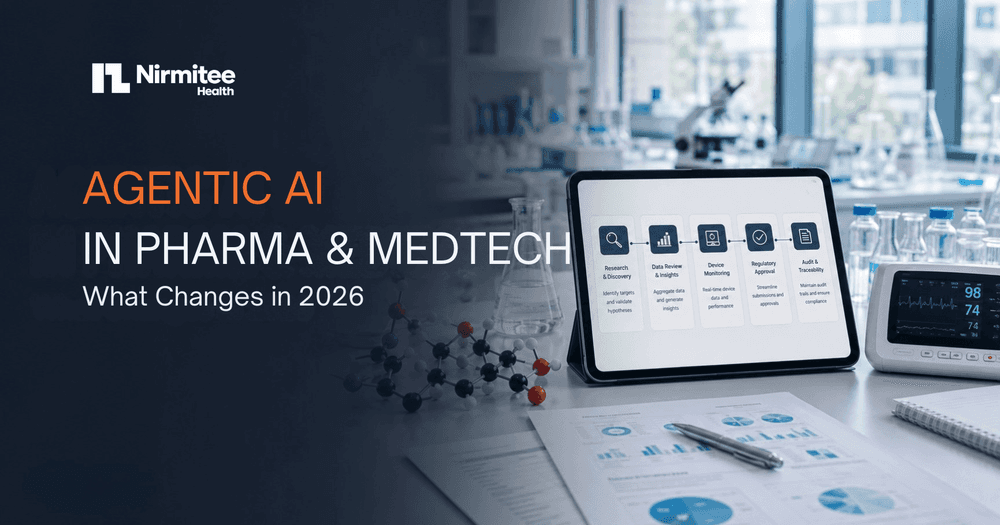
Artificial intelligence in pharma and MedTech is entering a new phase.
For the past few years, much of the industry conversation has focused on generative AI assistants: tools that summarize documents, answer questions, generate content, or help employees search large volumes of information.
In 2026, attention is increasingly shifting toward agentic AI: AI systems designed not simply to answer a question, but to perform multi-step tasks, make decisions within defined boundaries, interact with enterprise systems, and move workflows forward.
For pharmaceutical and medical device companies, this could fundamentally change how digital products are designed.
From AI Copilots To AI Agents
Consider a traditional AI assistant used by a medical affairs team. It may help summarize scientific literature when asked.
An AI agent could potentially go further: continuously identify relevant new publications, classify them by molecule or indication, extract important findings, compare them with existing scientific content, flag potential insights, and route those insights to the appropriate team for review.
The same principle can extend across the life sciences organization.
- Commercial teams could use AI agents for account intelligence, next-best-action recommendations, sales opportunity identification, and field-force preparation.
- Clinical and R&D teams could deploy agents to monitor study data, identify missing information, support query workflows, review protocol deviations, or surface emerging patterns.
- Regulatory and post-market teams could use agentic workflows to continuously organize evidence, monitor safety information, track documentation requirements, and support post-market evidence generation.
The opportunity is significant. Deloitte's 2026 Life Sciences Outlook found that nearly 80% of surveyed executives believe future competitiveness will depend on how effectively they use AI to reimagine how their organizations work. Thirty percent named agentic AI as a trend shaping their 2026 strategy, in the first year the survey tracked it. Yet only 22% reported successfully scaling AI, and just 9% reported significant returns, which highlights the gap between experimentation and enterprise adoption.
The Bigger Challenge Is Not The AI Model
The next competitive advantage will therefore not come from simply giving employees access to another AI tool.
It will come from building AI into real pharmaceutical and MedTech workflows.
That requires secure data architecture, integration with existing systems, domain-specific business rules, human review mechanisms, governance, auditability, and thoughtfully engineered user experiences.
Recent pharmaceutical R&D discussions have similarly emphasized that AI outcomes depend heavily on high-quality data and strong digital infrastructure rather than algorithms alone.
This is where AI product engineering becomes increasingly important.
Instead of asking, "Which AI tool should we buy?", life sciences companies may need to start asking:
"Which workflow should we redesign around AI?"
For pharma and MedTech organizations moving from AI experimentation toward measurable business outcomes, that may become one of the defining digital transformation questions of 2026.
At Nirmitee Healthtech, we believe the next generation of life sciences technology will be built around intelligent, connected digital infrastructure, where AI does not sit beside the workflow but increasingly becomes part of how the workflow operates.
Frequently Asked Questions
What is the difference between an AI assistant and an AI agent in pharma?
An assistant responds to a single request: summarize this paper, draft this email. An agent is given a goal and a set of permitted actions, then works through multiple steps on its own: querying systems, classifying results, deciding what to escalate, and handing the output to a person. The practical difference for a pharma or MedTech team is that an agent touches your systems of record, so it has to be scoped, governed and validated like any other computerized system.
Do agentic AI workflows need to be validated under 21 CFR Part 11 or EU Annex 11?
If the workflow creates, modifies or acts on a GxP record, yes. The validation target is the workflow the agent runs, not the model in the abstract: its intended use, approved data sources, prompt and tool behaviour, human approval gates, audit evidence, failure handling and change control. FDA's Computer Software Assurance approach and the EU's draft Annex 22 on AI in GMP both point toward a risk-based, lifecycle model rather than a one-time test script.
Where does a human stay in the loop?
Anywhere a decision affects patient safety, product quality or a regulatory submission. A well-designed agent can retrieve, draft, classify and route on its own, but batch release, protocol deviation classification, safety case assessment and anything that becomes a signed record should sit behind a formal human approval gate with the agent's reasoning captured for review.
Which pharma or MedTech workflows should be redesigned around agentic AI first?
Start with workflows that are high-volume, rules-based and already digital: scientific literature monitoring for medical affairs, data query generation and reconciliation in clinical operations, safety signal triage, and evidence organisation for post-market reporting. These have clear inputs, measurable outputs and a natural review step, which makes them easier to validate than open-ended tasks.
Why do most life sciences AI pilots fail to scale?
Usually because the pilot was built around a model rather than a workflow. Data lives in systems the agent cannot reach, business rules exist only in people's heads, there is no audit trail a QA team will accept, and no one owns the change-control process when a prompt or model version changes. Solving those four problems is engineering work, and it is the difference between a demo and a production system.


