EDC Selection: Twelve Questions to Ask Before You Sign
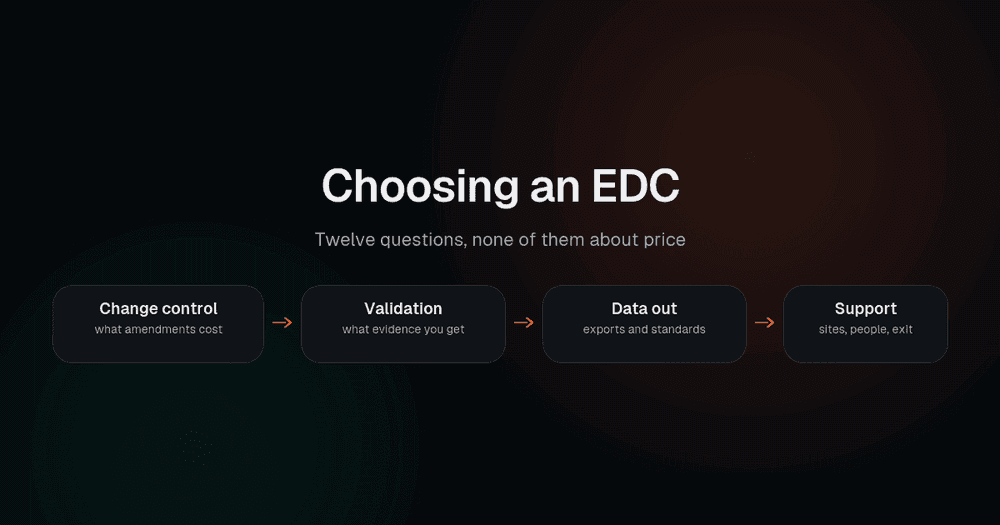
Twelve questions separate EDC vendors, and none of them is about price. They cover who can change the study once it is live, what validation evidence you receive, how easily your data leaves, and what site-facing support actually covers. Asked before signature they shape a contract. Asked in month six they shape an invoice.
Feature lists converge. Every established platform captures data, fires edit checks, keeps an audit trail and produces exports, and a demonstration will show all of that working well. What differs between vendors is the operating model around those features, and almost none of it is visible until you need something changed.
This guide gives the twelve questions, groups them, and says what a good answer sounds like against a weak one. It sits under how clinical trial data moves from site entry to submission, and it is written to be used on any vendor, including ours.
After reading this you will be able to:
- Run an evaluation on operating model rather than on feature parity
- Recognize a specific answer from a vague one on the four areas that matter
- Price the things that are genuinely ongoing, not just the license
- Ask the two questions most often skipped, about metadata and about exit
Why Price Is the Wrong First Question
Not because price does not matter, but because the license is frequently not where the cost sits.
A lower license fee attached to priced change requests, ticketed exports and a chargeable data return at contract end can cost more across a three-year study than a higher license with those included. Until you know what is inside the number, comparing numbers compares nothing. Establish the operating model first, then ask what it costs.
Four Things Worth Questioning Hard
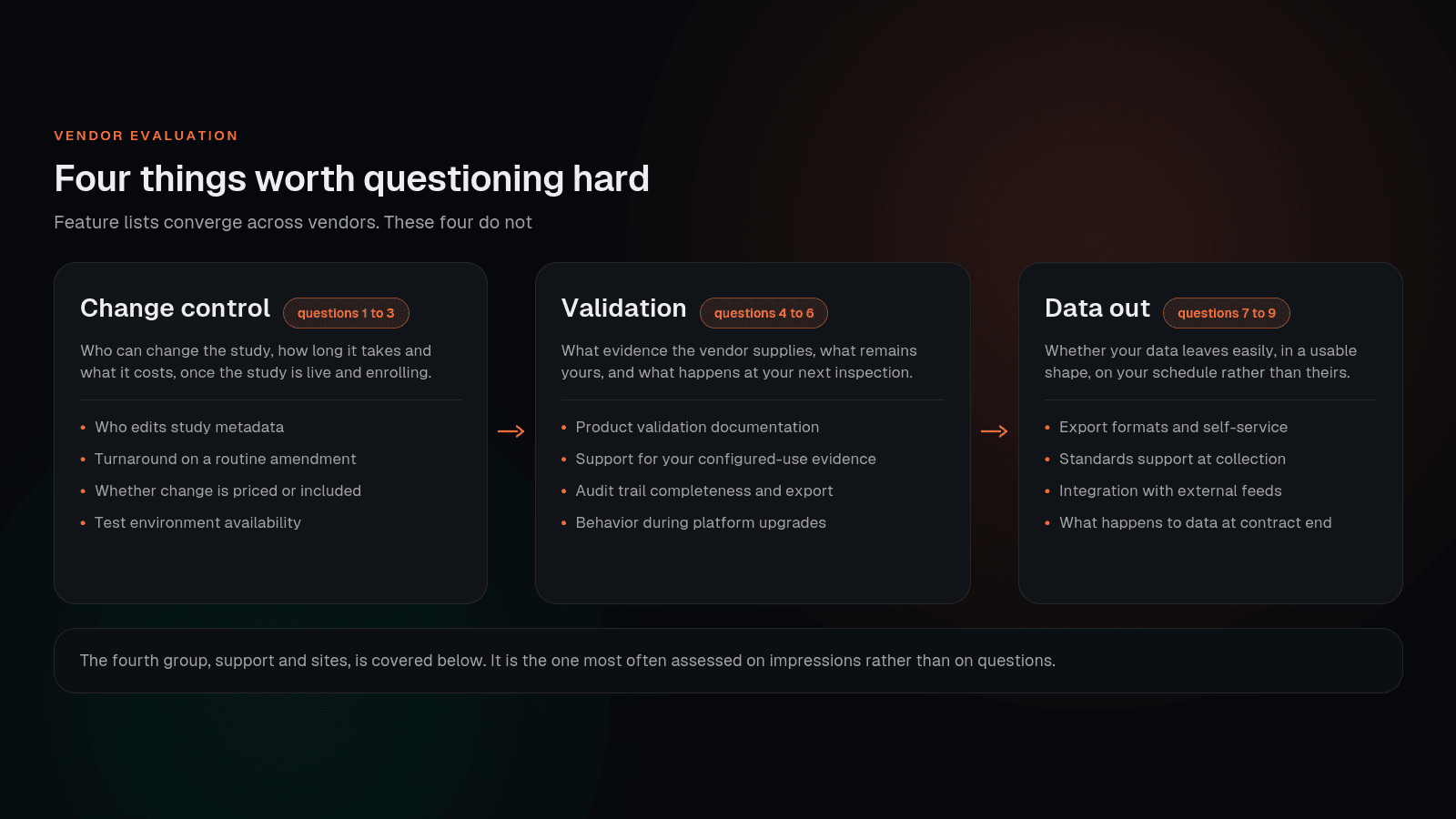
The fourth group, covering sites, support and exit, is the one most often assessed on impressions. It is also where the difference between vendors is most visible to the people who will actually use the system every day.
Questions One to Three: Change Control
- Who can edit study metadata, meaning field definitions, edit check logic and coding configuration, without raising a ticket?
- What is the turnaround on a routine mid-study amendment, and what makes that slip?
- Is change work included in the license or priced separately, and at what rate?
The first of these is arguably the most consequential answer in the whole evaluation. If your team can edit the study, an amendment is work you schedule. If only the vendor can, it is a request in a queue you do not control, priced and sequenced by someone else. Both models are legitimate. Only one of them should come as a surprise in month six, and the consequences are worked through in handling a mid-study amendment without revalidating the whole build.
Questions Four to Six: Validation Evidence
- What product validation documentation do we receive, specifically?
- What part of validation remains ours, and what do you provide to help us build it?
- What happens to our live study during a platform upgrade, and how much notice do we get?
Question five is a test as much as a question. A vendor validates the software as a product; you validate your configured use of it. A confident vendor says that unprompted and then describes what they hand you to build on. A vendor whose answer implies their certificate covers your study has either misunderstood the split or is content for you to. That boundary is set out in what an EDC system does, and the four jobs it cannot do for you.
Questions Seven to Nine: Getting Data Out
- Can our team run exports without raising a ticket, and does the audit trail come with them?
- What standards support exists at collection, in terms of CDASH structures and code lists?
- How are external data feeds configured, and is there a dry-run process before go-live?
Test question seven rather than asking it. Run an export during the evaluation, on demonstration data, with your own people driving. The gap between an export you can run and an export you can request is invisible in a demonstration and very visible later. Question eight matters because collection-side standards support is what decides submission cost, as covered in where CDASH to SDTM mapping breaks.
Questions Ten to Twelve: Sites, Support and Exit
- What does site-facing support cover: which hours, which languages, and how does a coordinator reach a human being?
- What does site training involve, who delivers it, and what materials come with it?
- At contract end, how do we get the data and the audit trail back, in what format, over what timescale, at what cost?
Question twelve is the one most often left unasked, because asking about the end of a relationship at the start of one feels awkward. It is also the question whose answer is hardest to improve later. A vendor who can name a format, a timescale, a cost, and a reference who has done it is telling you something real about how they operate.
What a Good Answer Sounds Like
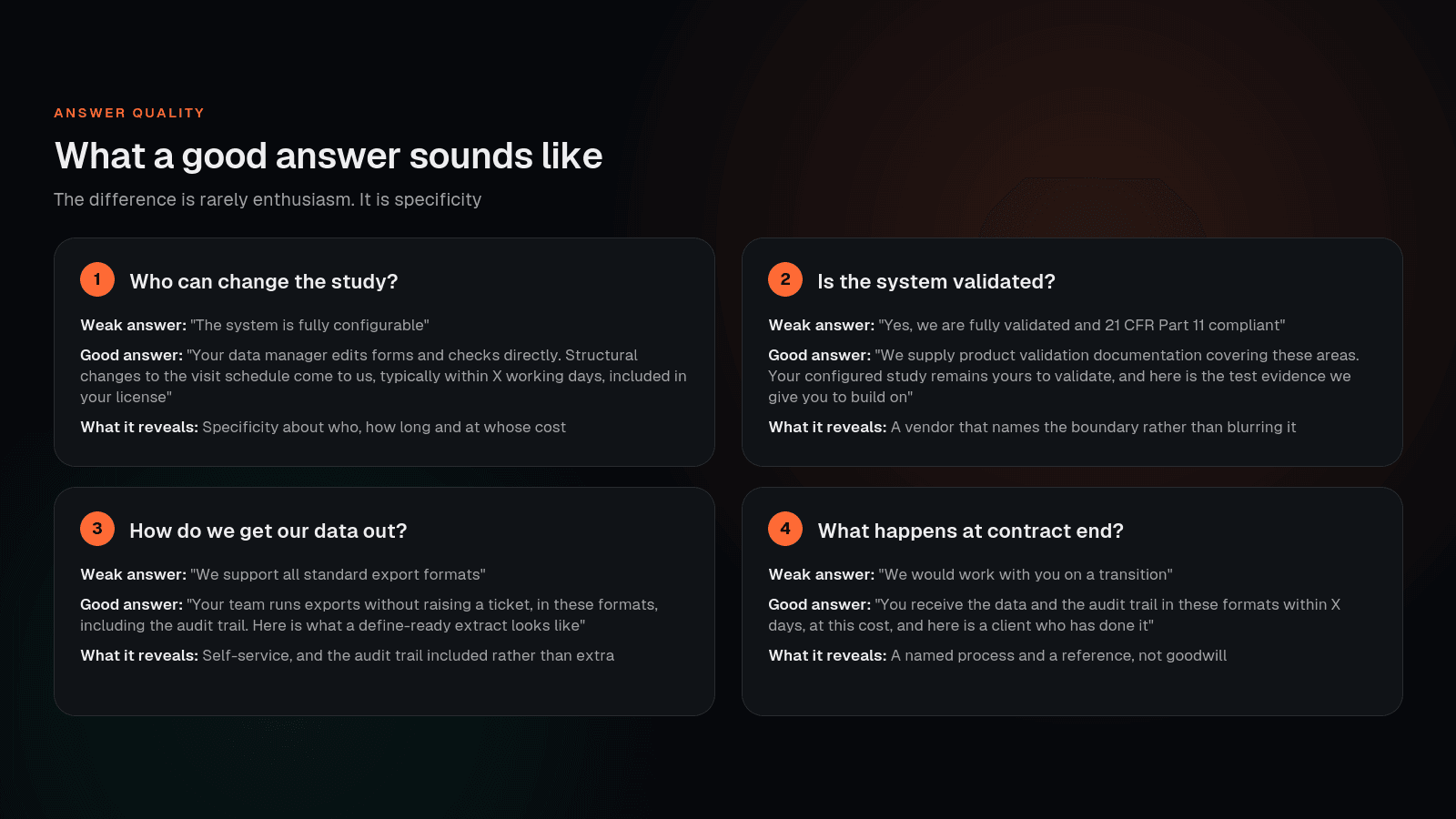
The pattern is specificity rather than enthusiasm. Good answers contain names, numbers, timescales or artifacts. Weak answers restate the question approvingly, which is easy to mistake for agreement in a room where everyone is being pleasant.
Scoring the Responses
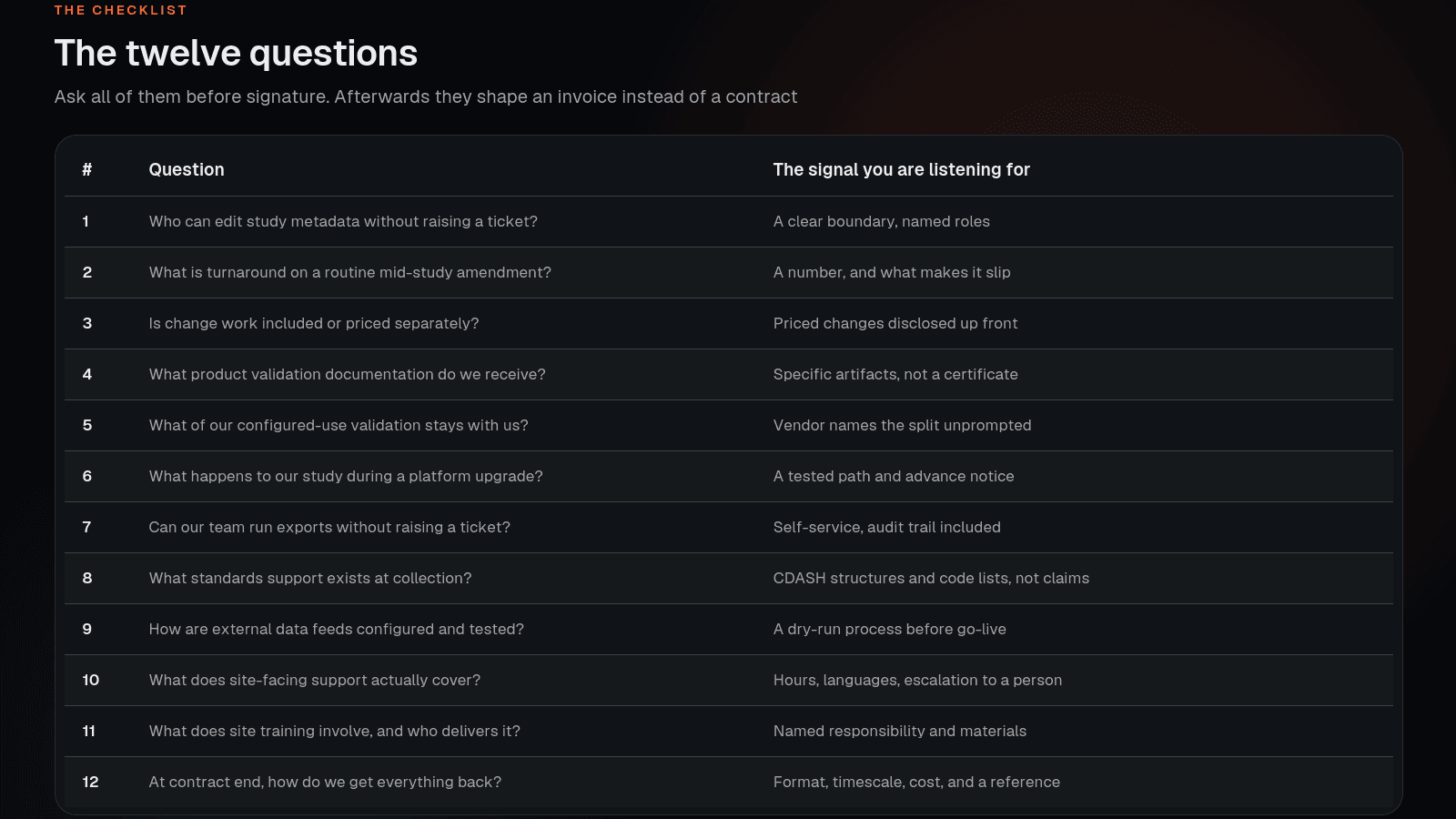
Rather than a numeric score, mark each answer as specific, vague or deflected. Specific contains something checkable. Vague agrees without committing. Deflected moves to an adjacent topic the vendor would rather discuss. A pattern of vagueness on questions one, five and twelve predicts more about the next three years than any feature matrix will.
Ask for a reference who has run a mid-study amendment or completed an exit, not one who is a year into a smooth study. Willingness to provide that particular reference is itself an answer.
These are the questions we would want asked of us. Clinera EDC is our answer to them, and the Clinera accelerator covers how a study gets stood up. If you are running an evaluation, we are happy to answer all twelve in writing for your study design, alongside whoever else is on your list.
References
- 21 CFR Part 11, Electronic Records; Electronic Signatures. US Code of Federal Regulations, Title 21, Part 11. www.ecfr.gov
- ICH E6(R3) Good Clinical Practice. International Council for Harmonisation, adopted 6 January 2025. www.ich.org
- Annex 11, Computerised Systems. EudraLex Volume 4, Good Manufacturing Practice guidelines. health.ec.europa.eu
- Good Clinical Data Management Practices. Society for Clinical Data Management. scdm.org
This guide describes process and regulatory expectations in general terms and is not legal or regulatory advice. Confirm the current version and applicability of any standard or guidance for your study and region.
Frequently Asked Questions
What should we prioritize when selecting an EDC?
The things that are hard to change after signature rather than the things that demo well. Feature lists converge across the established platforms, and most differentiate on areas you will not exercise until month six: who can change the study, what validation evidence you receive, how easily data leaves, and what site-facing support genuinely covers. Price matters, but it is the easiest thing to compare and therefore the least useful place to start.
Why is price the wrong first question?
Because the license is often not where the cost sits. A lower license with priced change requests, ticketed exports and a chargeable data return can cost considerably more across a study than a higher license without those. Establishing what is included before discussing what it costs means you are comparing the same thing, which is the only way a price comparison means anything.
What does a good answer on validation sound like?
One that names the boundary without being pushed. A vendor validates the software as a product; you validate your configured use of it. A confident vendor says that plainly, lists the documentation they supply, and describes what they give you to build your own evidence on. An answer that implies their certificate covers your study is either a misunderstanding on their side or a problem waiting on yours.
What should we ask about mid-study amendments?
Three things: who can make the change, how long a routine one takes, and whether it is included or priced. Then ask what makes the timeline slip, because the answer reveals whether they have a real process or a general willingness. Amendments are the most reliable ongoing cost in an eClinical contract and the least examined during selection.
Does it matter who owns the study metadata?
It is arguably the single most consequential answer in the whole evaluation. If your team can edit field definitions, edit check logic and coding configuration, amendments are work you schedule. If only the vendor can, they are requests in a queue you do not control, and your timeline depends on their backlog. Both models exist legitimately. Only one of them should be a surprise.
How does Clinera answer these questions?
Directly, and that is the point of publishing the list rather than a comparison table. The questions above are the ones worth putting to any vendor, including us. If you are running an evaluation, the most useful thing we can do is answer all twelve in writing for your specific study design, alongside whoever else you are considering.