
Real-World Data vs Clinical Trial Data: What's the Difference?
In healthcare research, data is the foundation of every decision. From evaluating treatment effectiveness to understanding patient outcomes, researchers rely on evidence to guide clinical and regulatory decisions. Traditionally, Clinical Trial Data has been considered the gold standard for generating medical evidence. However, the growing availability of Real-World Data (RWD) is changing how healthcare organizations generate insights and evaluate treatments throughout their lifecycle.
While both data sources are valuable, they serve different purposes and provide unique perspectives.
Understanding Clinical Trial Data
Clinical Trial Data is generated through structured and highly controlled research studies, most commonly Randomized Controlled Trials (RCTs). These studies are designed to evaluate the safety and efficacy of a treatment under predefined conditions. Participants are selected based on strict inclusion and exclusion criteria, treatment protocols are standardized, and researchers carefully monitor every aspect of the study.
The primary advantage of clinical trials is their ability to minimize bias and establish a clear relationship between a treatment and its outcomes. This level of control makes clinical trials essential for regulatory approvals and initial assessments of safety and efficacy. However, because the study population is often highly selected, trial results may not fully represent how treatments perform in routine clinical practice.
What Is Real-World Data?
Real-World Data refers to health-related information collected during routine healthcare delivery. Unlike clinical trials, RWD is not generated in a controlled research environment. Instead, it comes from sources such as Electronic Health Records (EHRs), insurance claims, disease registries, patient-reported outcomes, wearable devices, and digital health technologies.
When analyzed appropriately, RWD can generate Real-World Evidence (RWE), offering valuable insights into how treatments perform in everyday clinical settings across diverse patient populations.
Key Differences Between the Two
The most significant difference lies in the environment where the data is collected. Clinical trial data answers the question, “Can a treatment work under ideal conditions?” Real-world data helps answer, “How does a treatment perform in actual clinical practice?”
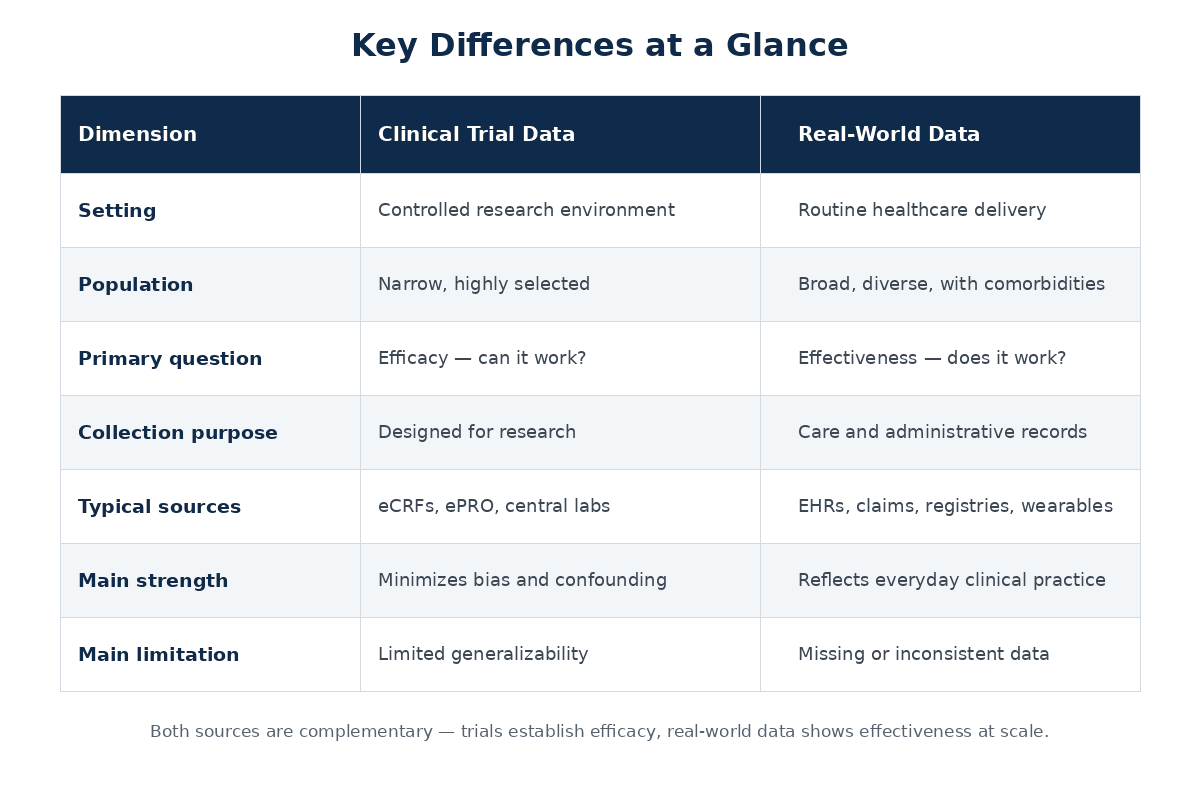
Clinical trials typically involve carefully selected patient groups, while real-world studies include broader populations with varying ages, comorbidities, treatment adherence patterns, and socioeconomic backgrounds. This makes RWD particularly useful for understanding treatment effectiveness, long-term outcomes, and healthcare utilization in real-world settings.
At the same time, RWD presents challenges. Because it is collected primarily for clinical care or administrative purposes rather than research, issues such as missing data, inconsistent documentation, and potential bias must be carefully addressed through robust study design and analytics.
Why Both Matter
Rather than replacing clinical trials, Real-World Data complements them. Clinical trials remain essential for establishing efficacy and supporting regulatory approvals, while RWD provides insights into effectiveness, safety, patient experiences, and outcomes after a treatment reaches broader patient populations. Regulatory agencies, including the FDA, increasingly recognize the value of combining both evidence sources to support healthcare decision-making.
As healthcare continues to become more data-driven, the future of evidence generation lies in integrating Clinical Trial Data and Real-World Data. Together, they create a more complete picture of patient care, helping researchers, healthcare providers, and life sciences organizations make informed decisions that ultimately improve patient outcomes.
Frequently Asked Questions
Can real-world data replace randomized controlled trials?
No. RCTs remain the standard for establishing efficacy and supporting initial regulatory approval because randomization controls for confounding. Real-world data answers different questions — how a treatment performs across broader populations, over longer periods, and in routine care — so the two are complementary rather than interchangeable.
What is the difference between real-world data and real-world evidence?
Real-world data is the raw input: health information captured in EHRs, claims, registries, patient-reported outcomes, and wearables during routine care. Real-world evidence is the output: the clinical conclusions produced when that data is analyzed with an appropriate study design. Data becomes evidence only through sound methodology.
Does the FDA accept real-world evidence in regulatory decisions?
Yes, within defined limits. Under the 21st Century Cures Act, the FDA established a Real-World Evidence Program and has since issued guidance on using EHR, claims, and registry data to support regulatory decision-making, including new indications for approved drugs and post-approval study requirements. Data reliability and study design still have to meet regulatory expectations.
Why do clinical trial results sometimes differ from real-world outcomes?
Trials measure efficacy in selected populations under standardized protocols with close monitoring. In routine practice, patients are older, have comorbidities, take concomitant medications, and adhere imperfectly to treatment. These differences — the efficacy-effectiveness gap — mean real-world outcomes can be smaller or different from what the trial reported.
What are the most common sources of real-world data?
Electronic Health Records, medical and pharmacy claims, disease and product registries, patient-reported outcomes, and data from wearables and other digital health technologies. Each source captures a different slice of the patient journey: claims show utilization, EHRs show clinical detail, registries capture purpose-built variables, and ePRO and wearables add the patient's own perspective.


