Distribution
Documents Go Out, Records Do Not Come Back
Protocols and SOPs are emailed to sites and acknowledged in replies, sign-in sheets and scanned PDFs. Proof of who was trained on what is rebuilt by hand.
Study Training and Qualification
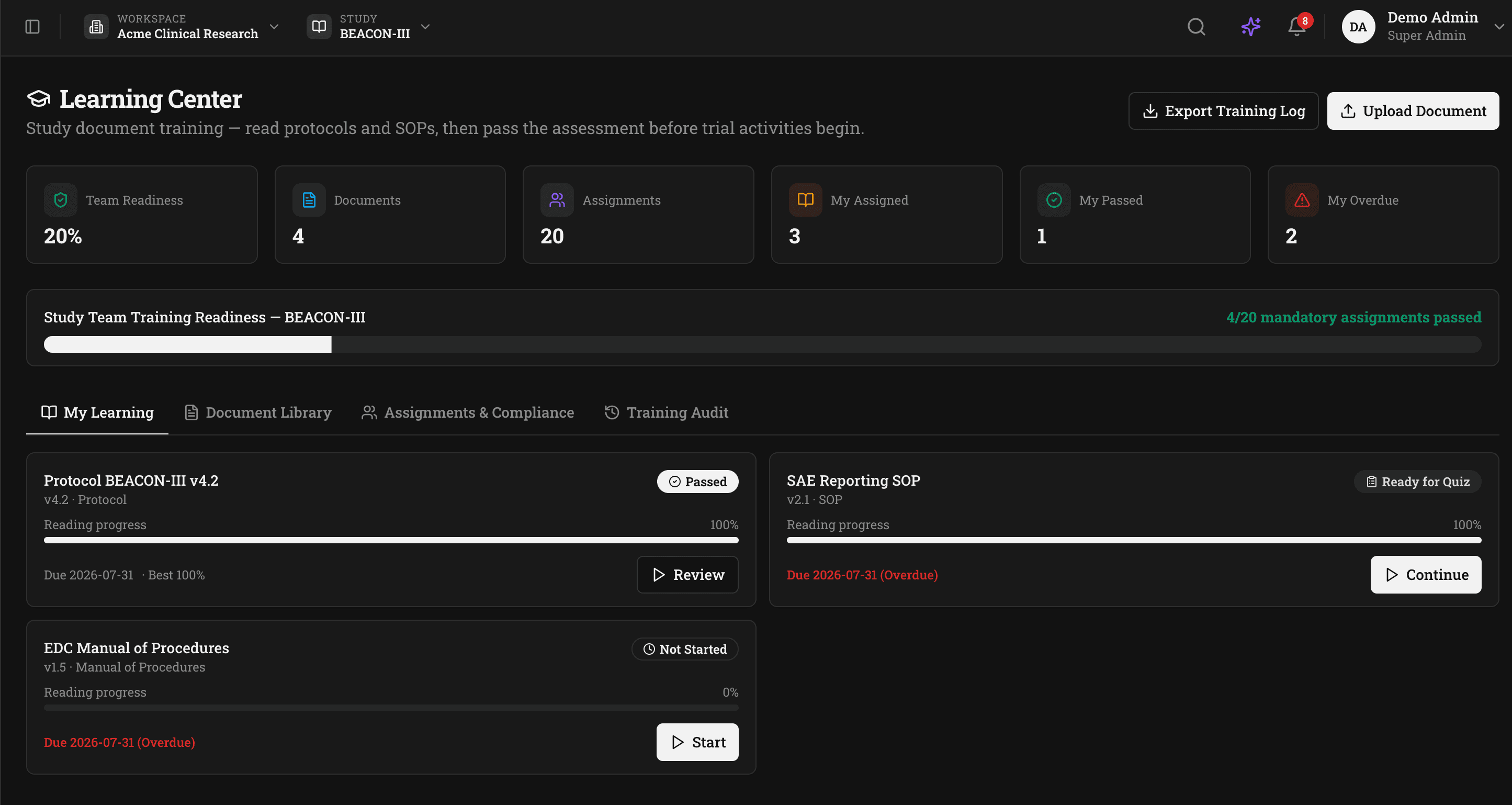
Controlled documents publish by role, comprehension is tested and every completion is signed under 21 CFR Part 11.
The Problem
Study teams do train. What fails at inspection is the evidence: which version a person read, whether they understood it and whether they were qualified for the task.
Protocols and SOPs are emailed to sites and acknowledged in replies, sign-in sheets and scanned PDFs. Proof of who was trained on what is rebuilt by hand.
An amendment is approved, but retraining assignments go out later and completion is chased by email. In the gap, staff can work to a superseded version.
The training happened; the record did not hold. Inspectors ask which version a person read, what they understood and whether they were qualified for delegated tasks.
The Solution
Clinera LMS publishes controlled documents to the roles that need them, tests comprehension and closes each completion with a re-authenticated electronic signature.
A document reaches the PIs, coordinators, monitors and pharmacists it applies to, without a distribution list to maintain.
Read progress thresholds and quiz passing scores make completion mean more than a document was opened.
Each passing attempt closes with a Part 11 e-signature and an immutable completion record.
Publishing an amendment or a revised SOP dispatches the new assignments on its own.
How It Works
The same four stages run for an initial protocol release and for every amendment after it.
A controlled document is released with the roles it applies to, and assignments fan out to everyone holding those roles.
Trainees work through the document, with minimum read progress enforced before the assessment unlocks.
A quiz confirms comprehension against the passing threshold, and the trainee re-authenticates to sign the attestation.
Completion lands in the training matrix, exportable for monitoring visits, audits and inspections.
Capabilities
Five features cover publishing, assessment, signed attestation, amendment-driven retraining and the export that carries the evidence.
Feature 01
Send each controlled document to the people it actually applies to.
Publish Setup
Protocol v2.1
PI
18 assigned
CRC
42 assigned
CRA
09 assigned
Pharmacist
07 assigned
Feature 02
Make completion mean comprehension rather than a click.
Assessment Builder
Passing Score and Read Gate
Feature 03
Close every completion with a signature that stands up on its own.
Signed Attestation
Re-authenticated Sign-Off
Completion Locked
Signer, document version, role, score and timestamp are stored together.
Score
9/10
Version
2.1
Status
Signed
Feature 04
Close the gap between a document changing and the team being trained on the change.
Amendment Release
Automatic Reassignment
Feature 05
Answer the training question in the room rather than the week after.
Training Matrix
CSV Export Columns
Use Cases
Four moments where training evidence is either ready or it is not.
Protocol and SOP training completed and signed before activation, so the initiation visit confirms qualification instead of starting it.
Retraining dispatches the moment the amendment publishes, with outstanding completions visible per site rather than chased by email.
A coordinator joining in month eight inherits the assignment set for their role, including every amendment issued so far.
The training matrix exports on request, showing person, document, version, score and signature date without assembling folders.
Workflow
Four groups use the same record differently: one builds it, two complete it, one interrogates it.
Publish controlled documents, set passing thresholds and monitor completion across sites.
Compliance position visible continuously rather than at audit.
Complete protocol and IB training, sign attestations and see outstanding training for site staff.
Confidence that delegated staff are qualified for their tasks.
Work through assigned documents, take assessments and sign off completions.
One list of what is outstanding, instead of email threads.
Read the training matrix and export the full log with versions and signature dates.
Evidence produced in the room rather than compiled afterwards.
Why Clinera LMS
A general corporate LMS tracks courses. Clinera LMS tracks document versions, which is what an inspector asks about.
Retraining is triggered by publication rather than by someone remembering to assign it. That gap is where compliance risk lives.
Because it sits on the Clinera platform, training records live next to the delegation log and monitoring visits.
Specifications
Clinera LMS is deployed as part of the Clinera platform and inherits its security, audit and access-control model.
FAQ
No. Assignments follow roles, so a change affecting pharmacy handling reaches pharmacists rather than the whole team, and a change affecting eligibility reaches investigators and coordinators. Scoping matters commercially as well as administratively: amendment training is the step that holds sites up.
They should not have to. Clinera LMS records external training completions against the person with the provider, completion date and expiry, so recognised GCP training can satisfy the requirement and only study-specific training is assigned.
Acknowledgement alone is weak evidence, which is why the read-progress threshold and quiz work together. A passing score against a defined threshold, signed by the individual, answers inspection questions in a way a read receipt does not.
The delegation log says what a person was authorised to do, and the training record says what qualified them to do it. Because assignments are driven by role, the training matrix can be read against the delegation log.
The signed attestation stays intact, attributed to the individual, the role they held and the document version they signed against. Inspections look backwards at whether the person who performed a task at the time was trained then.
Next Step
Bring one protocol and your current training log. We will publish it by role on the call and show the inspection matrix.
From our insights

Remote monitoring needs site document access. Document control needs restriction. How eISF permissioning…

Where publication timelines are lost after last patient out, and how electronic data capture, query cycles…

A 98% complete TMF can still fail inspection. What inspectors ask for beyond completeness percentages, and…