Allocation
Blinding Depends on Process Discipline
When allocation lists live in spreadsheets or envelopes, blind protection depends on file access and memory. That is hard to evidence at inspection.
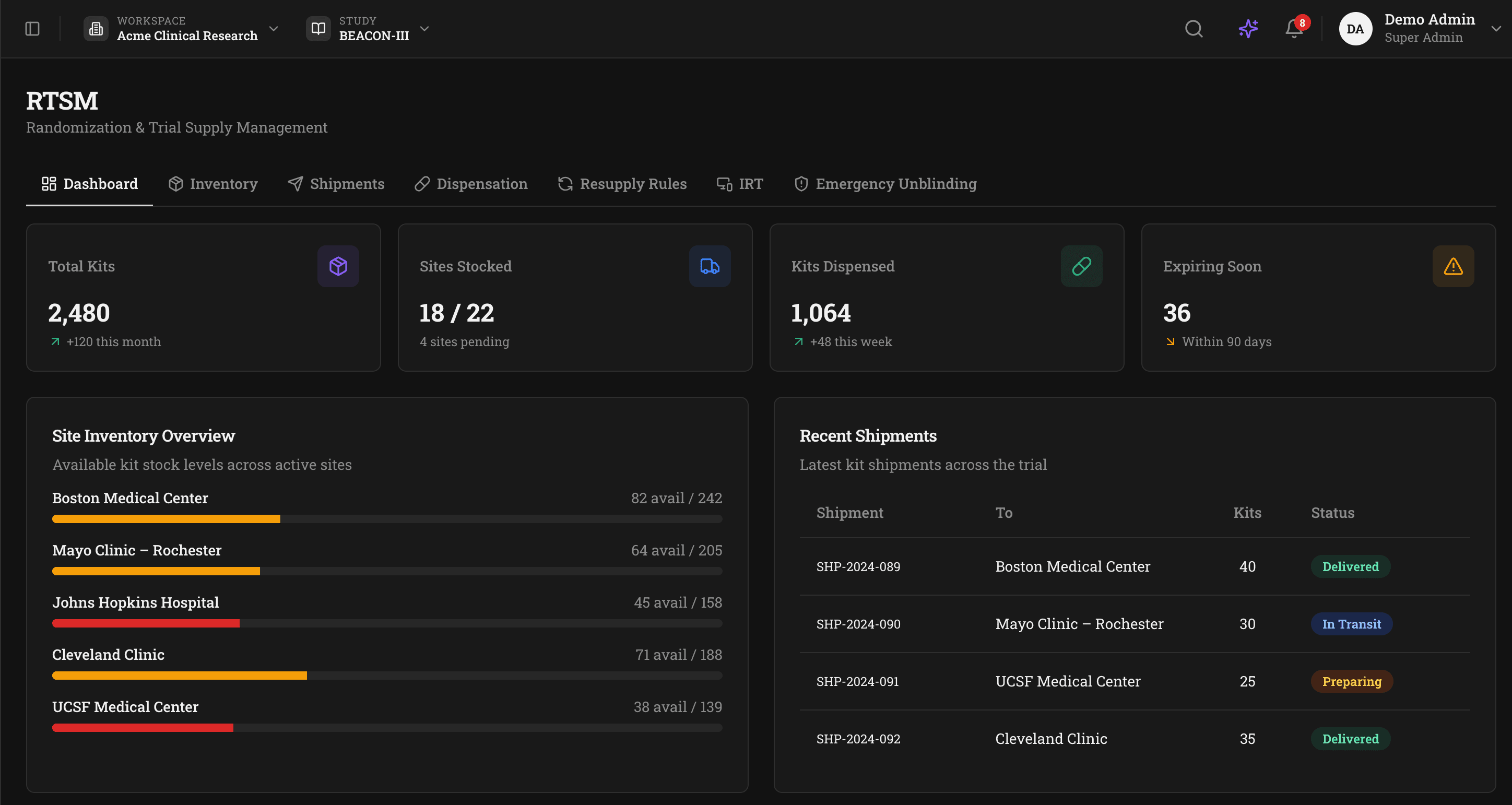
Randomization and Trial Supply Management
Clinera RTSM runs allocation, tracks every kit from depot to dispensing and triggers resupply before a site runs short.
The Operational Risk
Randomization and drug supply fail quietly. A stratum drifts, a site runs down to two kits or a shipment has an excursion. Clinera RTSM brings those events into one controlled record.
When allocation lists live in spreadsheets or envelopes, blind protection depends on file access and memory. That is hard to evidence at inspection.
Sites run short while depots hold expiring stock because resupply follows review cycles instead of actual dispensing and site inventory.
Temperature excursions and emergency unblinding are the events inspectors ask about, yet they are often recorded outside the trial system.
Controlled System
Clinera RTSM executes the randomization algorithm and owns kit status from depot receipt to destruction, keeping allocation, dispensing and inventory consistent by construction.
Permuted block, stratified block, dynamic minimization, adaptive allocation and list import.
Every kit is tracked by label, lot and expiry through defined supply status transitions.
PAR levels and reorder quantities generate shipment manifests when a site falls below threshold.
Excursion quarantine and emergency unblinding produce complete, timestamped records.
How It Works
Four stages, running continuously for the life of the study rather than as a startup sequence.
Select the allocation engine, define arms, strata, block sizes and the roles permitted to see anything treatment-related.
Kits are registered by label, lot and expiry at the depot, then shipped to sites and receipted into site inventory.
A subject is allocated by the engine, a kit is reserved from available site stock, and dispensing moves it out of inventory.
Falling below PAR triggers a manifest, while returns, quarantine and destruction close out every kit that was ever shipped.
Capabilities
Five modules cover allocation, global kit inventory, automated resupply, cold-chain exception handling and emergency unblinding.
Feature 01
Run the allocation method the protocol calls for, with blind protection enforced by the system.
Engine Configuration
Dynamic Minimization
Blinded Preview
Subject 014 randomized. Kit reserved. Treatment assignment hidden from site coordinator view.
Feature 02
Know where every kit is, what state it is in and when it expires.
Global Inventory
Depot to Site Tracking
In Inventory
Receipted and available at depot or site.
Reserved
Allocated to a subject, not yet handed over.
Dispensed
Given to the subject at a visit.
Returned
Brought back to site or depot.
Quarantined
Held pending disposition after an exception.
Destroyed
Disposed with the destruction record attached.
Feature 03
Ship on what the site has actually used, not on a monthly review cycle.
PAR Trigger
Site Inventory Below Threshold
Depot
Mumbai
Lot
L-2048
Release
Pending
Feature 04
Handle an excursion as a controlled process with a documented outcome.
Temperature Excursion
Automatic Quarantine
3 Kits Quarantined
Disposition required before release, return or destruction.
Feature 05
Make treatment assignment reachable in a medical emergency without weakening the blind for anyone else.
Emergency Unblinding
Scoped Disclosure
Authenticate Requester
Completed
Record Medical Reason
Required
Reveal Subject Assignment
Single Subject
Notify Sponsor and Auditor
Automatic
Use Cases
Four situations where allocation and supply have to hold up under pressure.
Allocation balanced within strata across regions, with kit inventory tracked per depot and site.
Temperature-sensitive product managed with excursion capture, automatic quarantine and recorded disposition.
Minimization factors or shifting allocation ratios executed by the engine rather than managed manually.
Consumption-driven resupply keeps sites stocked without committing more drug than enrollment justifies.
Role Benefits
Four roles work the same system with deliberately different visibility, because who can see treatment assignment is the whole point.
View treatment-level kit detail, dispense against the allocation, manage site stock and returns.
Full supply visibility inside the boundary of the unblinded role.
Set PAR levels, release shipment manifests, manage depot stock, expiry and excursion dispositions.
Resupply driven by consumption instead of periodic review.
Configure or import the randomization schedule, define strata and minimization factors.
The design is executed as specified, with allocation records intact.
Randomize subjects and request emergency unblinding when clinical care requires it.
Access to assignment in an emergency without compromising the study.
Why Clinera RTSM
Role scoping applies to screens, exports and reports, so blind protection does not depend on remembering which file a blinded user should not open.
Allocation, dispensing and inventory are one system, so resupply reflects what a site has actually used.
Excursion quarantine and emergency unblinding are built workflows with mandatory fields, notifications and inspection-readable records.
Specifications
Clinera RTSM is deployed as part of the Clinera platform and inherits its security, audit and access-control model.
FAQ
Build time depends on design complexity. Straightforward parallel-group studies are faster than designs with minimization factors, cohorts and multi-depot supply. Mid-study changes are handled as configuration changes with scoped revalidation.
Role scoping is applied at the data layer, so blinded roles receive no treatment-revealing values in the interface, exports or reports. Kit selection is made by the system from available stock, and every allocation and unblinded access is logged.
A documented contingency procedure is agreed during study setup. Fallback allocations are available only to defined roles and are reconciled into the system once service resumes.
PAR triggers respond to what a site has dispensed rather than a review cycle. Expiry is tracked per kit, and PAR levels can be tightened as enrollment uncertainty falls.
Nirmitee supplies the study specification, configuration records and validation documentation, and supports UAT in a sandbox environment. Your quality team owns acceptance and SOPs around system use.
Next Step
Bring your randomization schema and one site's supply profile. We will configure the engine, PAR triggers and a few allocation scenarios on the call.
From our insights

Paper CRFs, scattered data, slow queries and delayed publications: five signs a clinical research workflow is…

Where publication timelines are lost after last patient out, and how electronic data capture, query cycles…

Most RBM programs stall on data, not method. What EDC, CTMS, ePRO and lab feeds have to join up before a risk…